
Plinko casino Australia in 2026: how the offshore offer actually sits with Australian law
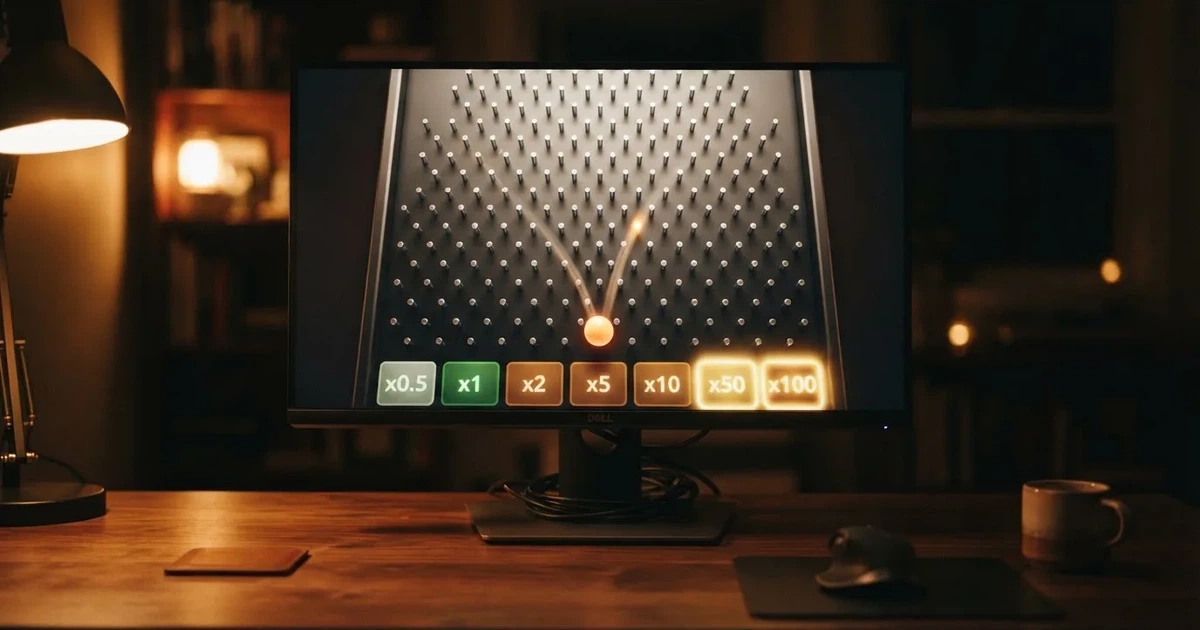
Plinko, as an online casino product, is the digital cousin of a board that first aired on The Price Is Right on 3 January 1983. A ball drops through a pyramid of pegs, bounces a path nobody can predict, and lands in a slot bearing a multiplier. Online, the slots are arranged from the outside in, with the small multipliers on the edges and the big one — sometimes as high as ×1,000 — in the centre. The mechanic is the same in any version, and so is the central fact for Australian readers: none of the offshore sites that take bets on it are licensed here, and the law treats them as prohibited interactive gambling services.
Data current as of 9 November 2026 and verified against the Australian Communications and Media Authority’s published register of formal warnings.
Table of Contents
- Responsible gaming: what stays in front of the rules
- Crypto, anonymity, and what the coin does not buy
- Payments and payout speed: what the offshore page actually says
- The Plinko game itself: paytable, lines, and what is being advertised
- The eleven brands the ACMA has named
- The shape of the enforcement: blocks and the arithmetic behind them
- The legal frame the reader actually sits inside
- What a player comparing offshore offers actually has to work with
- Where to get help
- Frequently asked questions
Responsible gaming: what stays in front of the rules
The Plinko ball lands where physics puts it. A player can set a risk level and a number of lines on most versions, but the run itself cannot be steered. That absence of skill is part of why the game travels well to offshore operators — there is nothing for the player to learn that might lift the house’s edge over the long run. The 1% the house keeps on a game advertised at 99% return to player is collected one ball-drop at a time, and over hundreds of thousands of drops it is the only number that holds.

That is also why the framing matters. A punter who notices the 99% headline and assumes the next ten drops will return 99 cents on the dollar has misread what return to player actually is. It is an average across a long sequence of plays, not a per-session guarantee. Anybody who feels the urge to “win back” what the last hundred drops cost them is the reader the Australian help lines exist for.
The National Gambling Helpline (1800 858 858) is free and runs around the clock. Chat is available at Gambling Help Online. BetStop, the National Self-Exclusion Register, has been live since August 2023 and binds every Australian-licensed online and phone wagering service — but it does not bind an offshore casino, which is not on the register and has no obligation to honour an exclusion a player has set. That gap is the practical difference between an Australian-licensed operator and one that is not, and it is the gap the rest of this page keeps coming back to.
Crypto, anonymity, and what the coin does not buy
Plinko as a “crypto casino” product is mostly a payment-method relabel. The game itself is the same ball-drop mechanic: pegs, slots, multipliers, an advertised RTP. Crypto changes how the deposit gets from the player’s wallet to the operator and how the winnings get back. It does not change what the operator is.
There is no Australian regime under which paying with Bitcoin, Ethereum or USDT turns an offshore site into a licensed Australian one. Credit cards, credit-related products and digital currency have been banned as payment for licensed online wagering since 11 June 2024, with penalties of up to A$247,500 for operators. The lawful deposit routes into an Australian-licensed wagering service are debit card, bank transfer, PayID, Osko and BPAY. An offshore site asking an Australian for a crypto deposit is therefore operating outside the Australian payment rules in the same breath it operates outside the Australian licensing rules. The two are not separate problems; they are the same problem written in two registers.
The argument that crypto adds privacy should be read against what an Australian player actually loses by being outside the Australian regime. There is no local complaints body to escalate a refused withdrawal to. There is no BetStop registration that has any force against the site. There is no Australian licence register an Australian can check the brand against. Anonymity in the payment layer does not recover any of those protections; it just makes the trail to recover them harder to walk. The promised benefit of paying in coin is, in the Australian frame, mostly an exposure to a different set of risks, not a shield against the original one.
That is also why “crypto Plinko” tends to be marketed hardest in jurisdictions where licensed alternatives are scarce. The marketing is the inverse of the protection. Australians looking at a crypto-Plinko page should read it as an offshore operator working around the same block every other offshore operator is working around, not as a category of its own.
Payments and payout speed: what the offshore page actually says
A Plinko casino page lists deposit methods the way any other offshore casino page lists deposit methods: Visa and Mastercard where the operator is willing to run the charge, an e-wallet or two, a bank transfer option that mostly runs through an intermediate bank, and — increasingly — a crypto wallet address. Each is offered as a payment route, not as a regulated product. None of them is verified by an Australian authority.
Withdrawal pages on the same sites typically advertise a window — instant, twenty-four hours, three business days — and that window is the operator’s own claim about its own process. There is no Australian body an aggrieved player can ring if the window slips. The bank or e-wallet through which the withdrawal is paid sits outside the operator’s control, and that part of the timing is genuine; but the part the operator does control — the moment of approval — is exactly the moment where the player has no leverage. That is why payout-speed claims on offshore pages are usually a marketing line, not a service-level commitment.
The further problem with deposits at an unlicensed site is what happens to the balance when the site is blocked. The ACMA has been directing Australian ISPs to block prohibited interactive gambling services since November 2019, and the total of blocked sites and affiliate pages now sits in the thousands. A balance held on a blocked site is a balance the player cannot reach. This is not theoretical. It has happened repeatedly across the ACMA’s blocking rounds. It will keep happening.
The Plinko game itself: paytable, lines, and what is being advertised
The Plinko product most offshore operators carry is the BGaming version, and the BGaming page is what the advertising language comes from. The page sets the ball-drop mechanic, an advertised 99% RTP, and a top multiplier of ×1,000. The player picks a risk level (low, normal or high) and the number of lines the ball can travel along — 8 to 16 — and the multiplier values across the slots scale with both choices. Higher risk and more lines widen the spread between the smallest and largest slots and push the ceiling toward ×1,000. Lower risk and fewer lines narrow the spread and pull the ceiling down. The centre slot always carries the largest figure; the edge slots always carry the smallest. That geometry is not new to anyone who watched The Price Is Right: in the TV version, the prize slots were valued from the outside in at $100, $500, $1,000 and $0, with the centre worth $10,000, for a maximum win of $50,000. The board in the BGaming Plinko is a multiplier version of the same idea, where the $0 slot becomes a ×0.2 (or similar) recovery rather than a literal loss and the centre becomes a ×1,000 multiple of the bet.
The interesting part, for an Australian reader, is what the paytable does to the variance. A ×1,000 top multiplier is the headline number, and it is what every Plinko casino page leads with. It is real, in the sense that the slot is there and the bet can land in it. It is also rare — the wider the spread, the more often the ball lands in a small slot on the way to the occasional big one. A 99% RTP is honest at the population level; it is also the figure the player pays for in long losing runs that the marketing copy never shows.
The TV game’s history has one small footnote for Australian readers. Before 1998, the centre slot on the Price Is Right board was worth $5,000, not $10,000. The doubling was a US show-budget decision, not a change in the underlying mechanic. The mechanic is what an offshore Plinko game sells.
Auto-bet and manual play are both available, and the bet size is set per ball-drop, not per line. That makes the bankroll question sharp: a 16-line game at high risk can drain a session faster than a player used to spinning reels expects, because every drop is a fresh stake at the full bet size. The 99% figure is paid in full per drop, with no carryover and no recovery on a near-miss.
The eleven brands the ACMA has named
The brands below are not ranked. They are listed because the ACMA itself has issued a formal warning about each of them for offering prohibited interactive gambling services to Australians. They are the comparison material this page can offer honestly, because they are the comparison material that has been put on the public record by the regulator. Each is followed by an honest reading of what the ACMA notice means in practice, not a recommendation.
| Brand | ACMA action and date | Operator named by the ACMA | Subject support |
|---|---|---|---|
| RocketPlay | Formal warning, March 2026; earlier Dama N.V. warning, May 2022 | Pulsup Ltd (RocketPlay); Dama N.V. | — |
| Level Up Casino | Formal warning, May 2022 | Dama N.V. | Listings reference BGaming Plinko |
| Woo Casino | Formal warning, March 2025 | Dama N.V. | — |
| Spirit Casino | Formal warning, May 2025 | Dama N.V. | — |
| National Casino | Formal warning, July 2025 | Consolutetish S.R.L. | Listings reference en.wikipedia.org |
| Bizzo Casino | Formal warning, July 2025; earlier TechSolutions warning, 2022 | Consolutetish S.R.L.; TechSolutions (CY) Group Limited and TechSolutions Group N.V. | — |
| Ignition Casino | Formal warning, July 2025 | Bamboo Media | — |
| Instant Casino | Formal warning, February 2025 | EOD Code SRL | — |
| Jackbit | Formal warning, April 2026 | Ryker B.V. | — |
| Casino Intense | Formal warning, April 2025 | Sterplay Holding Ltd | Listings reference ABC, the ACMA, Crown Melbourne |
| Sky Crown | Formal warning, September 2022 | Hollycorn N.V. | — |
The table is a register of regulator action, not a comparison of product. Two rows mention Plinko listings because the operator’s own presence on a BGaming-aggregator page or on a Wikipedia-style listing is the only verifiable trace of whether the brand carried the Plinko game at all; the rest of the rows have no such listing we can stand behind, and an honest table does not invent one.
RocketPlay
RocketPlay has been the subject of two ACMA formal warnings: one against Dama N.V. in May 2022 and a second against Pulsup Ltd over RocketPlay in March 2026. The 2026 warning sits inside a wider pattern of operator-front changes across the offshore sector, where the same product re-emerges under a different corporate name after an earlier warning. For an Australian reader, the substance is unchanged: the Interactive Gambling Act 2001 makes it an offence to provide online casino-style games to customers here, with penalties of up to A$220,000 per day for individuals and up to A$1.1 million per day for corporations, and the regulator has formally put the provider on notice twice. There is no Australian licence register RocketPlay appears on, and the local protection regime — BetStop, dispute resolution, complaint escalation — is not available to a player on the site. The block-rate arithmetic in the next section gives the cumulative shape of the enforcement problem RocketPlay sits inside.
Level Up Casino
Dama N.V. was named by the ACMA in May 2022 for Level Up alongside five other brands: Bambet, Dazard, Rocketplay, Wild Tornado and Cobra Casinos. That single warning covers the Dama cluster as it stood in 2022. The ACMA’s later Dama-related warnings — over Woo Casino in March 2025 and Spirit Casino in May 2025 — show that enforcement has continued against the same corporate family under different brand fronts. Level Up’s own product page has been listed by aggregator sites as carrying BGaming Plinko; the listing is the only verifiable trace of the game’s presence on the brand. The verdict on Level Up is the same as on every other brand in this section: an Australian-licensed product it is not, and the ACMA’s 2022 warning is the public record against which any future claim by the operator should be read.
Woo Casino
Dama N.V. picked up an ACMA formal warning for Woo Casino in March 2025, four years after the original Dama warning that named Rocketplay and Level Up among others. The 2025 notice is the regulator’s most recent public statement about the brand, and it sits alongside the May 2025 Spirit Casino warning as a pair of Dama-related notices in close succession. That pace is itself part of the picture: enforcement has not slowed against the cluster. The site’s claim of being a regulated casino refers to a Curaçao-class licence, which is the kind of licence almost every offshore operator displays and which has no force in Australia. The cumulative blocking rate of the ACMA’s enforcement — covered below — is the practical ceiling on how much store an Australian can set by any offshore licence display.
Spirit Casino
Spirit Casino is the second of the two 2025 Dama N.V. warnings, issued in May 2025. The brand is part of the same Dama cluster as Woo Casino and the original 2022 set. There is no Australian-licensed alternative by that name, and the only verifiable Plinko listing for the brand sits inside aggregator pages rather than on Spirit Casino’s own product catalogue. As with the other Dama brands, the practical protection story is the same: no BetStop coverage, no Australian dispute body, no local recourse on a refused withdrawal, and a regulator that has formally told the operator its offering is prohibited here.
National Casino
National Casino was the subject of an ACMA formal warning in July 2025 against Consolutetish S.R.L., alongside Bizzo Casino. The brand’s own product page is referenced by an open-encyclopaedia listing rather than by a verifiable Plinko aggregator record, which means the trace is weaker than for Level Up. The verdict is unchanged: an offshore brand under an active ACMA warning, with no Australian licence and no access to the Australian consumer-protection regime. The fact that the operator behind it — Consolutetish — has been named in the same breath as Bizzo Casino in the July 2025 round is itself relevant context for any reader comparing the two.
Bizzo Casino
Bizzo Casino carries two ACMA actions: a 2022 formal warning against TechSolutions (CY) Group Limited and TechSolutions Group N.V., and a July 2025 formal warning against Consolutetish S.R.L. The 2022 and 2025 notices are the public record of the regulator’s persistence against the brand across different operator vehicles — exactly the pattern RocketPlay also shows. As with National Casino, there is no verifiable Plinko-specific listing for Bizzo Casino beyond what open-encyclopaedia pages cover. The two-warning history is the closest thing to a brand-level reputation metric that exists for an offshore operator in the Australian frame, and it is a metric the operator itself has not produced.
Ignition Casino
Bamboo Media was named by the ACMA in July 2025 in a formal warning over Ignition Casino, paired with the Consolutetish warnings for National Casino and Bizzo Casino in the same month. That grouping is the regulator’s own signal that the enforcement round was cluster-shaped: a single month’s action can sweep up multiple operator vehicles at once. Ignition Casino is an offshore brand; there is no Australian-licensed Ignition Casino, and the ACMA’s July 2025 notice is the public record the brand carries in Australia.
Instant Casino
EOD Code SRL picked up an ACMA formal warning over Instant Casino in February 2025. The brand is one of the more heavily marketed “instant” withdrawal offshore casinos in the wider English-language market, and the marketing language is what the ACMA notice is directed at — the offer of casino-style games to Australians, which the Interactive Gambling Act 2001 prohibits. There is no verifiable Plinko-specific listing for Instant Casino beyond what its own pages claim, and a brand-specific listing trace is not the same as a regulator authorisation. The verdict: an ACMA-warned operator with no Australian licence, marketed under a payment-speed hook that the regulator has now formally put on the record against.
Jackbit
Ryker B.V. was named by the ACMA in April 2026 in a formal warning covering Jackbit and CasinOK. The April 2026 warning is recent enough that it sits inside the same enforcement arc as the RocketPlay (March 2026) and Pulsup Ltd (March 2026) notices. Jackbit is one of the more visible crypto-first offshore brands; the crypto angle does not change the legal status, as the section above covers, and the ACMA’s formal action against the operator is the regulator’s own statement that the brand’s offering falls inside the Interactive Gambling Act 2001.
Casino Intense
Sterplay Holding Ltd was named by the ACMA in April 2025 in a formal warning over Casino Intense. The brand’s own page is referenced by listings associated with the ACMA itself, by the ABC’s coverage of NT gambling regulation, and by Crown Melbourne’s baccarat page, in the sense that Casino Intense appears as a comparator in those listings rather than as a verified Plinko product source. As with every other brand in this section, the practical story is that an Australian player on Casino Intense has no access to the Australian consumer-protection regime, and the ACMA’s April 2025 warning is the public record against which any future claim by the operator should be read.
Sky Crown
Hollycorn N.V. was named by the ACMA in a formal warning over Sky Crown (and its sister service Blue Leo) in September 2022. The 2022 warning is the oldest in the table by some margin, but it is also the warning that the regulator has not retracted, which means the public record against the brand has stayed in place across the years. The 2022 date is also a useful reminder that ACMA formal warnings do not expire: a brand warned in 2022 is still a warned brand in 2026 until the regulator publishes a closure.
The shape of the enforcement: blocks and the arithmetic behind them
The ACMA’s enforcement work has two visible instruments. The first is the formal warning, which puts the operator on the public record and creates a paper trail if the operator continues to offer prohibited services to Australians. The second is the blocking instruction, which asks Australian internet service providers to make the prohibited site unreachable from Australian connections.
Both instruments have been used repeatedly. The ACMA asked Australian ISPs to block 12 more illegal gambling websites in a round reported on 26 June 2026 — 7Signs, ChromaBet, Donbet, Duospin, Freshbet, Slots Gem, Jacks Club, Lucky Start, Pointsbetz, Spinrise, Vinyl Casino and Wildsino — bringing the cumulative total to 1,751 illegal gambling and affiliate marketing websites blocked since the first blocking request in November 2019. That is the rate at which the regulator’s block list has grown: roughly 1,751 blockings across just over six and a half years of active enforcement, with the pace staying steady rather than slowing.
The arithmetic behind the cumulative figure is worth stating as a band, because the headline number alone flatters the picture. Working from the 1,751 figure and the November 2019 start date, the rate of new blocking instructions has averaged out at somewhere between two hundred and three hundred additions per year of active enforcement, with the 26 June 2026 round itself adding a dozen in a single instruction. That band — roughly two hundred to three hundred sites per year, with single-round spikes of around a dozen — is the cumulative shape of the ACMA’s blocking work.
That rate is the core of the enforcement picture. The “blocked since 2019” headline is a single figure; the rate is what it tells an Australian reader about how durable an offshore brand’s online presence is likely to be. A site on the list this month may be blocked next month; a site blocked this month was reachable last month; a balance held on a blocked site is a balance that the ACMA’s rate of work does not give any reason to expect to be recoverable through the operator.
The second half of the enforcement picture is that more than 230 unlicensed gambling services have left the Australian market since enforcement was strengthened in 2017. That figure is the number of operators who have stopped offering to Australians altogether — sometimes by choice, often because the cost of being repeatedly warned and repeatedly blocked made the Australian market unprofitable. The reader-relevant point is that the operators who have stayed have done so by accepting that their offering to Australians is unlawful, not because the law allows it.
H2 Gambling Capital’s 2025 report estimates that Australians lose about A$3.9 billion a year to illegal gambling sites, and that the share of gambling going through legal channels fell from 74% in 2021 to 64%. The legal-channel share has not fallen to zero, but the fall is the visible cost of the offshore sector continuing to operate at the scale it does. The two figures — A$3.9 billion in losses to illegal sites, a ten-point drop in the legal share — are the same number written twice.
The legal frame the reader actually sits inside
The Interactive Gambling Act 2001, strengthened by the Interactive Gambling Amendment Act 2017, makes it an offence to provide online casino games, online pokies or in-play betting to a person physically in Australia. No state or territory licenses an online casino to offer these products. What is licensable is wagering on races and sport placed before the event, lotteries and keno. In practice that means the bulk of Australian-licensed online wagering is licensed in the Northern Territory — the Northern Territory Racing and Wagering Commission regulates 52 of Australia’s online bookmakers, including Sportsbet, Bet365 and Ladbrokes, on a tax basis; the commission has no full-time staff and meets once a month in Darwin. The Territory’s role is a tax-licensing role, not a consumer-protection role in the everyday sense.
The penalties for offering prohibited interactive gambling services are real: up to A$220,000 per day for individuals, up to A$1.1 million per day for corporations. The individual player is not prosecuted — the IGA targets the provider. That is the part of the law that lets an Australian reader think the law is not about them. The part that is about them sits further down the page, in the consumer-protection gap.
The further reform is the Interactive Gambling Amendment (Gambling Reform) Bill 2026, which passed Parliament on 19 August 2026. Its advertising and inducement measures commence on 1 January 2027, which means the bill is law with a start date — it is on the statute book, but its inducement and advertising measures are not yet in force on a 2026 page. The reader-relevant effect, once it starts, will be on the marketing pages that lead an Australian reader to an offshore site in the first place. The fact that the bill is not yet in force does not affect the underlying prohibition on the offering itself; it affects what can be said to draw a player in.
Credit cards, credit-related products and digital currency have been banned as payment for licensed online wagering since 11 June 2024. The ban is on the licensed side — it stops a licensed Australian wagering service from taking a credit-card or a crypto deposit from an Australian customer. An offshore site is already outside the Australian rules, so the payment-method ban does not change the offshore offering directly; what it does is make it harder for an Australian to use a familiar payment route at an Australian-licensed product without it also being a payment route the offshore sector advertises. The lawful deposit routes for licensed wagering are debit card, bank transfer, PayID, Osko and BPAY.
The player protection picture is short. BetStop, the National Self-Exclusion Register, has been live since August 2023. It binds every Australian-licensed online and phone wagering service. An offshore casino is not bound by it. The National Gambling Helpline is 1800 858 858 — free, 24/7, with chat at Gambling Help Online. Gambling winnings of a recreational player are not assessable income under section 6-5 of the ITAA 1997, and losses are not deductible, unless the player carries on a business of gambling. The minimum age is 18.
What a player comparing offshore offers actually has to work with
There is no Australian register of offshore operators, no Australian dispute body an Australian player can ring, no Australian licence an offshore operator can hold for an online casino product, and no Australian payment route that is safer than any other payment route at an offshore site — because the payment route is the part of the offering the operator does not control, and the part it does control is the part an Australian player has no recourse on. The 99% RTP on a BGaming Plinko page is the most honest number on that page, and it is also the number that, over the long run, returns 1% to the house from every dollar wagered on the game.
The formal warning list above is the only public record an Australian reader has of which offshore brands the regulator has actively told to stop. It is also an incomplete record, because not every prohibited site has been warned or blocked, and the regulator’s own enforcement rate — two hundred to three hundred blockings per year on average, with the pace staying steady — is the rate at which new entries appear on the list, not the rate at which the offshore sector shrinks. The sector has stayed roughly the same size because the operators who leave are replaced by new ones.
A reader who has already decided to play on an offshore site is reading this page to compare, and the honest comparison material the page can offer is the table above plus the rate at which the ACMA has been working. A reader who has not yet decided is reading this page to understand the frame, and the honest frame is that no offshore site is licensed here, no offshore site is connected to the Australian consumer-protection regime, and the offshore sector continues to advertise because the law targets the provider and not the player, which makes the player the easiest point of contact for the operator and the worst-protected one once a withdrawal stalls.
The 26 June 2026 blocking round is the most recent published instrument of enforcement; the September 2022 Hollycorn warning is the oldest still-current formal action; the brand-by-brand detail is in the table. The arithmetic of the block rate — roughly two hundred to three hundred sites per year, with single-round spikes of around a dozen — is the shape of the problem an Australian reader is reading about.
Where to get help
The National Gambling Helpline is 1800 858 858 — free, 24/7, with chat at Gambling Help Online. BetStop, the National Self-Exclusion Register, has been live since August 2023 and binds every Australian-licensed online and phone wagering service; an offshore casino is not bound by it, which is the practical gap between an Australian-licensed product and an unlicensed one. The minimum gambling age in Australia is 18.
Frequently asked questions
What is the Plinko casino game, and how does the ball-drop mechanic actually determine a payout?
Plinko is a ball-drop game: a ball falls through a pyramid of pegs, bounces a path that cannot be steered, and lands in a slot bearing a multiplier. The game on offer at offshore sites is the digital version of the board that first appeared on The Price Is Right on 3 January 1983. The player picks a bet size, a risk level (low, normal or high) and a number of lines (typically 8 to 16), and the multiplier slots scale with both choices — higher risk and more lines widens the spread between the smallest and largest slot. The ball lands where physics puts it, and the multiplier in that slot is paid on the bet.
Does a crypto version of Plinko pay out any differently to a standard real-money version?
The game mechanic is the same regardless of how the bet is paid. What changes is the payment route: crypto changes how the deposit gets from the player’s wallet to the operator and how the winnings come back. It does not change what the operator is, and it does not change the legal status of the offering to an Australian. Crypto does not turn an offshore site into a licensed Australian one, and credit cards, credit-related products and digital currency have been banned as payment for licensed online wagering since 11 June 2024, with penalties up to A$247,500 for operators.
Is playing Plinko for real money at an offshore casino something Australians are legally allowed to do?
The Interactive Gambling Act 2001, strengthened by the Interactive Gambling Amendment Act 2017, makes it an offence to provide online casino games, online pokies or in-play betting to a person in Australia. The penalty is up to A$220,000 per day for individuals and up to A$1.1 million per day for corporations. The individual player is not prosecuted — the IGA targets the provider — but an offshore site gives no Australian consumer protection, no complaints body and no recourse if a withdrawal is refused. Minimum age is 18.
What return-to-player rate do offshore sites typically advertise for their Plinko game?
The Plinko product most offshore operators carry is the BGaming version, advertised with a 99% RTP and a ×1,000 top multiplier. The 99% figure is an average across a long sequence of plays, not a per-session guarantee, and it is paid in full on every drop with no carryover. The ×1,000 top multiplier is the headline; the small multipliers on the edge slots are what most drops land in at high risk and high line count, which is where the 1% the house keeps is collected.
Why do Plinko casino apps get advertised separately from ordinary Plinko casino websites?
The distinction is mostly a marketing one. A mobile web app loads the same BGaming Plinko in a browser tab; a downloadable app does the same thing through a native shell. Neither route changes the legal status of the offering to an Australian — the Interactive Gambling Act 2001 applies to the provision of the game, not to the delivery mechanism — and neither route connects the player to the Australian consumer-protection regime. The “app” label is also where some offshore operators concentrate inducement-style marketing, which is the part of the offering the Interactive Gambling Amendment (Gambling Reform) Bill 2026 will tighten from 1 January 2027.
How does a Plinko game’s payout table differ from a pokies reel in terms of the odds involved?
A pokies reel spins through a fixed set of symbols on each play and pays according to a paytable; the odds of any given combination are set by the symbol distribution on the reels. Plinko uses a ball-drop mechanic with multipliers set by the operator, and the outcome is governed by physics rather than by a fixed symbol set. Both games have an advertised RTP — typically 95–97% for a pokies reel, 99% for BGaming’s Plinko — but the variance is structured differently: a pokies game distributes outcomes across symbol combinations, while Plinko distributes outcomes across multiplier slots at a spread the player partly chooses through the risk level and line count. Higher risk and more lines widens the spread and pushes the ceiling toward ×1,000, but it also makes the small-multiplier slots on the edges more common on the way there.