
Pokies, Online Slots and Casino Sites: An Honest Read of Australia’s 2026 Market
This page was checked against the ACMA register and the most recent blocking round on 9 November 2026. Bonus terms and licence claims were verified against that authority.
Table of Contents
- Fundamentals of Pokies, Slots and the Games Australians Actually Play
- What a Top-Ranked Casino Site Looks Like in 2026
- The Core of Online Casino Gambling
- Prohibition, the Interactive Gambling Act and What It Actually Says
- Player Wellbeing Outside the Australian Self-Exclusion Net
- Crypto Casinos, Bitcoin Wallets and the Same Slot Math
- Eleven Brands, Eleven Formal Warnings: The Landscape of ACMA-Listed Casinos
- How Fast the ACMA Blocks: One Number, One Range
- Frequently Asked Questions
Fundamentals of Pokies, Slots and the Games Australians Actually Play
A reader who lands on this page is usually asking one of three things: how do the games actually work, is any of this legal where I live, and which operator should I trust. The sections below answer the first question; the legal frame later answers the second; the third is answered by the only external fact the Australian regulator publishes about an offshore casino — that the ACMA has named it in a formal warning.
How a Slot Machine Decides a Spin
Every modern video slot, whether it is running on a pub floor in Parramatta or on a Curaçao-licensed website, draws its outcome from a random number generator — an RNG. The RNG produces a stream of numbers at thousands per second, even when no one is touching the machine. The instant a player hits “spin”, the slot freezes the current number and uses it to pick the symbols that land on each reel. There is no memory of the previous spin, no “due” payout, no streak to break. Each spin is an independent event, which is why a punter who has lost ten in a row is no closer to a win than a punter who has lost none. The system does not owe anyone a hit, and it does not know anyone is playing.
The maths that sits under the reels is what the marketing never explains. A classic three-reel mechanical slot with about ten symbols per reel offers roughly a thousand possible combinations. A modern video slot can carry five or more reels with fifty or more symbols each, which produces odds as high as 300 million to one against the top combination. The bigger the reels, the glossier the brochure — and the longer the theoretical wait between top hits. “Big win potential” on a five-reel video slot means a top prize most players will never see in a lifetime of play, and the maths is built so that the house keeps its edge across millions of those lifetimes.
From Charles Fey to the Modern Pokies Machine
The ancestor of every pokies machine on an Australian floor is a three-reel device built in San Francisco in the late nineteenth century by Charles Fey. It used five symbols — horseshoes, diamonds, spades, hearts and the Liberty Bell — and three bells in a row paid ten nickels, the top prize. The Liberty Bell is the reason the symbol still shows up on hundreds of themed slots a century and a quarter later.
The next big leap came in 1963, when Bally’s “Money Honey” became the first slot machine with a bottomless hopper and automatic payout of up to 500 coins without an attendant. The lever on the side began its slow retirement. In 1976, Fortune Coin Co. in Kearny Mesa, California, developed the first video slot, replacing physical reels with a screen and clearing the path for the multi-reel, multi-payline games that fill every online lobby today.
Australia entered the picture in 1956, when New South Wales legalised the devices. By 2010 the country was home to an estimated 97,103 gaming machines outside casinos — a per-capita rate roughly five times that of the United States. The country did not invent the slot machine. It built the densest network of them outside a casino.
For comparison, US state regulation sets minimum payout percentages that vary widely by jurisdiction: Nevada requires at least 75 per cent, Mississippi at least 80 per cent and New Jersey at least 83 per cent. Australian state regulators set their own floors, and most state-level caps on cash input per machine sit between A$1 and A$5 per spin depending on the venue. None of those floors apply to an offshore casino serving Australians, because no Australian regulator is in a position to enforce them.
Australian Pokies: Distribution by State
| State | Number of Machines | Reference Date |
|---|---|---|
| New South Wales | 87,298 | June 2023 |
| Victoria | 26,380 | 2021–22 |
| Queensland | 21,122 | October 2023 |
| South Australia | 11,672 | September 2023 |
| ACT | 3,587 | November 2023 |
The bulk of those NSW machines sit in clubs and hotels, with concentrations in western Sydney and across the Hunter region. Councils and advocacy groups have pushed for “pokies-free” zones, and several clubs have removed machines voluntarily over the past five years, but the NSW total has barely shifted. Western Australia is the structural exception: its casino-style gaming machines are restricted to the one Burswood casino in Perth, which is why the WA figure never appears in the count above. Every state outside WA also caps cash input per machine, typically A$1 to A$5 per spin, a rule the offshore websites serving Australians ignore by definition.
Table Games: Baccarat, Blackjack and Craps at the Licensed Floor
Pokies are the headline product, but Australians who play inside Crown Melbourne or the Star Sydney sit down to a different set of games under maths that is unusually transparent for a casino. Baccarat, blackjack and craps each carry a published house edge, and the edges are small enough that the table is the only place in a casino where a player can read the maths in the signage.
In baccarat, the house edge is 1.06 per cent on the Banker bet, 1.24 per cent on the Player bet and 14.36 per cent on the Tie. The Tie figure is what makes every “Tie pays 8 to 1” sign on a baccarat table read like a discount on a bad bet. Punto banco, the variant most played today, was developed in Havana during the 1940s; the casino banks the game at all times and plays out both hands by fixed drawing rules, unlike variants where players choose. Chemin de fer, the French two-player variant whose name means “railway” and which emerged from baccarat banque in the late nineteenth century, is faster and rarer. Cards 2-9 count at face value, 10/J/Q/K count as zero and aces count as one, with hand totals taken modulo 10; punto banco is dealt from a shoe of six or eight decks.
Under section 66 of the NSW Casino Control Act 1992, a casino operator must not permit a game such as baccarat to be played unless the game and its rules are approved by the regulator, and the operator must make a copy of the approved rules available to patrons on request. Crown Melbourne offers three approved baccarat variants — Traditional Baccarat, Crown Baccarat and 2 to 1 Baccarat — under the Victorian Gambling and Casino Control Commission, which replaced the VCGLR as Victoria’s casino regulator on 1 July 2022.
Blackjack’s house edge depends almost entirely on the rule sheet. Under liberal Las Vegas Strip rules — dealer stands on soft 17, double on any two, double after split, resplit aces, late surrender — the edge is about 0.28 per cent. Under Atlantic City rules it is about 0.43 per cent. The Australian variants at Crown Melbourne and the Star run closer to the Strip figure, with rules approved by the VGCCC. The VGCCC’s public log of approved changes to Crown’s blackjack rules includes renaming the “Perfect Pairs” side bet to “Crown Pairs” on 23 December 2024 and introducing a “Free Bet” option with a new “Pot of Gold” side bet on 25 March 2024. Established blackjack variants elsewhere include Spanish 21, played without 10s but with player-favourable rules, Double Exposure with both dealer cards up, Blackjack Switch with cards swapped between two hands, and Super Fun 21 with up to four splits. Blackjack’s predecessor was the English game vingt-un; a related game called veintiuno appears in Miguel de Cervantes’ Rinconete y Cortadillo, written around 1601–1602, and formal rules were published in Britain in 1800. Card historian Thierry Depaulis dates the modern name to around 1899, with Klondike Gold Rush prospectors (1896–99) credited with coining it. The standard card values — number cards at face value, jack/queen/king at ten, ace at one or eleven — and the dealer’s “hit to 17” rule are what produce the low house edge under the right rule sheet.
Craps rounds out the table trio. The Pass and Come bets carry a house edge of 1.41 per cent, Don’t Pass and Don’t Come 1.36 per cent, and Any Craps 11.11 per cent. The Any Craps figure is the proposition bet doing its work; the Pass line is the bet a serious craps player actually makes. None of these edges are at issue on the licensed floor — what matters is that an offshore casino advertising “live baccarat” or “live craps” is offering them outside any of these regulators.
What a Top-Ranked Casino Site Looks Like in 2026
Search results for “best online casino Australia” return lists topped by offshore brands — every one of them. The reason is structural: Australia does not licence online casino games. Any list of “top” sites aimed at Australians is therefore a list of unlicensed offshore operators, ranked by criteria the Australian regulator has explicitly warned about.
The Ranking Used Here
The ordering on this page is unusual, and worth naming up front. The signal is not bonus size, payout speed or game count. It is the date of the ACMA’s most recent formal warning over each brand, and — where the brand has been warned twice under different operator entities — the earlier warning as well. Earlier warnings outrank later ones, so a brand first flagged in 2022 sits above one first flagged in 2026. The point is not to crown a winner. It is to surface how recently each of these brands has been in the regulator’s sights, in the order the regulator itself has published.
What the Comparison Table Sets Out
The table further down is the landscape. It carries four fields: the brand as the ACMA named it, the ACMA action and its date, the operator the ACMA named in the warning, and the evidence available on the brand’s slot or game supply. The fourth column is empty for most rows because the page’s own research could not confirm slot software or live table supply for an ACMA-warned brand; where it could, the listings that report it are named as listings, not as a brand-confirmed fact. A column repeating “unconfirmed” down most of its rows carries no information, so the column appears only where a source supports a cell.
The Core of Online Casino Gambling
For a reader in Australia, “online casino gambling” is two markets sitting side by side, and conflating them is the mistake most offshore affiliate sites exploit.
Two Parallel Markets
The first market is the licensed one. Online wagering on races and sporting events placed before the event is licensed in Australia — in practice, by the Northern Territory Racing and Wagering Commission, which regulates 52 of Australia’s online bookmakers, including Sportsbet, Bet365 and Ladbrokes, and meets once a month in Darwin. The commission has no full-time staff, which is a structural detail worth knowing when a reader wonders how a regulator covering more than fifty wagering brands operates with a part-time board. Lotteries and keno are licensed by their respective states. The minimum age for any gambling activity is 18. None of these licences extend to online casino games — slots, roulette, blackjack, baccarat, craps or live dealer tables.
The second market is the offshore one. Every online casino accepting Australian players operates outside the Australian licensing system. The Interactive Gambling Act 2001, strengthened by the Interactive Gambling Amendment Act 2017, makes it an offence to provide these services to a person in Australia. The offshore operator takes the legal risk, not the player. The player takes the practical risk: no Australian consumer protection, no complaints body, no recourse if a withdrawal stalls, and a service the ACMA can block while a balance still sits on it. The two markets look like one market when an affiliate page puts a licensed bookmaker above an offshore casino and labels the whole list “best Australian gambling sites”; they are not one market, and the difference is the whole point of this page.
What “Real Money” Actually Means Online
“Real money” in an offshore casino context means a balance funded by debit card, bank transfer, e-wallet or increasingly by cryptocurrency, played on slot software served from the operator’s own platform or licensed from a third-party studio. The player deposits in Australian dollars or in a crypto equivalent, plays, and — if they win and the operator permits — withdraws back through the same channel. The phrase does two jobs at once: it tells the reader this is not a social casino or a free-play lobby, and it tells them their bank balance is on the other end of the spin. The second part is the part affiliate sites glide past.
H2 Gambling Capital’s 2025 report puts the size of that second market at roughly A$3.9 billion a year lost by Australians to illegal sites, and finds that the share of gambling going through legal channels fell from 74 per cent in 2021 to 64 per cent in 2025. Those two figures together — A$3.9 billion, and a ten-point drop in the legal share — describe a market in which the licensed Australian wagering operators are losing ground to the offshore casino market they have no power to police.
Prohibition, the Interactive Gambling Act and What It Actually Says
The legal position is the part of this market that has not changed in a decade and that no offshore marketing page acknowledges plainly. It is worth spelling out.
The Statutory Frame
The Interactive Gambling Act 2001, reinforced by the Interactive Gambling Amendment Act 2017, makes it an offence to provide online casino games, online pokies or in-play betting to a person physically in Australia. The provider faces the penalty — the player does not. No state or territory licences online casino games; what is licensed is wagering on races and sport (placed before the event), lotteries and keno. The minimum age for any gambling activity in Australia is 18.
The 2017 amendment is the workhorse. It gave the ACMA the power to issue formal warnings, accept enforceable undertakings and direct Australian internet service providers to block illegal sites. The Interactive Gambling Amendment (Gambling Reform) Bill 2026 passed Parliament on 19 August 2026, and its advertising and inducement measures commence on 1 January 2027. It is law with a start date, not yet in force on a 2026 page — which means the rules in this section are the rules the regulator is currently applying.
How the ACMA Enforces
Enforcement runs on three rails. The ACMA investigates complaints, issues formal warnings naming the operator and the brand, and, when a service continues to be offered, asks Australian ISPs to block the domain. The player is not prosecuted under the IGA; the statute targets the provider. The practical bite for the player is on the consumer-protection side: an offshore casino gives no Australian complaints body, no recourse if a withdrawal is refused, and a service that can disappear overnight.
By June 2026, the ACMA had asked ISPs to block 1,751 illegal gambling and affiliate marketing websites since the first blocking request in November 2019, and more than 230 unlicensed gambling services had left the Australian market since enforcement was strengthened in 2017. The most recent round, reported on 26 June 2026, asked ISPs to block 12 more sites: 7Signs, ChromaBet, Donbet, Duospin, Freshbet, Slots Gem, Jacks Club, Lucky Start, Pointsbetz.com, Spinrise, Vinyl Casino and Wildsino.
What a Formal Warning Actually Means
A formal warning is not a fine and not a prosecution. It is a published notice that the ACMA has found the named operator to be providing prohibited interactive gambling services to Australians, and that further enforcement action will follow if the service does not stop. Most warnings name the brand and the corporate operator behind it. The published warnings over the past four years trace a clear pattern: the same operator-entities appear under different brand names, often in waves.
In March 2026 the ACMA warned Pulsup Ltd over Rocketplay. In May 2022 it had already warned Dama N.V. over six casino brands — Bambet, Dazard, Level Up, Rocketplay, Wild Tornado and Cobra Casinos — then warned the same Dama N.V. again in March 2025 over Woo Casino and in May 2025 over Spirit Casino. In July 2025 it warned Bamboo Media over Ignition Casino and Consolutetish S.R.L. over National Casino and Bizzo Casino — the second formal warning tied to Bizzo Casino since 2022. In February 2025 it warned EOD Code SRL over Instant Casino. In April 2026 it warned Ryker B.V. over Jackbit and CasinOK. In April 2025 it warned Sterplay Holding Ltd over Casino Intense. Hollycorn N.V. was warned earlier still, over its Sky Crown and Blue Leo services. The eleven brands covered below are drawn from that warning list, with the most recent warning date ordering them.
Player Wellbeing Outside the Australian Self-Exclusion Net
Player safety is the part of the market where the licensed and offshore worlds diverge most sharply. The Australian system has tools; the offshore system has words on a page.
BetStop and the Gap It Cannot Close
BetStop — the National Self-Exclusion Register, live since August 2023 — is the Australian answer to a player who wants to step away. Registration is free and binds every Australian-licensed online and phone wagering service. A self-excluded account cannot be reopened during the exclusion period, and licensed operators are required to take reasonable steps to prevent new account creation.
The catch sits in the second word: “Australian-licensed.” BetStop binds wagering services licensed in Australia. It does not bind an offshore casino serving the same customer from Curaçao or Anjouan. A punter who excludes themselves through BetStop and then opens an account at one of the brands covered below is not blocked from doing so by the register. The Australian Gambling Help service operates the National Gambling Helpline on 1800 858 858 — 24 hours, free, with chat at Gambling Help Online — and is the practical first call regardless of where a person plays.
Tools That Work Whether the Site Is Licensed or Not
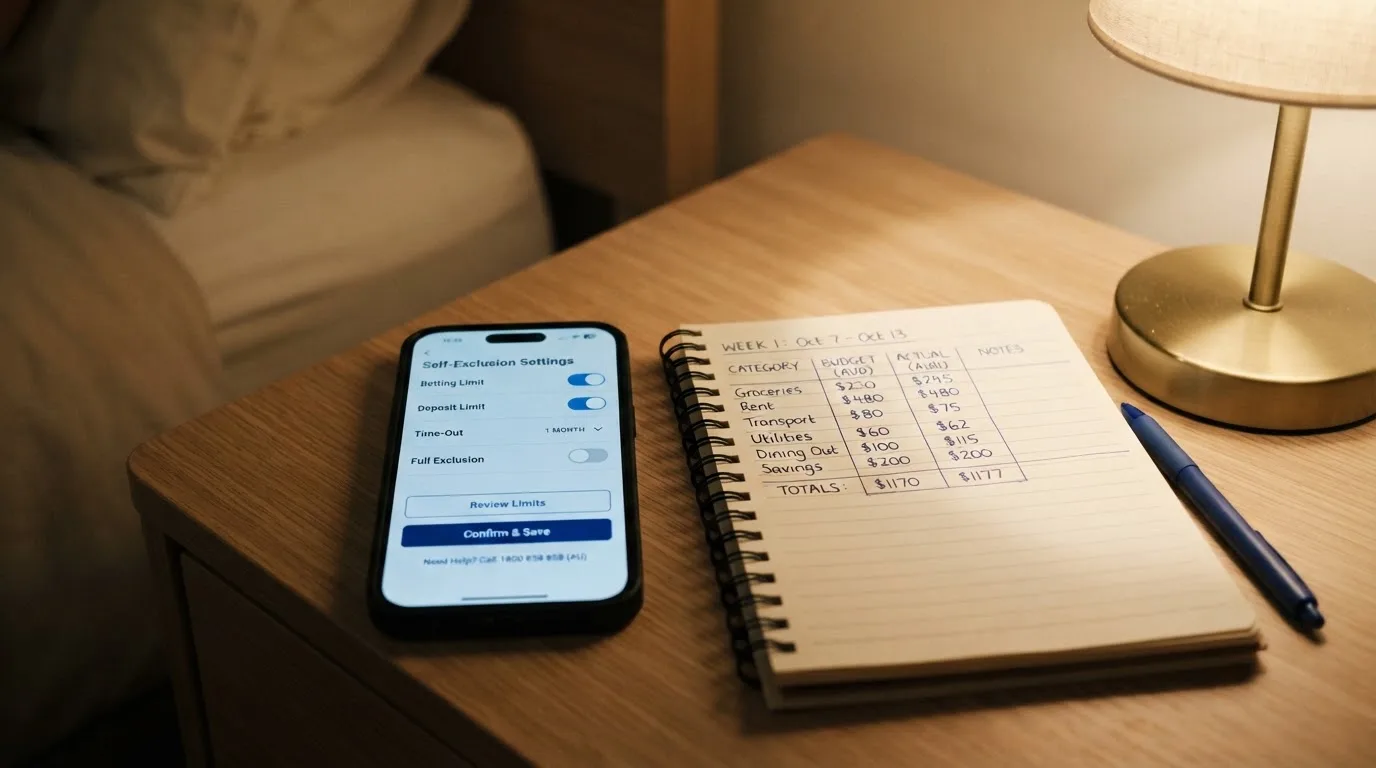
The deposit-and-time limits that licensed Australian wagering operators must offer are not, in most cases, mandatory on the offshore casino. What that means in practice is that the player is the one setting them. A weekly budget written on a notepad beside the laptop is not a metaphor; it is the substitute for a regulatory floor that does not exist offshore. Most reputable offshore operators do offer deposit caps, session timers and time-out periods in their account settings; whether the punter actually sets them is a different question, and the operator’s marketing has an interest in leaving the answer as “no.”
The Australian framework goes further on payments. Since 11 June 2024, credit cards, credit-related products and digital currency have been banned as a means of payment for licensed online wagering — penalties for operators reach A$247,500. The legal deposit routes for licensed wagering are debit card, bank transfer, PayID/Osko and BPAY. A site asking an Australian customer for a credit card or a crypto deposit is operating outside the Australian rules, and that one fact is the most reliable tell that the brand is on the ACMA’s list. The detail that the same operator will often describe the crypto option as “faster” or “more private” is marketing dressed as a feature.
Why the Offshore Responsible-Gambling Page Reads the Way It Does
For a punter who plays offshore, the only effective limit is the one they set themselves, and the only person enforcing it is themselves. That sounds like a counsel-of-perfection sentence, but it is the operational reality of a market where the regulator cannot reach the operator and the operator has no incentive to send a punter away. The responsible-gambling pages on offshore sites are written by the same marketing teams that write the welcome bonus. Read them as marketing, not as policy, and assume nothing in them is enforceable against the operator unless an Australian regulator stands behind it.
Crypto Casinos, Bitcoin Wallets and the Same Slot Math
Crypto-funded gambling is the part of the offshore market that has grown fastest in the past three years. The slot software is the same as on the card-funded sites; almost everything else is different.
What Stays the Same When the Wallet Is Bitcoin
A crypto casino runs the same slot titles a punter would find on a card-funded offshore site. The RNG is the same; the game library is licensed from the same studios; the maths that decides a spin is unchanged. The provider receives funds from the player’s Bitcoin, Ethereum, Litecoin or Tether wallet, converts them at the spot rate, and credits the casino balance. From the punter’s perspective, the visible difference is at the cashier: deposits confirm in minutes rather than days, withdrawals in hours rather than weeks, and the identity-verification step is often skipped because there is no card-issuing bank to coordinate with. The game lobby reads like the one on the card-funded site next door, because under the hood it usually is.
What Changes for the Player
Three things change, and all three cut the wrong way for the punter. First, there is no chargeback route. A card dispute that drags on is still recourse; a Bitcoin transaction that lands in the wrong wallet is gone. Second, the on-chain record is permanent, which makes crypto gambling one of the few consumer activities where the transaction history is publicly auditable forever — a feature for tax authorities and a complication for a punter who would rather their gambling did not surface in a future audit. Third, and most importantly, an Australian-funded crypto deposit at an offshore casino is exactly the transaction the June 2024 payment ban was written to stop. The licensed wagering market does not accept it; the offshore market is built on it.
The Australian Taxation Office treats gambling winnings of a recreational player as not assessable income (section 6-5 of the ITAA 1997) and losses as not deductible, unless the person carries on a business of gambling. The model answer for a casual punter is to check with the ATO, not to assume a crypto balance is invisible. A punter who treats the on-chain privacy of crypto as a substitute for honest record-keeping is building a future argument with the tax office that the operator’s marketing has no incentive to mention.
Eleven Brands, Eleven Formal Warnings: The Landscape of ACMA-Listed Casinos
The brands below are the eleven the ACMA has most recently named in formal warnings over prohibited online casino services. Each is an offshore operator; none holds an Australian licence to offer online casino games. The order follows the date of the most recent warning, with earlier warnings outranking later ones — so a brand first flagged in 2022 sits above one flagged in 2026. The table is the landscape; the entries below it add what the table cannot.
| Brand | ACMA action and date | Operator named by the ACMA | Subject support |
|---|---|---|---|
| Level Up Casino | Formal warning, May 2022 | Dama N.V. | Bgaming (listings-only) |
| Bizzo Casino | Formal warning, July 2025; earlier 2022 | Consolutetish S.R.L. (2025); TechSolutions (2022) | — |
| Woo Casino | Formal warning, March 2025 | Dama N.V. | — |
| Spirit Casino | Formal warning, May 2025 | Dama N.V. | — |
| Ignition Casino | Formal warning, July 2025 | Bamboo Media | — |
| Instant Casino | Formal warning, February 2025 | EOD Code SRL | — |
| Casino Intense | Formal warning, April 2025 | Sterplay Holding Ltd | ABC News, ACMA, Crown Melbourne (listings-only) |
| Sky Crown | Formal warning, September 2022 | Hollycorn N.V. | — |
| RocketPlay | Formal warning, March 2026; earlier May 2022 | Pulsup Ltd (2026); Dama N.V. (2022) | — |
| Jackbit | Formal warning, April 2026 | Ryker B.V. | — |
| National Casino | Formal warning, July 2025 | Consolutetish S.R.L. | Wikipedia (listings-only) |
Level Up Casino — An ACMA-Listed Operator
Level Up was named in the May 2022 ACMA warning to Dama N.V., one of six brands in the same published notice. It is the earliest of the eleven warnings on this page, which is why it sits at the top of the ranking. Independent slot-software listings on Bgaming mention the brand, but the listings do not confirm a particular provider relationship or a particular RTP — they are a directory entry, not a certification. The brand has not drawn a second warning since, but the May 2022 action is the most recent formal word on Level Up from the regulator, and the absence of a follow-up is a low bar for “doing business” in this market. A reader who treats the silence as a clean bill of health is reading the wrong dataset.
Bizzo Casino — An ACMA-Listed Operator
Bizzo is the only brand on this page with two formal warnings to two different operators. The July 2025 warning names Consolutetish S.R.L. as the operator; an earlier 2022 warning named TechSolutions (CY) Group Limited and TechSolutions Group N.V. The second warning matters because it tells a punter that a brand changes hands at the corporate level without changing the marketing — the same name on the lobby, a different entity behind it, and the regulator having to repeat itself to chase the new owner. The page’s research carries no independent supply confirmation for Bizzo, which is itself the most consistent feature of this landscape: every row of the table with a confirmed supply source sits on listings, not on operator disclosure.
Woo Casino — An ACMA-Listed Operator
Woo Casino drew the March 2025 formal warning to Dama N.V., the same operator named over Level Up in 2022 and Spirit Casino in May 2025. Three of the eleven brands on this page trace back to Dama N.V., which is itself a fact about how concentrated the offshore market is at the operator-entity level: one corporate address, several brand façades, a sequence of ACMA warnings across four years. The page’s research carries no independent supply confirmation for Woo. The relevant question for a reader is not whether the brand has games on the lobby — it does — but whether the operator behind them has changed names again between writing and reading.
Spirit Casino — An ACMA-Listed Operator
Spirit Casino drew the May 2025 ACMA warning to Dama N.V., the third Dama brand on this page. The pattern across the three — Level Up, Woo, Spirit — is the closest thing the offshore casino market has to a brand cycle: the same operator-entity, fresh domains, identical game lobbies. A punter who recognises the cycle before depositing is reading the ACMA register the way the regulator expects them to. No independent supply confirmation for Spirit was available for this page.
Ignition Casino — An ACMA-Listed Operator
Ignition Casino drew the July 2025 ACMA warning to Bamboo Media. It is the only brand on this page attached to that operator-entity. No independent confirmation of slot software or game supply was available for this page. The relevant fact for a reader is not the missing confirmation — it is the warning itself, and what it tells them about whether the brand will still be reachable through an Australian ISP by the time they try to log in.
Instant Casino — An ACMA-Listed Operator
Instant Casino drew the February 2025 formal warning to EOD Code SRL. The early-2025 timing makes it the most recently warned brand before the 2026 cohort. No independent confirmation of slot software was available for this page. EOD Code SRL is a relatively quiet operator-entity in the ACMA register — Instant Casino is its only published warning — which is again a low bar, and a reader weighing it should weigh that absence against the fact that the operator has had no second chance to behave differently.
Casino Intense — An ACMA-Listed Operator
Casino Intense drew the April 2025 formal warning to Sterplay Holding Ltd. The brand is the most recently warned name in the 2025 cohort before the 2026 warnings begin. ABC News, the ACMA register and the Crown Melbourne site all surface the brand in listings, but listings are not certification of supply. The most useful thing a reader can take from a brand at this point in the table is that the regulator’s action is the only external audit any of these brands has had.
Sky Crown — An ACMA-Listed Operator
Sky Crown is the second Hollycorn N.V. brand named in the ACMA’s September 2022 warning, alongside Blue Leo. The 2022 warning date makes Sky Crown one of the earliest brands on this page, and the only 2022 brand outside Level Up and the original Rocketplay warning. The brand has not been the subject of a follow-up ACMA action since, but Hollycorn N.V. has, and the absence of a fresh Sky Crown warning is not evidence of a clean operation — it is evidence that the regulator has not had to repeat itself to that brand this cycle. No independent confirmation of slot supply was available for this page.
RocketPlay — An ACMA-Listed Operator
Rocketplay is the most recently ACMA-named brand on this page. In March 2026 the regulator warned Pulsup Ltd over the brand. That is the second warning the brand has drawn: in May 2022 the same brand was named in the ACMA’s warning to Dama N.V. covering six casino brands, including Rocketplay itself. Two warnings, four years apart, against two different operators running the same brand. The page’s research turned up no independent confirmation of the brand’s slot software or live table supply, and that absence is itself information — a brand with two warnings and no verifiable supply chain is one a punter is gambling on blind.
Jackbit — An ACMA-Listed Operator
Jackbit drew the April 2026 formal warning to Ryker B.V., alongside CasinOK. The brand is one of two names attached to Ryker B.V. in the ACMA register. No independent confirmation of slot or game supply was available for this page. A punter reading the table should note the pairing: when an operator-entity gets named for two brands in the same warning, the regulator is signalling that the corporate level is where the enforcement bites, not the brand level.
National Casino — An ACMA-Listed Operator
National Casino drew the July 2025 warning to Consolutetish S.R.L. — the same operator named over Bizzo Casino in the same month. Wikipedia mentions the brand in its listings, but listings are not a verification of supply. The closest a reader can get to a verdict on National Casino is the company it shares an operator-entity with: the regulator has now had to name Consolutetish S.R.L. twice in a single month, and that is the data point that outlives the marketing.
How Fast the ACMA Blocks: One Number, One Range
Between the first blocking request in November 2019 and the regulator’s June 2026 tally, the ACMA asked Australian ISPs to block 1,751 illegal gambling and affiliate marketing websites. These figures demonstrate how consistent the regulator’s enforcement pace has been over time.
Counting from November 2019 to June 2026 gives roughly 79 months, or about six years and seven months. Divide 1,751 sites by 79 months and the rate is approximately 22 sites per month. Divide by the same span in years and the rate is approximately 266 sites per year. Both figures describe the same underlying pace — the ACMA has been adding blocked domains faster than one a working day for nearly seven years — but they answer different questions, and the choice between them depends on whether a reader wants to think about a month or a year.
The pace is not linear. The June 2026 round added 12 sites in a single batch; other rounds have added more, some fewer. The 1,751 figure also includes affiliate marketing sites, not only casino brands, which inflates the number relative to a count of casino brands alone. The honest statement is a band: somewhere between 20 and 25 sites per month over the full period, or roughly 250 to 280 per year, with the understanding that the casino-only subset would land lower. The arithmetic does not predict the next round; it describes what the regulator has actually been doing, at the rate at which it has actually been doing it.
Frequently Asked Questions
If a person is in Australia, is it legal for them to play real-money casino games online?
No. The Interactive Gambling Act 2001 makes it an offence for an operator to provide online casino games to a person in Australia, but the player is not prosecuted. The practical consequence is that no offshore casino offers Australian consumer protection — no complaints body, no recourse if a withdrawal stalls, and a balance the ACMA can block at any time.
What is actually happening when a slot machine stops on a particular combination?
The random number generator produces a stream of numbers at thousands per second, even when no one is pressing spin. The instant the player hits the button, the machine freezes the current number and uses it to pick the symbols that land on each reel. Each spin is independent of the one before it, which is why no strategy system changes the long-term edge.
Do Bitcoin and other crypto casinos run the same games as the ones you pay into with a card?
Yes, generally. The RNG, the game library and the maths that decides a spin are the same on a crypto-funded site as on a card-funded offshore site; the difference is at the cashier. Deposits confirm faster, withdrawals happen in hours, and there is no chargeback route — and the June 2024 payment ban means a licensed Australian wagering operator cannot accept either route.
What sets an offshore online slot apart from a pokies machine in a local pub or club?
The maths behind the spin is the same — RNG-driven, independent events, a fixed house edge over time. The differences are the regulatory environment, the cash-input cap and the maximum stake per spin. Pub and club machines in NSW, Victoria and Queensland carry mandatory cash-input limits of A$1 to A$5 per spin; offshore online slots do not.
Where does a player find tools to track and limit how long they spend on online slots?
On a licensed Australian wagering site, BetStop (the National Self-Exclusion Register) and the operator’s deposit-and-time limits are the main tools. On an offshore casino, only the limits a player sets themselves apply, and BetStop does not bind the offshore operator. The National Gambling Helpline on 1800 858 858 and Gambling Help Online are free, 24/7 and operate regardless of where the person plays.