
Pokie machines in Australia, and why the obvious answer is the wrong one
Current as of 7 November 2026, checked against the ACMA’s formal-warning register and the Interactive Gambling Act 2001.
The question this page opens on is simpler than the answer. “Best pokie machine to play in Australia” returns, on every search engine, an offshore casino site the ACMA has already warned, blocked or both. None of them licensed to take your money. The licensed product is land-based — more than 160,000 machines in pubs, clubs and casinos, regulated state by state — and the maths behind it (RTP, volatility, paylines, bet sizing) is what decides which one is the best for a particular punter, on a particular budget, on a particular day. The first half of this page covers that maths. The second half covers the eleven offshore sites the ACMA has named, what the warnings actually say, and where the Interactive Gambling Amendment (Gambling Reform) Bill 2026 — passed in August, not yet in force — lands.
Table of Contents
- Where to get help before any machine, in any venue
- Funding the play: cash at the venue, nothing at the offshore cashier
- Mobile pokie-machine apps: a category that should not be in your phone
- Choosing a pokie machine on the floor: what the paytable really tells you
- Eleven offshore pokie sites the ACMA has named, in the order the warnings landed
- The fundamentals of pokie machines in Australia
- Prohibition and the offshore pitch
- Frequently asked questions
Where to get help before any machine, in any venue
This page is about how to pick a pokie machine, not how to start playing one. The reason for opening on help services is not editorial manners; it is the shape of the Australian market. About 3 per cent of the world’s pub and club poker machines sit in a country with 0.3 per cent of the world’s population, and that concentration has consequences for every punter who walks onto a gaming floor. The services below are free, confidential and reachable before any choice is made.
The National Gambling Helpline is 1800 858 858, free from any Australian phone, twenty-four hours a day, every day of the year. The same service runs a chat and email counselling arm under the name Gambling Help Online, with state-specific pages for New South Wales, Victoria, Queensland, Western Australia, South Australia, Tasmania, the ACT and the Northern Territory. Both services are funded by the Commonwealth and the states; they take problem-gambling calls from anyone — punter, partner, parent or employer — and they do not share information with venues or with the ATO.
For self-exclusion, BetStop — the National Self-Exclusion Register — has been live since August 2023 and binds every Australian-licensed online and phone wagering service. A punter who registers with BetStop cannot open a new account with a licensed bookmaker, and existing accounts are closed for the registration period (three months, twelve months, or indefinitely until revoked). The catch — and it is the only catch that matters on this page — is that BetStop is built on the same licensing regime as the wagering services it covers. An offshore casino is not a licensed Australian wagering service, and BetStop cannot close an account or block a withdrawal on a site that has no presence in the register. The self-exclusion binds the licensed side; the illegal side does not see it.
State-level self-exclusion operates differently. New South Wales runs a gaming-machine self-exclusion order through Liquor & Gaming NSW that bars a person from any pub or club gaming area in the state for a chosen period. Victoria runs a similar order under the Victorian Gambling and Casino Control Commission, and Queensland, Western Australia, South Australia and Tasmania each run their own. These orders bite the moment a venue scans the punter’s licence or matches their face against the in-house exclusion list, and they are the strongest exclusion tool in the country. They do not, however, reach an offshore website on a phone in the punter’s pocket.
The consequence is that offshore play offers no self-exclusion lever the punter can pull from the inside. None of the help lines above can withdraw a balance from an offshore casino, and the offshore casino does not subscribe to the registers that would let them try. The page returns to this in the section on prohibition, because the consequence compounds the further the punter moves from the licensed venue.
Funding the play: cash at the venue, nothing at the offshore cashier
There are three payment situations in Australian gambling, and they are not interchangeable. Land-based pokies are paid in cash, with eftpos top-ups at the venue where a credit or debit card is accepted. Licensed online wagering — which is races, sport and lotteries, not casino games or pokies — runs through debit card, bank transfer, PayID, Osko or BPAY, and is the only online wagering product on which a credit card is illegal. Offshore sites, where the casino games and online pokies actually live, take whatever their payment processor will process, and that is the test.
The credit-card and digital-currency ban for licensed online wagering came into force on 11 June 2024 under amendments to the Interactive Gambling Act 2001. The penalties for a licensed operator accepting either are up to A$247,500 per breach. The practical effect for a punter is that an Australian-licensed sports book or lottery will never ask for a Visa or a Bitcoin deposit; the methods available are the four above and nothing else. The framing here matters: the ban does not extend to offshore casino sites because offshore casino sites are not licensed in Australia in the first place, and the legislation that creates the ban does not need to reach them. A site that asks an Australian punter for a credit card or a crypto deposit is, by that request alone, advertising an unlicensed product.
Settlement times follow from the same split. At a pub or club the cash is immediate and the receipt is the punter’s evidence; if a machine fails to pay, the venue’s gaming attendant can call the technician and the machine’s last transactions are auditable. At a licensed wagering site, PayID and Osko deposits are near-instant, BPAY can take one to two business days and bank transfers run overnight. At an offshore casino, the timeline is whatever the operator says it is, and the regulator that would audit it does not exist. The withdrawal is the moment the marketing promise meets the absence of consumer protection: an offshore site that processes a deposit in minutes can hold a withdrawal for days or weeks on grounds the punter cannot verify, and there is no Australian complaints body to appeal to.
The consequence lands hardest on the punter who treats an offshore site as if it were a licensed product. The deposit succeeds because the site wants it to; the withdrawal fails for the same reason the deposit succeeded, which is that the operator chose to allow it. The payment route that licensed Australian wagering sites are forbidden to take is the route an offshore casino offers first, and the offer itself is the proof that the product sits outside the rules.
Mobile pokie-machine apps: a category that should not be in your phone
The phrase “real pokie machine app” returns, in every app store, an offshore casino product wrapped in a kangaroo or a flag. None of them are licensed to offer casino games to people in Australia. The Interactive Gambling Act 2001 makes it an offence to provide such apps to a person physically in Australia, and the ACMA’s blocking power extends to app-store listings as well as to websites — the round reported on 26 June 2026 added twelve more URLs to the blocklist, and prior rounds have included specific mobile-app endpoints. The legal category “real-money pokie machine app for Australians” is, in plain terms, empty.
What the apps actually are is an offshore casino with a smaller file size. The game library is the same as the desktop product under the same brand: BGaming, Pragmatic Play, Evolution, the rest of the supplier roster the operator’s marketing pages list. The deposit methods are the ones the licensed Australian side is banned from offering — credit cards, USDT, a small exchange’s crypto rails. The verification is either absent (the marketing word is “instant play”) or performed against an offshore document set that has no link to an Australian identity database. The marketing is pitched at Australians: AUD currency, “pokies” as the product name, sometimes a .com.au landing page registered through a privacy-proxy service.
The consequence of installing one is the same as the consequence of depositing on an offshore casino site, with one added step. The phone becomes a single-tap route to a product the ACMA is actively working to make unreachable. A punter whose balance is sitting on a blocked URL can still load the app on a different network, but the balance does not move with the network — the withdrawal request still routes through the offshore cashier, still on whatever timeline the operator chooses. The punter has not gained convenience. The punter has given the operator another channel to ask for a deposit.
The browser is no better. Browser-based play for offshore casino games, on any device, is the same product under a different file format, and the ACMA’s blocking reaches both. The legal real-money pokie machine for a punter in Australia is a physical machine, on a licensed floor, with a paytable that can be read before the first spin. The mobile version of that product does not exist under Australian law, and the apps that claim to provide it are the offshore market’s pitch, not the licensed market’s offer.
Choosing a pokie machine on the floor: what the paytable really tells you
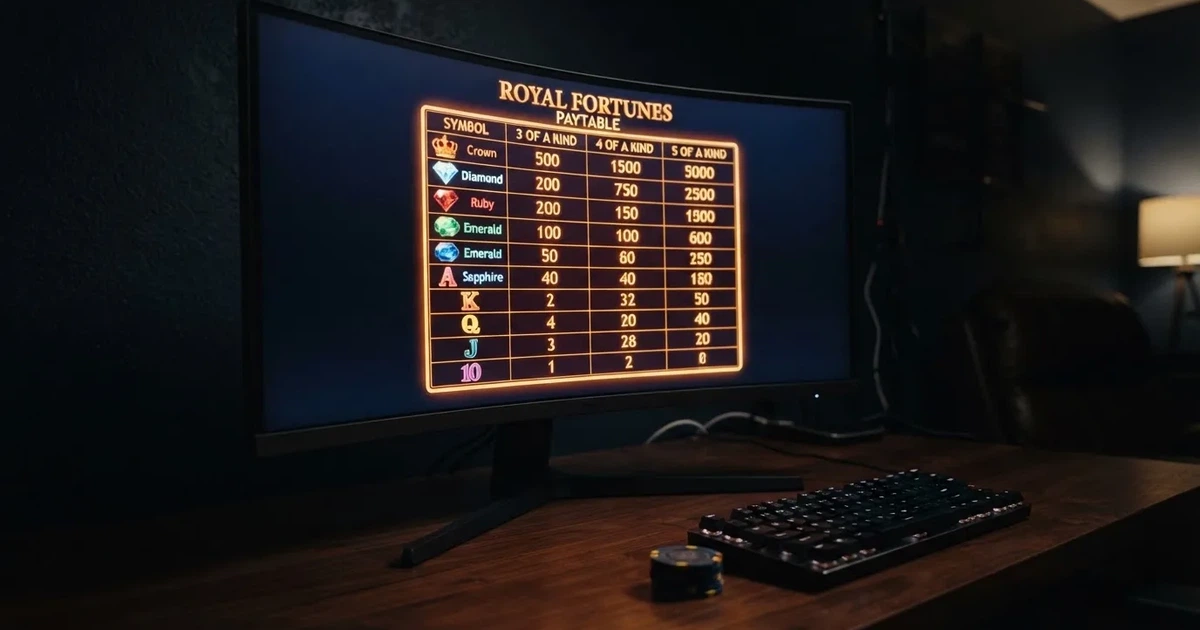
The paytable is the page that lists, for a specific machine and a specific stake, what each combination pays and what each feature does. In a licensed Australian venue the paytable is on the machine itself — a help screen on the player terminal, or a printed card on older games. The figures on it are fixed by the game’s software, audited by an external testing house (the regulators list approved labs; Gaming Associates, eCOGRA, BMM Testlabs and others appear on state registers) and cannot be changed by the venue. Reading the paytable is the single highest-value action a punter can take before sitting down, because the four numbers that follow are on it.
Return to player is the first number, and it is the one the marketing copy borrows when it says “high-paying”. The legal minimum RTP varies by jurisdiction: 85 per cent in New South Wales, the Northern Territory and Queensland; 87 per cent in the Australian Capital Territory, Tasmania and at Crown Melbourne (higher than the rest of Victoria by concession); 87.5 per cent in South Australia; and 90 per cent in Western Australia, where the machines sit only on the casino floor at Crown Perth. The 5 percentage point gap between NSW and WA is not a coincidence — it reflects how much stake volume each jurisdiction decided to leave on the table — and a punter who sits down at a 90 per cent machine in Perth is, in mathematical terms, losing less per dollar bet than a punter at an 85 per cent machine in Sydney. The difference compounds over a session.
Volatility is the second number, and it is the one the paytable does not print. Volatility is a property of the game’s hit distribution: a low-volatility machine pays out small wins frequently; a high-volatility machine pays out less often, with a longer tail of larger wins. The figure is not on the paytable because it is a property of the maths underneath, and the only public sources for it are the developer’s own game sheet (where it is published, as a class, on the developer’s site) and third-party trackers. For a punter on a small bankroll, low-volatility play extends session length at the cost of the prize ceiling; for a punter on a longer bankroll chasing the feature bonus, high-volatility play does the opposite. The paytable tells you what each combination is worth. Volatility tells you how often those combinations will land, and the gap between the two is where most bankrolls die.
Bet sizing is the third decision, and it is the one the punter can change at the terminal. A machine’s paytable is built for a specific credit value, and several machines — particularly those with progressive jackpots or with multi-level bonus features — require the maximum bet to qualify for the top prize. The punter who drops to a lower credit value is not playing the same game with a smaller stake; the punter is playing a different game, with the top prize removed. The marketing word is “bet what you can afford”, which is true enough, but the punter who bets a smaller credit value to extend the session has also opted out of the largest payouts on the paytable.
Paylines are the fourth. Multi-line machines — five reels, nine or twenty or more lines, all evaluated on every spin — pay out more often, in smaller amounts. Single-line or three-reel machines pay out less often, in larger amounts relative to the stake. The maths is the same on aggregate over a long session; the shape of the session is different. A multi-line machine at A$1 a line and nine lines is a A$9 spin with a high hit rate; a single-line machine at A$1 a spin is a A$1 spin with a low hit rate and a larger relative top prize. The punter who prefers a long session with a steady trickle of small wins is on a multi-line machine; the punter who prefers an occasional larger win is on a single-line.
The consequence of all four is that “best” is not a single answer. Best for a punter with a A$50 budget and a preference for steady play is a low-volatility, multi-line machine at the minimum credit value; best for a punter with a A$500 budget and a preference for the feature bonus is a higher-volatility machine at the maximum credit value. Both choices are rational. The marketing word “best” elides that fact, and the offshore casino advertising “the highest paying pokie machine” is using the same elision to push a product the punter cannot legally buy in Australia.
Eleven offshore pokie sites the ACMA has named, in the order the warnings landed
The ACMA’s formal-warning register lists every offshore gambling service the regulator has put on notice under the Interactive Gambling Act 2001. The list runs to hundreds; the eleven below are the ones a punter is most likely to encounter in Australian-facing search results, drawn from the ACMA’s own publication record. They are not a ranking by quality (they are all the same product, on the same legal footing) and they are not a recommendation. They are a comparison by what the regulator named, when it named them and under which operating company — which is the information the punter needs to recognise the brand on the search results page.
| Brand | Warning and date | Operator of record | Supplier claim |
|---|---|---|---|
| RocketPlay | Formal warning, March 2026 | Pulsup Ltd (earlier: Dama N.V., May 2022) | — |
| Level Up Casino | Formal warning, May 2022 | Dama N.V. | BGaming lists it |
| Woo Casino | Formal warning, March 2025 | Dama N.V. | — |
| Spirit Casino | Formal warning, May 2025 | Dama N.V. | — |
| National Casino | Formal warning, July 2025 | Consolutetish S.R.L. | Wikipedia reference only |
| Bizzo Casino | Formal warning, July 2025; earlier, 2022 | Consolutetish S.R.L. (earlier: TechSolutions) | — |
| Ignition Casino | Formal warning, July 2025 | Bamboo Media | — |
| Instant Casino | Formal warning, February 2025 | EOD Code SRL | — |
| Jackbit | Formal warning, April 2026 | Ryker B.V. (with CasinOK) | — |
| Casino Intense | Formal warning, April 2025 | Sterplay Holding Ltd | ABC, ACMA and Crown Melbourne mention it |
| Sky Crown | Formal warning, September 2022 | Hollycorn N.V. (with Blue Leo) | — |
Two patterns are visible in the table. The first is the operator churn. Dama N.V. is named three times (in 2022, March 2025 and May 2025) for five distinct brands, and the same Dama N.V. licence shell has been on the register for almost four years. The ACMA issued its first formal warning to Dama N.V. in May 2022 covering six brands (Bambet, Dazard, Level Up, RocketPlay, Wild Tornado and Cobra Casinos); the brand reappeared at a new operator in 2026 and the regulator had to publish a fresh warning. Consolutetish S.R.L. is named twice in 2025 (National Casino and Bizzo Casino), and Bizzo Casino had previously been warned in 2022 under TechSolutions (CY) Group Limited and TechSolutions Group N.V. — meaning the brand itself outlasted the operator change the regulator’s paper trail records. Hollycorn N.V. is named for Sky Crown and Blue Leo, paired on the same warning in September 2022.
The second pattern is the escalation. Of the eleven warnings, four are dated 2025 or later. The ACMA’s blocking power has been in place since 2017 and the first formal warning under the IGA 2001 as amended was published soon after; the rate of warning per year has not been constant. In a round reported on 26 June 2026 the ACMA asked Australian internet service providers to block a further twelve illegal gambling sites, on top of the warnings the table records, and the cumulative number of sites blocked since the first blocking request in November 2019 was reported as 1,751 in that same round. The eleven write-ups below close on what each brand does to the comparison, and on what the warning actually costs the punter who reaches the site.
RocketPlay: the only brand on this list with two ACMA warnings under two different operators
The headline here is the duplication, not the date. RocketPlay has been named twice by the ACMA: first in May 2022 as one of six brands operated by Dama N.V. (alongside Bambet, Dazard, Level Up, Wild Tornado and Cobra Casinos), and again in March 2026 under Pulsup Ltd at the brand’s .com.au landing page. The brand survived the operator change and came back into the regulator’s view because someone at the new operator thought an Australian domain was a reasonable advertisement for an unlicensed casino.
The Interactive Gambling Act 2001 prohibits online casino games — pokies included — to people in Australia, regardless of what licence the operating company displays elsewhere. A formal warning is the regulator’s first step; it does not block the site or fine the operator, but it puts the company on notice that its services are unlawful if offered to Australians. The warning to Pulsup Ltd in March 2026 was published on the ACMA register and named Rocketplay.com.au specifically.
The brand maintains no public game-supply relationship; the operator simply does not publish where its gaming content originates.
The verdict, then, is about brand persistence. The warning is chasing the brand, not the operator: Dama N.V. walked away, Pulsup Ltd picked up, and the ACMA had to do the same paperwork again. A punter searching the brand today is being led to an offshore cashier, and the next step — referral to ISPs for blocking — is the one that turns the warning into a withdrawn balance.
Level Up Casino: one of the original 2022 group of six
Level Up Casino was named in the ACMA’s first formal warning to Dama N.V. in May 2022, alongside Bambet, Dazard, RocketPlay, Wild Tornado and Cobra Casinos — a group of six brands the regulator bundled into a single notice. The 2022 warning was issued under the Interactive Gambling Act 2001 and named each brand’s website. Level Up Casino has not been re-warned under a different operator in the consulted record.
The brand is one of two on this list (Casino Intense is the other) where a game-supplier listing exists in the consulted data. The BGaming supplier’s own website lists Level Up Casino as an operator that integrates its games, which means the brand sits on a public supplier roster — though the supplier’s own page publishes the listing, not the brand, and any integration is irrelevant in Australia because BGaming games cannot lawfully be offered to Australian residents from an unlicensed offshore casino.
Level Up Casino sits in the regulator’s gap: a 2022 warning that has not been escalated to a blocking request in the four years since. The brand is still trading, the formal warning is a notice not a block, and the ACMA’s escalation path — blocking by ISP direction — has been applied to other Dama N.V. brands but not, on the consulted record, to Level Up Casino specifically. The punter who lands on the site today is on a 2022-warned brand that the regulator has not yet asked ISPs to block. That gap is the enforcement record’s own statement.
Woo Casino: the first Dama N.V. warning of 2025
Woo Casino came back onto the ACMA’s register in March 2025, three years after the original 2022 warning to Dama N.V. covered six other brands. The 2025 escalation is significant: Dama N.V. was warned in 2022, the warning covered six brands, and three years later the regulator had to publish a fresh warning for the same operator on a brand it had not named in 2022. Either Dama N.V. did not receive the 2022 message, or it received it and decided Woo Casino was not on the list.
There is no game supplier data on file for Woo Casino. The operator offers no public indication of its game-supply relationships in the data the consulted set holds.
The gap between warning and compliance is the verdict. Three years between the first Dama N.V. warning and the second is the regulator’s timeline for the brand to leave the Australian market — and the brand did not leave. A punter who reaches Woo Casino in 2026 has reached a brand the ACMA has now named twice, and the regulator’s escalation pattern — warning, then blocking — puts the brand closer to the second step than the first was.
Spirit Casino: the second Dama N.V. warning of 2025
Spirit Casino was named in May 2025, two months after Woo Casino, under the same Dama N.V. operator of record. Two Dama N.V. warnings in three months is the regulator’s signal that the 2022 warning did not change the operator’s behaviour on Australian-facing brands.
The brand has no public footprint in developer distribution lists.
The second warning is the louder one. A single warning is a notice; a second warning is the regulator’s evidence that the operator received the first one and continued. Spirit Casino’s 2025 warning is the ACMA’s record that Dama N.V. heard the Woo Casino warning and brought Spirit Casino to the Australian market anyway. The brand whose warning is the most recent of the Dama N.V. trio is the brand the operator most clearly chose to keep running.
National Casino: one of the Consolutetish S.R.L. pair
National Casino was named in the ACMA’s July 2025 warning to Consolutetish S.R.L., on the same notice as Bizzo Casino. The two brands were bundled into a single warning — a structure the regulator uses when a single operator runs multiple brands and the warning is about the operator’s behaviour rather than any one brand’s.
The brand appears as a referenced name in Wikipedia’s coverage of the offshore-casino sector, but not on any game supplier’s distribution list. The reference does not turn the brand into a legitimate Australian product; it turns it into a brand documented in the encyclopaedia’s coverage of an unregulated market.
Consolutetish S.R.L. was named once, for two brands. National Casino sits on the same escalation timeline as the Dama N.V. brands above — the regulator’s first signal that the operator is offering prohibited services, with the next step (blocking) the inevitable regulatory conclusion when a warning is ignored.
Bizzo Casino: warned twice, by two operators, four years apart
Bizzo Casino is the second of the Consolutetish S.R.L. pair, but its history is longer. The brand was named in an earlier ACMA warning in 2022 under TechSolutions (CY) Group Limited and TechSolutions Group N.V., and then re-warned in July 2025 under Consolutetish S.R.L. The brand survived the operator change the regulator’s paper trail records — the same pattern as RocketPlay, with a different operator handover and a longer gap.
No game developer credits this brand in their own distribution network.
The brand outlasted the operator change the regulator’s paper trail records. Bizzo Casino’s warning history crosses two operators and four years, and the regulator has had to issue the same notice twice to chase the same product. The escalation step — blocking — is the regulator’s primary tool when early notices fail to remove the brand from the Australian market.
Ignition Casino: the Bamboo Media warning of July 2025
Ignition Casino is the only brand on this list named under Bamboo Media, an operator that does not appear elsewhere in the consulted ACMA record. The July 2025 warning was Bamboo Media’s first appearance in the regulator’s publication, and Ignition Casino was the brand attached to it.
Consulted listings show no game supplier relationships for this operator.
The pattern across the table — Dama N.V. in 2022, the Consolutetish pair in 2025, Bamboo Media also in 2025 — is the regulator’s record that the offshore operator pool is not shrinking. Bamboo Media is a fresh operator in a fresh year, and the ACMA’s warning is the regulator’s first piece of paper on the file. A punter on Ignition Casino is on a brand whose operator is new to the register and whose next step has not yet been taken.
Instant Casino: the EOD Code SRL warning of February 2025
Instant Casino was named in the ACMA’s February 2025 warning to EOD Code SRL, which is also the operator’s first appearance in the consulted record. The brand markets itself on speed — the name is the pitch — and the regulator’s warning is the part of the pitch the marketing page leaves out.
There is no game supplier data on file. The brand does not appear on any consulted listing as a supplied operator.
“Instant” is the word the cashier uses; “warning” is the word the regulator uses. A punter who values the deposit speed above the cash-out is the punter who has not yet met the offshore site’s withdrawal timeline, and the cash-out is the moment the marketing stops being in charge. Instant Casino is the brand that named its promise after the part of the transaction the ACMA is most actively trying to close.
Jackbit: the Ryker B.V. brand paired with CasinOK
Jackbit was named in the ACMA’s April 2026 warning to Ryker B.V., on the same notice as CasinOK. The warning was published in the same reporting cycle that this article was being drafted, and the brand is one of two on this list paired on a single notice (alongside Sky Crown and Blue Leo).
The brand name does not surface on any developer’s site or industry supply roster.
A paired warning puts two brands on the regulator’s notice at the same time. Jackbit and CasinOK sit on the same Ryker B.V. escalation, and the next step — blocking — would be applied to both brands in one round. The punter on Jackbit is on a brand whose regulatory position is shared with CasinOK, and whose withdrawal timeline is whatever the operator chooses to allow between the warning and the block.
Casino Intense: the Sterplay Holding warning of April 2025
Casino Intense was named in the ACMA’s April 2025 warning to Sterplay Holding Ltd. Sterplay Holding does not appear elsewhere in the consulted ACMA record, and the warning was the operator’s first appearance.
The brand does not name a game supplier on its own pages, but it surfaces in passing across Australian listings — the ABC’s coverage of offshore-casino enforcement, the ACMA’s own warning publication, and Crown Melbourne’s table-games directory mention Casino Intense in passing but not as a supply relationship. The listings do not give Casino Intense a supplier; they give the regulator and an Australian casino brand a reason to name the brand in their own materials.
An Australian press mention is not a supply claim. Casino Intense is named in the ABC, on the ACMA register and on Crown Melbourne’s directory because the regulator’s enforcement activity puts it on their beat. A punter who follows any of those mentions back to Casino Intense is following the regulator’s paper trail, not a partnership the press mention endorses.
Sky Crown: one of the oldest ACMA warnings on this list, paired with Blue Leo
Sky Crown was named on the ACMA’s formal warning to Hollycorn N.V. in September 2022, on the same notice as Blue Leo. The Hollycorn warning is the oldest warning in the table that is still tied to a single operator (the 2022 Dama N.V. warning covered six brands; the Hollycorn notice covered two). Sky Crown is the only brand on this list that has been on the register for four years without a re-warning under a different operator.
No game provider claims this brand as a partner in their public listings.
Four years on the ACMA register, no blocking request, no re-warning under a different operator. Sky Crown sits in the regulator’s gap, and the gap is wider than for any other brand on this list. The regulator’s blocking-by-ISP power has been used; it has not been used on Sky Crown. The brand persists because the regulator’s escalation has not reached it, not because the regulator has decided it is in order.
The fundamentals of pokie machines in Australia
Australia has about 3 per cent of the world’s pub and club poker machines and 0.3 per cent of the world’s population. That concentration is the first number a punter should know, because it explains everything else about the market — the state-by-state regulation, the per-venue density, the political fights over pre-commitment cards, and the volume of offshore marketing that targets Australian search results. The licensed machines are land-based, state-regulated and audited; the offshore machines are the rest of the world’s supply, marketed to the country with the highest per-capita machine density.

The first legal poker machines in Australia were installed in New South Wales registered clubs in 1956. The NSW club industry had been running housie and other gaming for years, but 1956 was the year the registered-club poker machine became lawful, and the format the rest of the country adopted was, in outline, the one NSW licensed clubs started with. The technology has changed — mechanical reels became video, then video with progressive jackpots, then multi-line video with feature bonuses — but the regulatory pattern NSW set in 1956, with state-by-state design approval and venue-level licensing, is the one every other jurisdiction has followed or modified.
The scale is the second number. In 2020–21 Australians bet almost A$150 billion through gaming machines and lost A$12.18 billion on them. New South Wales alone, in June 2023, had 87,298 gaming machines outside casinos across 2,195 venues, with player losses of A$8.18 billion in 2022–23. Queensland had 21,122 gaming machines operating in 351 venues in October 2023; Victoria had 26,380 outside Crown Casino in 488 venues in 2021–22, under a 30,000-machine statewide limit that the regulator set in the late 2010s and that has not been loosened. Western Australia banned poker machines in pubs and clubs entirely when Crown Perth opened in 1985, and Crown Perth’s own machine count has since grown from about 200 in 1985 to roughly 2,500 — all approved by the state’s Gaming and Wagering Commission, all on the casino floor, and the only legal pokies in the state.
The Tasmanian pattern is the one the rest of the country is watching. The Federal Group held a monopoly licence over all of Tasmania’s poker machines from 1968, and legislation passed in November 2021 ended that monopoly, moving oversight of the machines to the Tasmanian Liquor and Gaming Commission. Tasmania planned nation-leading mandatory pre-commitment cards for its poker machines, but implementation of the reform was delayed until late 2025, and the delay is the part of the story most of the national press carried.
The consequence is that the licensed Australian market is state-by-state, machine-by-machine, and audited. The punter who walks onto a NSW pub floor sits down at a machine whose software is approved by Liquor & Gaming NSW, whose RTP is at or above the 85 per cent legal minimum, and whose last transactions are auditable by the venue. The punter who reaches an offshore casino site sits down at a machine whose software is whatever the operator’s licensing jurisdiction approved, whose RTP is whatever the operator published, and whose last transactions are not auditable by anyone the punter can call. The product is the same shape; the difference is everything around it.
Prohibition and the offshore pitch
The legal frame for online pokies in Australia is the Interactive Gambling Act 2001, strengthened by the Interactive Gambling Amendment Act 2017. The 2017 amendment closed the loophole that had allowed offshore operators to advertise online casino games to Australians on the basis that the games were provided from a server outside Australia; the amendment made the location of the customer the test, not the location of the server. The result is that providing online casino games, online pokies or in-play betting to a person physically in Australia is an offence under Commonwealth law, and no state or territory licences the product. What is licensable is wagering on races and sport placed before the event, lotteries and keno — in practice licensed by the Northern Territory through the Northern Territory Racing and Wagering Commission, a body with no full-time staff that meets once a month in Darwin and regulates 52 of Australia’s online bookmakers including Sportsbet, Bet365 and Ladbrokes.

The enforcement sits with the ACMA. The regulator investigates complaints, issues formal warnings and, where the warning is not acted on, asks Australian internet service providers to block the offshore site. A round reported on 26 June 2026 asked ISPs to block twelve more sites — 7Signs, ChromaBet, Donbet, Duospin, Freshbet, Slots Gem, Jacks Club, Lucky Start, Pointsbetz.com, Spinrise, Vinyl Casino and Wildsino — bringing the cumulative number of blocked illegal-gambling and affiliate-marketing websites to 1,751 since the first blocking request in November 2019. The arithmetic of that run is the regulator’s pace: across the seventy-nine months from the first blocking request to the round reported in June 2026, the run works out to roughly twenty-two sites blocked per month, or between two hundred and sixty and two hundred and seventy per year. The figure is a band rather than a single number, because the ACMA publishes the running total and the dates of each blocking round but not a per-round average, and the band spans the cycles between rounds where one month may take ten sites and the next may take forty.
The ACMA’s role is the regulator’s, not the punter’s. The IGA targets the provider, not the individual player — an Australian punter cannot be prosecuted for placing a bet on an offshore site. The consequence of that fact is the shape of the risk: an offshore operator offers no Australian consumer protection, no complaints body and no recourse if a withdrawal is refused, and it can be blocked with a balance still on it. H2 Gambling Capital’s 2025 report estimates that Australians lose about A$3.9 billion a year to illegal gambling sites, and that the share of gambling going through legal channels fell from 74 per cent in 2021 to 64 per cent. The 10 percentage point drop is the offshore market’s growth, not the licensed market’s contraction, and the ACMA’s blocking run is the regulator’s response to a market that has not stopped offering.
The credit-card and digital-currency ban for licensed online wagering came into force on 11 June 2024, with penalties up to A$247,500 for operators. The legal deposit routes for licensed wagering are debit card, bank transfer, PayID, Osko and BPAY. A site asking an Australian for a credit card or a crypto deposit is operating outside the Australian rules, and the request itself is the marker. The 2026 reform is the Interactive Gambling Amendment (Gambling Reform) Bill 2026, which passed Parliament on 19 August 2026; its advertising and inducement measures commence on 1 January 2027. The bill is law with a start date, not yet in force on the page a punter reads today, and the offshore marketing the page has been describing is the kind of advertising the new law is built to constrain.
The tax treatment is the last frame. Gambling winnings of a recreational player are not assessable income under section 6-5 of the Income Tax Assessment Act 1997, and losses are not deductible, unless the person carries on a business of gambling. The model is that a punter who plays a pokie machine for recreation reports no income and claims no deduction; a punter who plays as a business has a different set of obligations. The ATO’s advice is to check, because the test is on what the punter does, not on what the punter calls themselves.
The consequence of the legal frame, taken together, is that the legitimate product is land-based and the offshore product is unregulated. The punter who picks a venue floor and reads the paytable is on the regulated side of the line. The punter who picks an offshore site is on the unregulated side, regardless of what licence the offshore site displays, and the ACMA’s blocking run is the regulator’s way of containing a supply that does not shrink.
Frequently asked questions
What is the difference between a low-volatility and a high-volatility pokie machine?
Volatility is a pokie’s payout distribution. A low-volatility machine pays small wins often, extending a session at the cost of a lower prize ceiling. A high-volatility machine pays less often, with a longer tail of larger wins. Two machines can share an RTP at different volatilities; the difference is how the maths lands on a bankroll across the session.
Does bet size change the odds on a pokie machine?
No. On a regulated Australian pokie, the RTP, hit frequency and bonus-feature trigger rates are fixed in the software and audited. Changing the credit value or the line count changes the size of the stake and the size of the prize on a winning combination, but it does not change the proportion of stake that returns to the player over time.
Are mobile pokie-machine apps the same as the licensed machines in a pub or club?
No legal real-money pokie machine app exists for people in Australia. The IGA 2001 prohibits providing online casino games to a person physically in Australia, and the apps in app-store search results are offshore casino products. The licensed version is on a venue floor, with an audited paytable and a state regulator’s approval.
How can someone find the payout percentage of a specific pokie machine before playing?
On a licensed Australian venue floor, the paytable and help screens on the player terminal list the game’s RTP, or the range the operator has configured. The state regulator publishes the approved games list. A punter who cannot find a number on the terminal can ask the venue’s gaming attendant for the information sheet.
Are multi-line pokie machines more likely to pay out than single-line ones?
Multi-line machines produce a higher hit frequency — more winning combinations per spin, in smaller amounts. Single-line machines produce a lower hit frequency, with a larger top prize relative to stake. The long-run RTP can be similar; the difference is in the shape of the session, not in the proportion of stake returned to the player.