
Best Aus Pokies Online in Australia: What 2026 Actually Permits
Data current as of 1 November 2026 · Licence and enforcement record verified against the Australian Communications and Media Authority register.
Online pokies are prohibited for Australians. No state or territory issues a licence for them, no licensed Australian venue offers them online, and there is no honest ranked list of online pokies sites to write for an Australian reader. What follows is the picture that sits behind the search result: the part the marketing cannot say, the part the regulator’s register records, and the part that lands at the moment a deposit button either works or stops working.
The consequence shows up in seven places, and the order in which they show up is roughly the order a player meets them. It shows up first in the absence of any local safety net for the person whose gambling has started to feel out of control. It shows up next at the cashier, where the rails an Australian is asked to use tell the reader which side of the law the operator sits on. It shows up in the bonus terms an offshore operator writes into its own fine print, which the ACMA cannot enforce. It shows up on the screen, where the paytable is the document a player can read before committing a stake. It shows up in the register of brands the regulator has warned and the cumulative rate at which the register grows. It shows up in the scale of the licensed land-based market the prohibition carves around. And it shows up in the statute itself, in plain English, in section after section of the Interactive Gambling Act 2001.
The licensed alternative is the land-based poker machine inside a pub, club or casino — a different product, regulated state by state, and treated separately here. The point of drawing the line is not to moralise about gambling. It is to make clear which product an Australian is being offered when the search engine suggests one, and what the difference between the two costs.
Table of Contents
- Responsible Gaming: When the Question Stops Being About Games
- Payments & Payout Speed: Why the Banking Rails Tell the Story
- Bonuses & Free Spins: Why the Marketing Words Do Not Survive the Reading
- What a Pokies Paytable Shows: Reading the Numbers Before They Read You
- The Enforcement Record: Eleven Brands the ACMA Has Warned
- The Fundamentals: How Licensed Pokies Actually Run in Australia
- Prohibition Under the Interactive Gambling Act: What the Law Actually Says
- Operator Write-ups: What the ACMA Warnings Add Up To
- The Picture Behind the Search
- Frequently Asked Questions
Responsible Gaming: When the Question Stops Being About Games
The first consequence shows up before any spin, deposit or signup. For anyone in Australia whose thinking about online pokies has started to feel compulsive, late-night, or a way of dealing with something else, free confidential help is available around the clock through Gambling Help Online, with phone support on the National Gambling Helpline at 1800 858 858. The service is free, the conversation is confidential, and a person can reach it without giving a name. The cost of using it is zero, the obligation to keep using it is none, and the conversation does not become part of any database a reader has to worry about later.
BetStop, the National Self-Exclusion Register, has been live since August 2023. It binds Australian-licensed online and phone wagering services — the licensed bookmakers, the licensed lottery operators, the licensed totalisator services. A self-excluded player cannot deposit, cannot place a bet, cannot open a new account with any operator covered by the register while the exclusion is in force. The mechanism works exactly as intended for the licensed market, and it works at scale: every Australian-licensed wagering operator is connected to the same register, the exclusion takes effect across them simultaneously, and the period of the exclusion — six months, twelve months, or longer — runs without the player having to do anything to keep it in place.
The mechanism does not extend to an offshore casino. An offshore online pokies site is not bound by BetStop; it has no obligation to check the register, refuse the deposit or block the account, and it carries no penalty for failing to do so. The exclusion a player sets up to protect themselves works exactly where the player is not playing, and stops working at the boundary of the licensed market. The mechanism a person relies on to step back does not extend to the part of the market doing the most damage to step back from. That is the consequence that lands first, and it lands before the player is in any position to do anything about it.
The 2026 reform picture sharpens the asymmetry rather than closes it. The Interactive Gambling Amendment (Gambling Reform) Bill 2026 passed Parliament on 19 August 2026, with its advertising and inducement measures commencing on 1 January 2027. From that date, licensed Australian wagering operators will face stricter rules on the way they advertise bonuses and sign-up offers — the kind of offer that, in the licensed market, the ACMA, the operator’s licensing body and the Australian Financial Complaints Authority can already regulate. None of that changes the offshore situation. The reform tightens the licensed side; it leaves the offshore side exactly where it has been since 2001. The marketed consequence — “tougher advertising rules” — and the operational consequence — “still no offshore coverage” — are not the same consequence.
For a reader who is reading this analysis because they want a ranked list of online pokies sites, the responsible-gaming section is the part that says what to do first. The ranked list does not exist. The help line does.
Payments & Payout Speed: Why the Banking Rails Tell the Story
The second consequence shows up at the cashier. From 11 June 2024, credit cards, credit-related products and digital currencies are banned as a payment method for licensed online wagering in Australia. The legal deposit routes for a licensed Australian bookmaker are debit card, bank transfer, PayID/Osko and BPAY. The operator side faces penalties of up to A$247,500 for accepting a payment that is not on that list. The ban sits where it sits for a reason: a credit card turns gambling debt into consumer debt in a way a debit transaction does not, and a digital currency sits outside the Australian consumer-protection framework that the rest of the rails are built inside.
PayID is the rail that has done the most to make a deposit feel instant. It is the New Payments Platform address book that lets a payer send from their own bank account to a BSB-and-account number, a registered mobile number, or a registered email, with the funds typically clearing in under a minute. For a licensed wagering operator, PayID is the natural fit: it is fast, it is Australian, and it sits inside the regulated banking system. For an Australian who sees “PayID” on an offshore casino’s deposit page, the implication is that the offshore casino is running through a PayID-compatible Australian intermediary that the licensed framework does not regulate. The deposit goes through. The protection does not.
The marketing copy “PayID deposits” tells the reader exactly one useful fact: the operator has chosen to route payments through an Australian rail. It does not tell the reader whether the operator has an Australian licence, because no Australian licence is available for it to have. The presence of PayID on the deposit page is, if anything, evidence of the opposite of what the marketing suggests. The payment goes through an Australian intermediary because the operator is trying to make the deposit feel like a domestic transaction. The operator itself sits somewhere else entirely.
A site asking an Australian for a credit card or a crypto deposit on an online pokies page is doing one of two things. Either it has not read the rules, or it has decided the rules do not apply to it. Neither option is reassuring. The first suggests an operator who has not done its homework on the market it is selling into, and that is the operator most likely to misread the rest of the regulation that market sits inside. The second is the operator that takes the deposit and decides, on its own terms, when — and whether — to send the money back.
The payout side tells the same story from the other end. A licensed wagering operator runs inside a complaints and dispute process that the ACMA, the bookmaker’s licensing body and the Australian Financial Complaints Authority can be involved in, with statements a player can request and transaction records a player can subpoena. An offshore operator runs on its own house rules. The “instant payout” promise on an offshore landing page is a promise from a company in a jurisdiction the player has no leverage over, made under terms the player has agreed to on its own terms page. When the payout does not arrive, the recourse is whatever the operator’s complaints email decides to do about it.
There is no Australian withdrawal speed benchmark for offshore online pokies, because there is no licensed offshore online pokies product to benchmark. The figures on an offshore landing page — “under one hour”, “same day”, “instant to crypto” — are statements the operator has chosen to put on its own marketing, not measurements a third party has confirmed. The audit operator at the cashier is the reader’s own account history, and the only way an Australian reader can audit an offshore cashier is to ask for a withdrawal and see what arrives.
The consequence, stated plainly: the rails an operator accepts tell the reader where the operator sits relative to Australian law. The licensed rails sit on the licensed side. The banned rails, and the licensed rails used by an unlicensed operator, sit on the unlicensed side. The reader who wants to know which side of the line an operator is on does not need to ask the operator; the deposit page is the answer.
Bonuses & Free Spins: Why the Marketing Words Do Not Survive the Reading
The third consequence shows up in the bonus terms. The marketing language on an offshore online pokies site is a fixed vocabulary: welcome package, deposit match, free spins, no deposit bonus, cashback, loyalty rewards. Each of those terms has a real meaning inside the licensed wagering market — none of those terms is regulated by the ACMA when it appears on an offshore landing page.
A “no deposit bonus” on an offshore pokies site means the operator credits a small amount of playable balance to a new account, then attaches a wagering requirement to the bonus, the deposit, or both, before any of it becomes withdrawable. The phrase “no deposit” describes the entry point, not the exit. The deposit is the part the player does not make; the wagering requirement is the part the player does not clear. A no-deposit offer that carries a 50x wagering requirement on a bonus of A$10 means the player has to wager A$500 before the A$10 becomes withdrawable, and any winnings generated along the way are subject to the same requirement. The “no deposit” is, in plain English, the only thing about the offer that costs the operator nothing.
A “free spins” offer credits a number of spins at a fixed stake on a named title, with the winnings paid as bonus balance rather than cash. The wagering requirement attached to those winnings tends to sit in the 30x to 50x range across the offshore market; the maximum cashout from the free-spin winnings is usually capped; and the games on which the spins are usable are typically a narrow list set by the operator. None of those conditions is unusual in a market sense. All of them are reasons the headline word “free” reads as it does — a marketing word for a particular kind of cost.
A “deposit match” offer matches a percentage of the player’s first deposit with bonus funds, attached to a wagering multiple the operator has chosen and a maximum bonus ceiling it has set. The headline is “100% up to A$500”. The fine print is the wagering multiple. The arithmetic that determines whether the bonus is worth claiming is the multiple, not the percentage. A 100% match up to A$500 with a 40x wagering requirement means the player has to wager A$20,000 of the combined deposit-and-bonus balance before any of it becomes withdrawable. The headline number is the number the player sees; the A$20,000 is the number the player works through.
Across the offshore online pokies market, the bonus terms that materially change the value of an offer to a player are not visible on the marketing page. They live in the bonus terms and conditions, which a player has to open, read and accept before claiming, and which the operator can change after acceptance at the standard wording level of the industry. The consequence is structural. The bonus cost — what an offer actually takes from a player’s bankroll before any of it can be withdrawn — is set by terms the player reads after the headline has done its work.
The shape of the cost is consistent enough to be worth naming. A wagering requirement applies the multiplier to the bonus, to the deposit, or to the combined bonus-plus-deposit figure; the larger the base, the larger the required turnover; the larger the required turnover, the longer the play-time needed to clear it. A max-cashout cap turns a winning session that would, in a fair market, return the full amount into a session that returns the cap and absorbs the rest. A game-restriction clause limits which titles the bonus is playable on, often to a short list of high-house-edge slots chosen because the bonus clears faster on them. Each clause is, on its own, an ordinary commercial term. Together, they are the reason the headline word does not survive the reading.
The single piece of advice that survives every offer in the market: read the wagering multiple and the maximum-cashout cap before claiming, and treat the headline figure as the marketing figure rather than the value figure. The reader who does that will decline roughly four out of every five offers the marketing presents, and will keep the bankroll they would otherwise have spent clearing the bonus.
What a Pokies Paytable Shows: Reading the Numbers Before They Read You
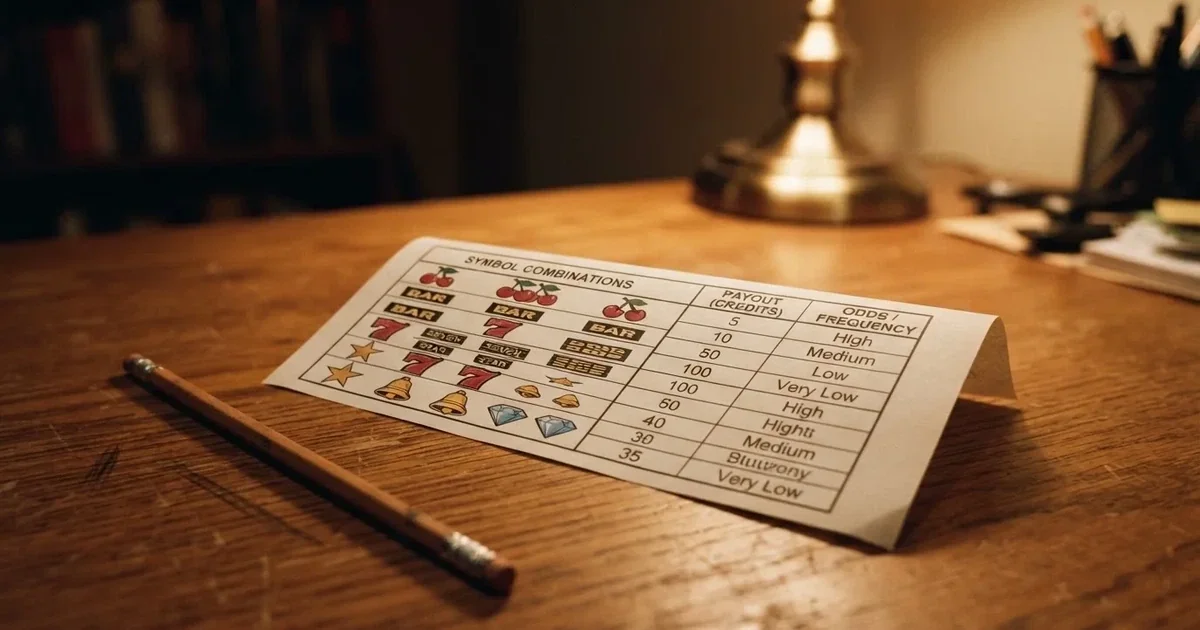
The fourth consequence shows up on the screen. The screen shows a paytable, and the paytable is the document that tells a player what each combination pays, what the special symbols do, and what the machine returns over the long run. Reading a paytable is a skill that holds up in any venue, online or land-based, licensed or offshore, because the information on it is the information the player needs to compare two games on the same machine — and the only information a player has before committing a stake.
A paytable lists every symbol and the credit value that symbol pays when it lines up in a winning combination on a designated payline. The number of paylines on a modern five-reel video pokie typically sits somewhere between twenty-five and several hundred, with the active paylines fixed in some games and adjustable in others. A line bet is set per payline; the stake is the line bet multiplied by the number of active lines. The “bet per spin” on the screen is the product of those two numbers, and is the figure a player is committing each spin. The mistake most players make on first contact is to read “25 paylines” as a measure of generosity, when it is in fact a measure of how many lines the stake is being spread across. The total bet is the bet; the number of lines is the divisor.
Scatter symbols pay independently of the paylines, usually by triggering a free-spins feature when three or more land anywhere on the reels. Wild symbols substitute for other symbols to complete winning lines. Multiplier wilds do the same and apply a multiplier to the resulting payout — typically 2x or 3x — to any line they help form. A bonus symbol on a defined set of reels triggers a feature round — a wheel spin, a pick-and-click, a cascading-tumble sequence, or a free-spin set with a retrigger mechanic. The detail of those features is on the paytable, and the detail is what separates a title whose paytable is worth reading from one whose paytable is just a screen.
Return-to-player is the figure the paytable implies but rarely states. It is the percentage of all wagered money that the game returns to players over a large number of spins, with the remaining percentage being the house edge. The legal minimum return-to-player for poker machines in Australia varies by jurisdiction. It sits at 85 per cent in New South Wales, the Northern Territory, Queensland and (generally) Victoria — with 87 per cent at Crown Melbourne — and rises to 87 per cent in the Australian Capital Territory and Tasmania, 87.5 per cent in South Australia, and 90 per cent in Western Australia. Those are the floors for the licensed land-based market, set by each state and territory regulator, with each floor reflecting a different policy choice about how much of every dollar wagered on a poker machine the machine must return to players over the long run.
The figure for an offshore online pokies title is whatever the developer published, and the developer is not bound by an Australian floor. A 90 per cent RTP online title is competitive with Western Australia’s licensed floor; a 94 per cent online title returns more than any licensed venue in the country is required to return; a 96 per cent title returns roughly what the long-run economics of a high-end international online slot look like. The numbers are not in themselves suspicious. The reader cannot, however, check them, because the random number generator is the developer’s, the audit certificate is the developer’s, and the regulator who would normally verify the certificate is not the regulator who licensed the machine. The reading of the paytable is the reading the player has to rely on, because no third party is going to do the reading for them.
Volatility — sometimes called variance — is the figure the paytable implies even less directly. It describes the spread of outcomes a player is likely to see: a low-volatility title returns small wins frequently, with the bankroll moving slowly; a high-volatility title returns larger wins less frequently, with the bankroll moving in jumps and the long sessions running on the hope of a feature round. Neither volatility is “better” than the other. Both cost the player the house edge; they differ in the texture of the cost. The reader who chooses between them is choosing between a slow erosion and a faster one with bigger swings. The choice is real. The choice does not change the percentage.
The single consequence of playing without reading a paytable: the player is comparing headlines, not games. Two titles can carry the same theme and the same number of paylines and run at materially different return-to-player figures. The paytable is where that difference shows up, and it shows up only if the player looks.
The Enforcement Record: Eleven Brands the ACMA Has Warned
The honest answer to the question that opens this analysis is that no fair comparison of online pokies sites is possible for Australian readers, because the product is prohibited and the only meaningful list of operators in this space is the one the ACMA has compiled through its enforcement actions. That list does exist. It runs to several hundred brands across the years since the first warning was issued. Eleven of them appear in the table below, on the grounds that each is the subject of a named, dated ACMA formal warning, and each is a brand an Australian reader is likely to meet in search results.
The comparison that follows is not a ranking. It is a record. The “best” of these brands, in the only sense the word applies, is the one the reader does not deposit with.
Brands the ACMA has formally warned
| Brand | ACMA action and date | Operator named by the ACMA | Subject support |
|---|---|---|---|
| RocketPlay | Formal warning, March 2026; earlier warning to Dama N.V., May 2022 | Pulsup Ltd | — |
| Level Up Casino | Formal warning, May 2022 | Dama N.V. | Listed at BGaming |
| Woo Casino | Formal warning, March 2025 | Dama N.V. | — |
| Spirit Casino | Formal warning, May 2025 | Dama N.V. | — |
| National Casino | Formal warning, July 2025 | Consolutetish S.R.L. | Listed at en.wikipedia.org |
| Bizzo Casino | Formal warning, July 2025; earlier TechSolutions warning, 2022 | Consolutetish S.R.L. | — |
| Ignition Casino | Formal warning, July 2025 | Bamboo Media | — |
| Instant Casino | Formal warning, February 2025 | EOD Code SRL | — |
| Jackbit | Formal warning, April 2026 | Ryker B.V. | — |
| Casino Intense | Formal warning, April 2025 | Sterplay Holding Ltd | Listed at ABC, ACMA, Crown Melbourne |
| Sky Crown | Formal warning, September 2022 | Hollycorn N.V. | — |
The names in the third column are the operators the ACMA named in its formal warnings, not the operators the marketing shows on its own site. The two are not always the same. RocketPlay’s Australian-facing domain attracted a March 2026 warning against Pulsup Ltd, while the same product had previously been the subject of a May 2022 warning against Dama N.V. under the RocketPlay brand. The same operator name appearing across two dates, two domains and a chain of related brands is itself part of the picture: an enforcement record that travels with the corporate entity, not the landing page.
The fourth column is what an external listing directory — a game-developer catalogue, an encyclopaedia entry, a regulator publication — actually says about the brand. Where the column is blank, no listing of substance was found in the consulted set. The column is not a recommendation; a brand with listings is not licensed in Australia by virtue of being listed on a third-party site, and a brand without listings is not more dangerous by virtue of being absent from one. The column simply reports what the third-party sources report, which is a different thing from what the brand itself claims.
What the blocking rate looks like
Across the period the ACMA has been directing Australian internet service providers to block illegal gambling sites, the cumulative total reached 1,751 websites by the round reported on 26 June 2026, with the first blocking request issued in November 2019. That is 1,751 sites across roughly 79 months. The average is about 22 sites blocked each month — a figure that flattens the actual pattern, which runs in waves: a single round can take out a dozen at once when a cluster of brands share an operator and a hosting arrangement, followed by quieter months when no new round is published.
The first round the ACMA asked ISPs to block was in November 2019, which gives the cumulative figure its starting point. The intervening rounds — twelve brands in a 2026 wave (7Signs, ChromaBet, Donbet, Duospin, Freshbet, Slots Gem, Jacks Club, Lucky Start, Pointsbetz, Spinrise, Vinyl Casino and Wildsino), two more in a separate wave, smaller clusters in earlier years — add up to the headline figure. The rate is not the rate at which new illegal sites are appearing in Australia. It is the rate at which the ACMA is catching up with sites that were already live, with the brand rotation that operators do to stay ahead of enforcement, and with the affiliate marketing pages that route Australian traffic toward them.
The consequence shows up for the player as the moment a previously working deposit button stops working. The brand on the page is still there; the Australian ISP cannot route the player to it. If the player had a balance on the site at the moment of the block, the balance is still held by the operator, and the operator is still in a jurisdiction the player cannot reach through Australian consumer law. The blocking rate is the part of the picture measured in months and accumulated on a register. The consequence for a player is binary: the deposit works, or it does not, with no warning in between.
H2 Gambling Capital’s 2025 estimate puts Australian losses to illegal gambling sites at roughly A$3.9 billion a year, with the share of gambling going through legal channels falling from 74 per cent in 2021 to 64 per cent. The decline is the part of the figure that matters: legal channels are losing share to illegal ones at roughly five percentage points every two years, which is the rate at which the search result and the marketing page are doing what the regulator cannot undo.
The Fundamentals: How Licensed Pokies Actually Run in Australia
The reason the comparison fails is that the licensed Australian product is the land-based machine inside a pub, club or casino. About 195,000 poker machines operate in Australian venues outside casinos, with New South Wales alone accounting for 87,298 of them across 2,195 venues as of June 2023, and player losses on those machines alone running to A$8.18 billion in 2022–23. Queensland runs 21,122 machines across 351 venues (October 2023). Victoria runs 26,380 outside Crown Casino across 488 venues (2021–22) under a statewide cap of 30,000. Those are the figures that the analysis keeps separate from any offshore online offer, because they describe the licensed market rather than the prohibited one.

Australia has roughly three per cent of the world’s pub and club poker machines with 0.3 per cent of the global population. In 2020–21, Australians bet close to A$150 billion through gaming machines and lost A$12.18 billion on them — a figure that includes both the licensed venues and the prohibited online play. The licensed venue is regulated state by state, with each jurisdiction setting its own minimum return-to-player floor and its own design rules for what a machine may and may not display, and with its own mandatory pre-commitment, harm-minimisation and self-exclusion measures. None of that machinery applies to an offshore online pokies site, and the offshore site has no obligation to reproduce any of it.
The first legal poker machines in Australia were operated by registered clubs in New South Wales in 1956. The shape of the licensed market today is a function of decisions taken state by state over the decades since. Tasmania ran a monopoly structure through the Federal Group from 1968, with legislation passing the upper house in November 2021 to end that monopoly and move oversight of the machines to the Tasmanian Liquor and Gaming Commission. Western Australia banned poker machines in pubs and clubs entirely when Crown Perth opened in 1985; the casino’s own machine count has since grown from about 200 in 1985 to roughly 2,500, all approved by the state’s Gaming and Wagering Commission. Tasmania also planned nation-leading mandatory pre-commitment cards, with implementation delayed until late 2025.
The variation between states is what a reader needs to keep in mind when they sit down at a machine in a pub or club. New South Wales, the Northern Territory and Queensland all run at the 85 per cent floor, which means fifteen cents of every dollar wagered on a poker machine in those jurisdictions is, on average, retained by the operator over the long run. The Australian Capital Territory and Tasmania run at 87 per cent; South Australia at 87.5 per cent; Western Australia at 90 per cent. Crown Melbourne runs at 87 per cent under its own concession. Each floor is a policy choice that reflects a different balance between operator return and player return, and the reader who knows which state they are in knows which floor the machine they are sitting at must meet. The reader who does not know has no way to check the figure from the machine itself.
The licensed market has a floor, a complaint body and a record. The prohibited market has a marketing budget and an offshore company behind it. The reader who treats the two as comparable is comparing the wrong products.
Prohibition Under the Interactive Gambling Act: What the Law Actually Says
The Interactive Gambling Act 2001, strengthened by the Interactive Gambling Amendment Act 2017, makes it an offence to provide online casino games, online pokies or in-play betting to a person physically in Australia. The offence sits on the provider, not the player; the ACMA investigates, issues formal warnings, and directs Australian internet service providers to block illegal sites, and the individual player is not prosecuted. What is licensable under the regime is wagering on races and sport placed before the event, lotteries and keno, in practice licensed by the Northern Territory Racing and Wagering Commission. The Commission regulates 52 of Australia’s online bookmakers — including Sportsbet, Bet365 and Ladbrokes — licensed in the Territory for tax reasons; it has no full-time staff and meets once a month in Darwin.

The structure of the licence is itself part of the picture. A bookmaker can be licensed anywhere in Australia; in practice, the vast majority are licensed in the Northern Territory because the Territory’s licensing regime is the most efficient for a national digital operator, and the Commission has grown to oversee dozens of brands on the same monthly meeting cycle. The Commission is not a full-time regulator in the way the ACMA is a full-time enforcement body for the prohibited side. The Commission’s job is to issue the licence, monitor compliance with the wagering rules, and apply the harm-minimisation measures that the licensed wagering market carries. The ACMA’s job is everything else: the prohibited games, the offshore supply, the affiliate marketing, and the blocking rounds that follow.
The 2026 reform path runs through the Interactive Gambling Amendment (Gambling Reform) Bill 2026, which passed Parliament on 19 August 2026. The advertising and inducement measures in the bill commence on 1 January 2027, with the rules applying to the licensed Australian wagering market rather than to offshore online pokies providers. A reform that tightens the licensed side and leaves the offshore side as it stands is the structure of the picture, and is also the limit of what tightening the licensed side can do. The marketed consequence — “tougher advertising rules for Australian wagering” — and the operational consequence — “still no offshore coverage” — are not the same consequence.
The legal minimum age for any gambling activity in Australia is 18. Tax treatment for a recreational player is that gambling winnings are not assessable income (section 6-5 ITAA 1997) and losses are not deductible, unless the player carries on a business of gambling. The model is the model; the ATO is the source for anything that depends on the reader’s own situation.
The consequence for a reader searching for “best aus pokies online australia 2026” is that the search returns marketing, not legality. The marketing is structured to land at the top of the result; the legality is what this analysis carries. The search result is the part the reader has to read past.
Operator Write-ups: What the ACMA Warnings Add Up To
The eleven write-ups below take each ACMA warning in turn. Each one names the operator the ACMA named, the date the warning was issued, and the consequence the warning has for an Australian reader who is reading a marketing page that names the same brand. The verdicts differ, because the warnings differ, and the point of taking them one at a time is to show that the regulator’s record is not interchangeable from brand to brand.
RocketPlay — Two Warnings, Same Brand Family
The Australian-facing version of RocketPlay attracted an ACMA formal warning in March 2026 against Pulsup Ltd. The same product had already been the subject of an earlier warning in May 2022 against Dama N.V. under the RocketPlay brand. Two warnings across four years, two different operators named, one brand — the corporate structure travels further than the warning does. An operator can change its trade name and maintain the same prohibited product, meaning the regulator’s formal warning record attaches to the service regardless of the name it currently carries.
Level Up Casino — The First in the Dama N.V. Cluster
Level Up was one of six casino brands covered by the May 2022 formal warning to Dama N.V., alongside Bambet, Dazard, RocketPlay, Wild Tornado and Cobra Casinos. The brand appears in listings at Bgaming.com as one of the operator partners that uses BGaming-developed titles. Listing presence is not licensing. Australia does not license any of the six.
The consequence is the cluster: one warning, six brands, one operator. The reader who reads only one of the six has read one sixth of the picture.
Woo Casino — The March 2025 Warning in the Same Cluster
Woo Casino attracted an ACMA formal warning in March 2025, again to Dama N.V. The same Dama N.V. name that took the May 2022 warning for six brands took a separate March 2025 warning for Woo Casino. The ACMA acts on the operator, not the brand. The consequence is that the warning follows the corporate entity rather than the marketing URL, and a brand the reader has not yet heard of can be the same operator as a brand the reader has already seen warned.
Spirit Casino — A May 2025 Warning, Same Operator
Spirit Casino attracted an ACMA formal warning in May 2025, again to Dama N.V. Three warnings across three years to the same operator across the Level Up, RocketPlay, Woo Casino and Spirit Casino brand names is the corporate shape that the warnings, taken together, draw. Each brand is effectively a separate storefront for the same offshore company, ensuring that the ACMA’s regulatory findings apply equally to all of them.
National Casino — A July 2025 Warning to a Different Operator
National Casino attracted an ACMA formal warning in July 2025 to Consolutetish S.R.L., the same operator named in the Bizzo Casino warning that month. The brand appears in listings on en.wikipedia.org; the listing is encyclopaedic rather than regulatory, and an encyclopaedia entry is not an Australian licence. Two brands, one operator, one round.
The consequence is the same shape the Dama N.V. cluster draws, drawn by a different operator: the warning record is the operator’s, not the brand’s.
Bizzo Casino — A Repeat Warning Across Operators
Bizzo Casino attracted an ACMA formal warning in July 2025 to Consolutetish S.R.L. The brand had already been the subject of a 2022 formal warning to TechSolutions (CY) Group Limited and TechSolutions Group N.V. Two warnings across three years, two different operators named, one brand. The same pattern RocketPlay shows, drawn by a different brand.
Ignition Casino — A July 2025 Warning to a New Operator Name
Ignition Casino attracted an ACMA formal warning in July 2025 to Bamboo Media, a name that had not appeared in the previous Dama N.V. or TechSolutions clusters. The warning is its own event; the operator is its own entity. The prohibition remains unchanged, and the register itself serves as a running history, with new operator names being added to the list as the ACMA continues its enforcement rounds.
Instant Casino — A February 2025 Warning to EOD Code SRL
Instant Casino attracted an ACMA formal warning in February 2025 to EOD Code SRL. The brand and the operator are recent to the warning register. The same prohibition applies, and the same consequence follows: no Australian licence, no BetStop coverage, no Australian complaint body.
Jackbit — An April 2026 Warning to Ryker B.V.
Jackbit attracted an ACMA formal warning in April 2026 to Ryker B.V., the same operator named in a warning to CasinOK. Two brands, one operator, one warning round. The pattern is the pattern of the warning register rather than the pattern of the brand, and the reader who reads only one of the two is reading the half of it.
Casino Intense — An April 2025 Warning to Sterplay Holding Ltd
Casino Intense attracted an ACMA formal warning in April 2025 to Sterplay Holding Ltd. The brand has listings presence across the consulted set, including at Abc.net.au, acma.gov.au and Crownmelbourne.com.au. Listing presence is not licensing; a brand with third-party mentions is not licensed in Australia. The marketing value of those mentions is what the marketing does with them. The legal value is zero.
Sky Crown — The 2022 Warning to Hollycorn N.V.
Sky Crown attracted an ACMA formal warning in September 2022 to Hollycorn N.V., alongside the operator’s Blue Leo casino service. The warning is the oldest in the operator set. The same prohibition has applied since the warning was issued, and the consequence for the reader is the same: no Australian licence, no BetStop coverage, no Australian complaint body.
What the Eleven Add Up To
Eleven brands, eleven formal warnings, a pattern that runs through ten operator names: Pulsup Ltd, Dama N.V., Consolutetish S.R.L., Bamboo Media, EOD Code SRL, Ryker B.V., Sterplay Holding Ltd, Hollycorn N.V., TechSolutions (CY) Group Limited, and TechSolutions Group N.V. The product is the same product across all eleven: prohibited interactive gambling services supplied to people in Australia. The reading of the operator set is that there is no Australian licence behind any of them, no BetStop coverage, no Australian complaints body. The market the ACMA warns is the market an Australian reader reaches by following a search result to a landing page.
The Picture Behind the Search
The reason the search returns a “best of” list at all is that the search engine indexes the marketing, and the marketing is what an offshore operator has paid to put in front of an Australian searcher. The ACMA register is the other list — the list of brands the regulator has warned — and it does not look like a “best of” list. It looks like a record of which operators the regulator has caught up with in the period since November 2019, with the warnings accumulating at an average rate of about 22 per month and the brand rotation that operators do to stay ahead of the enforcement adding new names to the register between rounds.
The recommendation the analysis refuses to write is straightforward: do not deposit with any of the brands on the regulator’s list, and do not deposit with any brand that is not on it on the assumption that being unlisted means being unlicensed. The market is unlicensed in its entirety. The choice is between unlicensed operators the ACMA has warned and unlicensed operators the ACMA has not warned yet, with the only certainty being that the next round will add more names to the warning column.
The legal alternative is the licensed land-based machine in a pub, club or casino, with its state-level return-to-player floor, its mandatory harm-minimisation measures and its Australian complaint body. It is a different product, on a different screen, regulated under a different framework. It is the only product in the market that an Australian regulator has decided Australians can be offered. The machine the regulator has decided Australians cannot be offered is the one the marketing page is selling.
For a reader who has read this far, the consequence is the consequence the analysis opened with. The ranked list does not exist, because the product does not exist in any licensed form. The register that does exist is the one the ACMA keeps, and the only safe interpretation of the register is that the brands on it are the brands the regulator has already caught up with. The brands the regulator has not yet caught up with are not safer by virtue of being absent; they are simply newer.
Frequently Asked Questions
Is there a licensed, ranked list of online pokies sites for Australians?
No. Online pokies are prohibited for Australians under the Interactive Gambling Act 2001. No state or territory issues a licence for them, so there is no licensed list to rank from. The closest legal equivalent is the land-based poker machine in a pub, club or casino, which is a separate product, regulated state by state, with a minimum return-to-player floor set by each jurisdiction.
Does a PayID deposit option make an offshore site more Australian or legal?
No. PayID is a licensed rail for licensed Australian wagering services. An offshore online pokies site offering PayID as a deposit method is routing through an Australian intermediary that the licensed framework does not regulate. The deposit goes through; the protection does not.
What separates a licensed pub machine from an offshore online pokie?
A licensed pub or club machine runs inside a state-level regulatory framework, with a minimum return-to-player floor, harm-minimisation measures and an Australian complaint body. An offshore online pokies site runs on its own house rules, in a jurisdiction the reader has no leverage over, with no BetStop coverage and no recourse under Australian consumer law.
Can an offshore site legally offer a sign-up bonus to Australians?
No. Under the Interactive Gambling Act 2001, supplying online casino games and online pokies to a person in Australia is an offence for the provider. The 2026 reform bill tightens advertising rules on the licensed side from 1 January 2027. Neither change touches the offshore offer.
Is online pokies play covered by the same ban as online casino table games?
Yes. Under the Interactive Gambling Act 2001, online casino games, online pokies and in-play betting are all prohibited interactive gambling services for anyone in Australia. The ban is on the activity, not on the venue, and the consequences are the same across each.