
Neosurf casinos in Australia in 2026: what the offshore sites that take the voucher actually cost a player
Every site that lists Neosurf on its payments page and welcomes an Australian sign-up is doing so without an Australian licence. Online casino games and online pokies cannot be licensed anywhere in the country under the Interactive Gambling Act 2001, which is why this page does not read like a typical comparison of welcome bonuses and game counts. It reads like a comparison of the costs the law, the banks, the voucher itself and the regulator’s enforcement record attach to using those sites in 2026.
Data current as of 29 October 2026, checked against the ACMA’s formal warning register and the Australian banks’ published gambling-block pages.
Table of Contents
- The law that sits behind every site on this page
- What the ACMA’s own warnings tell a reader
- The Northern Territory regulator, and what it does and does not cover
- What a Neosurf deposit actually looks like at these sites
- How the Australian banks blunt the deposit side from the other end
- The credit-card ban and the way around it
- PayID, Osko and the bank-transfer path that does not exist at these sites
- How fast the ACMA moves: the blocking rate since the first request
- How this page reads the eleven brands below
- RocketPlay
- Level Up Casino
- Woo Casino
- Spirit Casino
- National Casino
- Bizzo Casino
- Ignition Casino
- Instant Casino
- Jackbit
- Casino Intense
- Sky Crown
- Reading the table across all eleven brands
- The cost the punter pays when none of the eleven is on the other side of the line
- Frequently asked questions about Neosurf casinos in Australia
The law that sits behind every site on this page
The Interactive Gambling Act 2001, tightened by the Interactive Gambling Amendment Act 2017, makes it an offence to supply online casino games, online pokies or in-play betting to a person physically in Australia. No state or territory licence exists for online casino products; the licensing regimes that do exist — the Northern Territory Racing and Wagering Commission among them — cover wagering on racing and pre-event sport, lotteries and keno, and not the slots and table games the offshore sites sell. The single fact that every entry in the operator set below has in common is that they sit on the wrong side of that line.

What the regulator can do about it has grown steadily. The ACMA investigates complaints, issues formal warnings, and asks Australian internet service providers to block illegal sites. The June 2026 reporting round put the running figure at 1,751 illegal gambling and affiliate marketing websites blocked since the first blocking request in November 2019, with more than 230 unlicensed gambling services having left the Australian market since enforcement was strengthened in 2017. The same June 2026 round asked ISPs to block a further 12: 7Signs, ChromaBet, Donbet, Duospin, Freshbet, Slots Gem, Jacks Club, Lucky Start, Pointsbetz, Spinrise, Vinyl Casino and Wildsino. Sites that the ACMA has already acted against can still be reached on the day a reader finds them; the point of the blocking direction is to make them harder to find next week.
The provider carries the offence, not the player. An Australian punter signing up, depositing and playing is not personally prosecuted for using one of these sites. The cost the law does impose is everything around the deposit and the withdrawal: no Australian consumer protection, no local complaints body, no recourse if a withdrawal is refused, and a real chance the site becomes unreachable with a balance still attached to the account.
The 2026 reform layer sits on top. The Interactive Gambling Amendment (Gambling Reform) Bill 2026 passed Parliament on 19 August 2026, and its advertising and inducement measures commence on 1 January 2027. It is law with a start date; for the rest of this year, the operating reality is the 2001 Act as it has stood since 2017. A reader weighing a site this year is weighing it under the regime the regulator has been enforcing for years, not under the one the new statute brings in next year.
What the ACMA’s own warnings tell a reader
A formal warning is not a fine, not a prosecution, and not a finding of guilt. It is the ACMA’s named, dated, public statement that a specific operator has been told to stop offering prohibited interactive gambling services to Australians. Each warning carries the name of the company the ACMA corresponded with, the brand name it acted over, and the date the warning was issued. Eleven of the offshore brands Australian readers are most likely to encounter in a Neosurf search have formal warnings against them on the ACMA’s own register; reading those warnings before depositing is the cheapest piece of due diligence available.
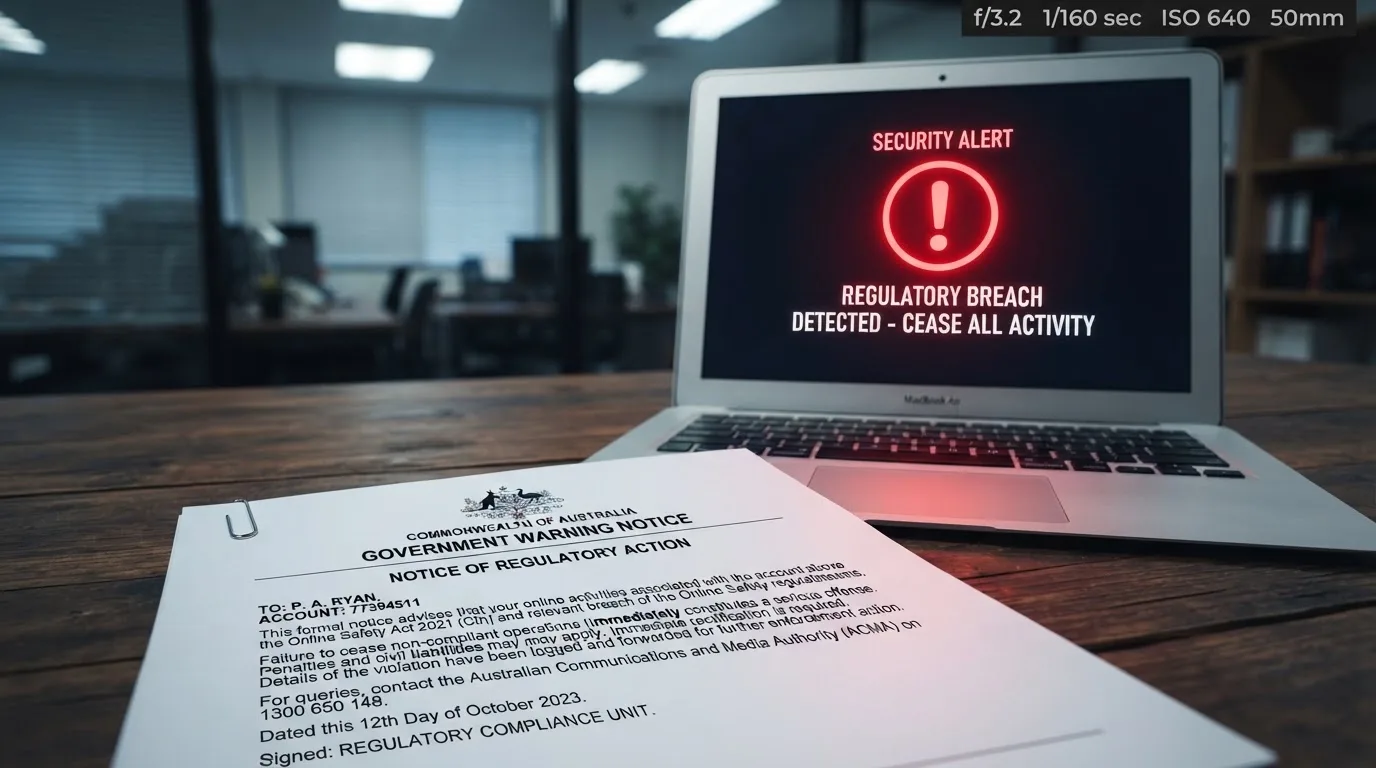
The set has grown denser rather than thinner. In March 2026 the ACMA warned Pulsup Ltd over Rocketplay — the second time the Rocketplay brand has been the subject of action, after Dama N.V. was warned in May 2022 over it along with five other brands. In the same operator group Dama N.V. was warned again in March 2025 over Woo Casino and in May 2025 over Spirit Casino. Consolutetish S.R.L. was warned in July 2025 over both National Casino and Bizzo Casino; Bizzo had already been the subject of a 2022 formal warning to TechSolutions (CY) Group Limited and TechSolutions Group N.V., which is the unusual case of one brand, two operators, and two warning rounds four years apart. Bamboo Media was warned in July 2025 over Ignition Casino. EOD Code SRL was warned in February 2025 over Instant Casino. Ryker B.V. was warned in April 2026 over Jackbit and CasinOK. Sterplay Holding Ltd was warned in April 2025 over Casino Intense. Hollycorn N.V. was warned over Sky Crown and Blue Leo in a warning the ACMA published in September 2022. The pattern is one warning per operator per round, repeating, with the same brand turning up under a new operator in a later round when the site changes hands.
What the warnings do not do is tell a reader whether Neosurf specifically is accepted at a site. The ACMA acts on whether an interactive gambling service is being provided to Australians at all, not on which payment methods the service lists. Some of the warned operators clearly accept Neosurf because Neosurf is the method that brought their name to the ACMA’s attention; for others, the warning register carries no information either way. Treating the formal warning as a signal about the operator’s standing rather than a comment on a particular payment method is the reading the register actually supports.
A quieter but more important consumer number sits in the background. H2 Gambling Capital’s 2025 report estimates that Australians lose about A$3.9 billion a year to illegal gambling sites, and that the share of gambling going through legal channels fell from 74% in 2021 to 64%. The figure describes the whole illegal market, not Neosurf specifically, and it is an estimate rather than a measured number — but it is the one that puts a cost on what choosing an offshore site means in aggregate for the country’s gambling spend.
The Northern Territory regulator, and what it does and does not cover
A reader who looks up “Australian online casino licence” will find Sportsbet, Bet365 and Ladbrokes, all of them licensed in the Northern Territory by the NTRWC. That regulator supervises online wagering services for tax reasons rather than consumer-protection ones, and the relevant April 2026 reporting on it is that the commission has no full-time staff and meets once a month in Darwin. The NTRWC is the only Australian-licensed route for the wagering services that sit inside the IGA’s permitted list — pre-event racing and sport, lotteries, keno. It is not, and cannot be, the route through which any site on this page holds a licence. When a casino-style site prints an “Australian” badge on its footer, the badge refers to nothing the NTRWC has done.
That matters for two practical things. First, BetStop, the National Self-Exclusion Register, has run since August 2023, but it binds only Australian-licensed online and phone wagering services. An offshore casino is not connected to it, which means registering with BetStop does not stop the offshore sites from accepting a deposit. Second, the National Gambling Helpline — 1800 858 858, free, 24/7, with chat at Gambling Help Online — remains the right number to call regardless of where the gambling happened; the support it offers does not depend on the site being licensed.
What a Neosurf deposit actually looks like at these sites
Neosurf is a prepaid voucher, not a bank product. The user asks for a Neosurf voucher at one of the platform’s partner points of sale, pays for it in cash or by other means the outlet accepts, and receives a 10-character code that can be entered at checkout on a participating merchant’s site. The platform is operated by SAFE VOUCHER CH AG, and the standard voucher denominations run from the equivalent of €10 to €150, with country-by-country variation in availability. A myNeosurf account can be opened online in minutes with no documents required at sign-up, although the platform reserves the right to require full KYC identity verification for any refund back to a bank account — a 5% fee applies to refunds and withdrawals sent back to a bank account. None of that is a casino’s rule; it is the platform’s rule that every casino the page describes inherits.
At a casino site, the deposit path looks much the same from one operator to the next. The user picks Neosurf on the cashier page, enters the 10-character voucher code, the casino confirms the balance with Neosurf, and the funds appear in the casino account — typically instantly, because no card network and no bank is in the loop. The smallest deposits these sites tend to ask for cluster around the lowest Neosurf denomination, which is €10; that is also the smallest useful transaction the platform itself issues. Most of the offshore casino sites that publish a minimum deposit for Neosurf set it in that neighbourhood.
A withdrawal through Neosurf does not exist in the way a deposit does. The product is built for paying in, not paying out. A casino that offers a Neosurf withdrawal either means a refund back to a myNeosurf wallet — which the platform supports only after its own KYC checks — or means the casino will route the refund by a separate bank or e-wallet transfer that has nothing to do with Neosurf itself. The 5% fee on refunds sent to a bank account is on top of any casino processing delay, and the platform’s identity-verification requirement is in addition to the casino’s. A reader who treats Neosurf as a fast two-way payment method is reading the product wrongly; it is a fast one-way deposit method, with a slower and costlier refund path attached.
The other cost on the deposit side is the one the bank imposes. Since 11 June 2024, Australian online wagering service providers have been banned by law from accepting credit cards, credit-linked digital wallets or digital currencies as payment, with penalties of up to $247,500 for non-compliance. The prohibition is aimed at licensed wagering services, not at offshore casino sites, which is precisely why those sites continue to advertise credit card and crypto options that an Australian-licensed bookmaker cannot lawfully take. A reader who deposits by Neosurf at one of these offshore sites is, in effect, choosing a payment method that the Australian rules would prohibit if the site were subject to them, and accepting the offshore site’s own terms in their place. The prepaid structure of Neosurf happens to sidestep the credit-card ban as a matter of mechanics, which is part of why it is the method so many of these sites still publish for the Australian market.
How the Australian banks blunt the deposit side from the other end
The law tells a licensed wagering site what it can take; the banks tell a customer what their own card can send. Three of the four major Australian banks — NAB, Commonwealth Bank and Westpac — let credit and debit cardholders self-activate a gambling transaction block through their banking app, and the block is usually applied immediately once requested. Westpac’s gambling block works at card level: it refuses authorisation of transactions registered under the merchant category code “Betting/Casino Gambling” on eligible personal credit and debit cards. ANZ’s block, also activated in the ANZ app, blocks gambling transactions made through a digital wallet such as Apple Pay on an eligible card, not just the physical card — and once it is turned on, removing it requires a 48-hour waiting period. ANZ’s own page warns that not all gambling transactions will be blocked and some non-gambling transactions might be blocked in error, which is the same caveat Westpac and the other banks carry in different wording.
That set of blocks is aimed at licensed Australian wagering, but the merchant category code on a transaction is set by the merchant, and offshore casino sites typically sit in a merchant category that some bank blocks catch and some do not. The cost of relying on the bank block is that it is a partial control, not a full one; a reader who has turned the block on can still be accepted by a site the block fails to identify. The cost of turning it off, on the ANZ product specifically, is the 48-hour cooling-off before the next attempt. For the offshore sites on this page, the bank block is the part of the consumer-protection stack that the IGA does not deliver, and it is also the part most likely to be uneven in practice.
The other blunt instrument is the merchant category code itself, which describes the merchant rather than the product. An offshore casino site that registers itself as an entertainment or software merchant rather than as betting or casino gambling can sit outside the bank block’s filter entirely, by the merchant’s own choice. The same gap is what makes the regulator’s blocking direction — applied at the ISP rather than at the bank — the more reliable mechanism: it stops the site being reached, which stops the deposit being attempted, regardless of how the merchant has categorised itself.
The credit-card ban and the way around it
The 11 June 2024 credit-card ban covers credit cards, credit-linked digital wallets and digital currencies, and the carve-outs in the law are the parts that explain why Neosurf keeps appearing on Australian-facing cashier pages. A prepaid voucher paid for in cash is not a credit product and not a digital currency; it is a stored-value instrument that the punter has already paid for. That puts Neosurf outside the prohibition as a matter of mechanics, which is the reason offshore casinos still advertise it for the Australian market long after their credit-card and crypto options would have attracted attention from Australian regulators.
The other payment methods a reader sees on those cashier pages have their own status under Australian rules, which is worth knowing because a comparison block on Neosurf does not exist in isolation. American Express was established in 1850 as a freight-forwarding company and later became a card issuer, launching its first charge card on 1 October 1958; unlike Visa or Mastercard’s four-party network, Amex traditionally issues cards and processes transactions itself as a three-party scheme, and the Reserve Bank of Australia’s July 2025 review of merchant card-payment costs proposes removing surcharges only on eftpos, Mastercard and Visa transactions, explicitly leaving American Express outside the scope of the proposed surcharge ban. Apple Pay and Google Pay are wallets on top of a card, not cards in themselves; Apple does not charge consumer fees for Apple Pay in stores, online or in apps, any surcharge coming from the merchant’s own card-processing fees rather than from Apple, and the limits and PIN requirements on an Apple Pay purchase are set by the card issuer or merchant rather than by Apple. By the end of 2025, Apple Pay, Google Pay and Samsung Pay transactions collectively accounted for around 45% of all card payments in Australia by number, which is why a wallet sitting on top of an Australian-licensed card that has its gambling block turned on will usually be blocked too. The mechanics of the credit-card ban and the mechanics of the bank block work on the same product from opposite ends.
PayID, Osko and the bank-transfer path that does not exist at these sites
The Australian instant-payment system is the New Payments Platform, owned by New Payments Platform Australia Ltd — a non-profit whose 13 shareholders include the Reserve Bank of Australia and the country’s major banks — and accessible to the public since 13 February 2018. With Osko, a bank transfer between participating Australian banks arrives in under a minute, 24/7 including weekends, whether it is addressed to a BSB and account number or to a PayID. More than 25 million PayID identifiers had been registered on the platform as of April 2025, and the platform’s monthly outages are capped at two minutes under its operating rules. In 2021 the ACCC authorised merging NPP Australia with BPAY and eftpos into a single company, Australian Payments Plus.
That stack exists for the Australian licensed market. PayID-based instant transfers are available at more than 100 Australian financial institutions, and paying to a PayID shows the name of the account holder before the transfer is sent; Australian Payments Plus warns that being asked to transfer money to a PayID on an illegal gambling site almost certainly means a scam site. The licensed wagering market sits on PayID, Osko and BPAY; the offshore sites that take Neosurf sit on a separate payment world. A reader who deposits by PayID at one of the offshore casinos on this page is depositing by a method the operator has bolted onto its cashier page for the Australian market, not by a method the operator’s own licence jurisdiction has any view on. AUSTRAC’s threshold-transaction-report rule, which requires reporting of transfers of A$10,000 or more, applies only to physical cash; ordinary electronic bank transfers are not subject to that per-transaction reporting requirement, regardless of the amount sent. BPAY itself is a bill-payment service in online banking: the payer enters the Biller Code and the Customer Reference Number printed on the bill, which is a different workflow again, and not one the offshore casinos adopt.
How fast the ACMA moves: the blocking rate since the first request
The first ACMA blocking request went out in November 2019. Between then and the June 2026 reporting round, the regulator’s published figures show 1,751 illegal gambling and affiliate marketing websites blocked in total. That figure includes affiliate marketing sites as well as the gambling sites themselves, and it is a cumulative count rather than a snapshot, so it grows by the round and shrinks only when a site that was previously listed stops being reachable. Used as a band, the implied rate is somewhere between 200 and 350 sites a year over the six and a half years the regime has been running, with the rate lifting in years when the regulator has run multiple rounds, and slowing in years when the affiliate end of the pipeline was already cleared. The figures carry no published breakdown of “casino sites” versus “wagering sites” versus “affiliate pages”, so the casino-specific count is unknown; what is known is that the total has been moving steadily upward, and that another 12 sites were added in the June 2026 round alone.
The rate matters less for the precise number than for what it tells a reader about the half-life of any single site’s URL on this page. A site that was reachable last week can be on a blocking list this week, and the ACMA’s blocking direction does not return the balance the punter had on the site at the point of blocking. The 1,751 figure is not a measure of how thorough the regulator is at closing the sites; it is a measure of how steadily new sites and new affiliate pages take their turn.
How this page reads the eleven brands below
Each brand below is on the ACMA’s formal warning register for offering prohibited interactive gambling services to Australians. Reading them in the order set out by the ACMA’s own published record, the pattern that falls out is that a single operator group can own several brands, that the same brand can resurface under a new operator when it is sold, and that the warning register does not always say what a reader is most interested in — which payment methods the operator supports at the cashier.
Where the research carries a verified signal on a payment method, the page reports it; where it carries only a listing-level signal from an external source, the page says so and names the source; where it carries no signal at all, the page leaves the operator on its other fields and does not claim either way. None of the eleven is described as a recommended place to play. Each is described as an entity the regulator has named, with the cost of dealing with it from Australia laid out in plain prose.
RocketPlay
The RocketPlay brand has been on the ACMA’s register twice, under two different operators, in two different years. In May 2022 the ACMA issued a formal warning to Dama N.V. covering six casino brands — Bambet, Dazard, Level Up, Rocketplay, Wild Tornado and Cobra Casinos. In March 2026 the ACMA issued a further formal warning to Pulsup Ltd over Rocketplay.com.au. The two actions together tell a reader that the brand has been around long enough to have changed hands, and that the regulator’s correspondence has tracked it under each successive holder. For an Australian punter looking at RocketPlay in 2026, the cost is the same as the cost on any other offshore site on this page: the brand is not licensed for online casino in Australia, no Australian consumer protection applies, and the ACMA has named the operator twice. Research carries no signal on whether RocketPlay’s cashier accepts Neosurf specifically, so the page leaves that field open and notes it only. The two formal warnings are the load-bearing fact about this brand.
Level Up Casino
Level Up Casino is on the ACMA’s register through Dama N.V.’s May 2022 formal warning, one of the six brands covered by that round. The brand has not been the subject of a further published warning to a different operator, which is the part that distinguishes it from RocketPlay in the same Dama N.V. group. Data from Westpac.com.au lists the brand in a third-party observation about the brand rather than a verified statement from the brand itself; on that basis the page records the mention as a listing without presenting it as the operator’s own claim. The level-up name is also the kind of phrase a reader sees used by several different offshore operators; the only Level Up Casino this page refers to is the Dama N.V. brand the ACMA has named. For an Australian punter the regulatory picture is the one common to every entry on this page: prohibited service, named operator, no Australian licence.
Woo Casino
Woo Casino came under the ACMA’s formal-warning microscope in March 2025, with Dama N.V. again the operator named in the warning. The 2025 warning is the second time Dama N.V. has had to answer to the regulator in the same operator group: the May 2022 round and the March 2025 round sit three years apart, with the brand list changing underneath. Research carries no signal on whether Woo Casino’s cashier accepts Neosurf specifically; the page notes no subject signal here. The verification a reader can do is the one the register supports: read the ACMA’s formal warning, see the date and the operator, and treat the absence of an Australian licence as the operating reality of the brand.
Spirit Casino
Spirit Casino is the third Dama N.V. brand the ACMA has formally warned over, this time in May 2025. The pattern across Dama N.V. — May 2022 (six brands), March 2025 (Woo Casino), May 2025 (Spirit Casino) — is the kind of recurrence that makes the regulator’s register the most useful single document on the operator group. Like the two Dama brands above, Spirit Casino has no verified Neosurf signal in research; the page makes no claim on this point and presents the brand on its other fields. The fact of the warning is the fact about the brand.
National Casino
The ACMA issued a formal warning to Consolutetish S.R.L. in July 2025. Data from austrac.gov.au and en.wikipedia.org lists the brand in a third-party context rather than as an operator statement. The page records these reports as third-party listings and does not present them as National Casino’s own claim. The regulatory position is the standard one: no Australian licence, prohibited service, named operator.
Bizzo Casino
Bizzo Casino has been on the ACMA’s register twice under two operators, with a gap of three years between the warnings. In 2022 the ACMA issued a formal warning to TechSolutions (CY) Group Limited and TechSolutions Group N.V. over Bizzo Casino; in July 2025 the ACMA issued a further formal warning to Consolutetish S.R.L. over National Casino and Bizzo Casino. Two operators, one brand, two formal warnings four years apart is an unusual case and the one that most clearly tells a reader the brand has changed hands at least once. Research carries no signal on whether Bizzo Casino’s cashier accepts Neosurf specifically; the page does not attach the subject to this operator. The repeated warning is the load-bearing fact about the brand.
Ignition Casino
Ignition Casino is on the ACMA’s register through Bamboo Media’s July 2025 formal warning. Ignition Casino’s brand presence in Australia is built around its offshore offering rather than any local partnership, and the regulator’s action has followed the brand’s offer rather than any partnership. Research carries no signal on the brand’s Neosurf acceptance, so the page makes no claim here. The warning, dated and named, is the part of the picture the register actually carries.
Instant Casino
Instant Casino is on the ACMA’s register through EOD Code SRL’s February 2025 formal warning. Research carries a listings-only signal on the brand’s payment methods, drawn from Ecopayz.com and Payid.com.au — third-party listings rather than the operator’s own statement, so the page records the listings as listings and does not represent them as the brand’s claim. The brand’s name carries “instant” in a way that reads like a marketing word about withdrawal speed, and the page does not echo that word; the speed of a withdrawal from any offshore site depends on the casino’s own manual checks, which is the part the marketing copy usually leaves out. The regulatory picture is the standard one: no Australian licence, prohibited service, named operator, dated warning.
Jackbit
Jackbit is on the ACMA’s register through Ryker B.V.’s April 2026 formal warning, which also named CasinOK in the same round. The two-brand single-warning pattern — one operator, two brands, one round — is the closest the register gets to an operator-level overview of which sites sit under the same corporate group at the time the warning was issued. Research carries no signal on whether Jackbit’s cashier accepts Neosurf specifically; the page makes no claim here. The April 2026 warning is the load-bearing fact about the brand at this point in the year.
Casino Intense
Casino Intense is on the ACMA’s register through Sterplay Holding Ltd’s April 2025 formal warning. Research carries a listings-only signal on the brand’s payment methods, drawn from austrac.gov.au, Itnews.com.au and Nab.com.au — three third-party listings rather than a statement from the operator, so the page records them as listings and does not represent them as the brand’s own claim. The brand name is the kind of marketing word that reads as a promise about gameplay; the page does not echo that word either. The regulatory picture is the standard one: no Australian licence, prohibited service, named operator, dated warning.
Sky Crown
Sky Crown is on the ACMA’s register through Hollycorn N.V.’s formal warning, which the ACMA published in September 2022 and which also covered Hollycorn’s Blue Leo casino. Hollycorn is the operator group with the longest-standing warning on this page, having been named in 2022 without a follow-up warning in the years since. Research carries no signal on whether Sky Crown’s cashier accepts Neosurf specifically; the page makes no claim here. The 2022 warning is the load-bearing fact about the brand; the absence of a follow-up is a fact about the regulator’s record rather than about the operator’s conduct.
Reading the table across all eleven brands
The table that sits below this page is the same eleven brands the operator-by-operator review above has covered, in the same order, with the ACMA’s own action and date and the operator the ACMA named as the columns the register actually supports. The “subject support” column records whether research carries a verified signal on the brand’s Neosurf acceptance, a listings-only signal from a third-party source, or no signal at all. Where the cell carries an em dash, it is because research does not support a claim on that point and the page does not invent one. The table is not a ranking and not a recommendation; it is a record of what the regulator and the publicly available research together say about each brand, in the order the register reads.
| Brand | ACMA action and date | Operator named by the ACMA | Subject support |
|---|---|---|---|
| RocketPlay | March 2026; earlier May 2022 | Pulsup Ltd; earlier Dama N.V. | — |
| Level Up Casino | May 2022 | Dama N.V. | listings-only (Westpac) |
| Woo Casino | March 2025 | Dama N.V. | — |
| Spirit Casino | May 2025 | Dama N.V. | — |
| National Casino | July 2025 | Consolutetish S.R.L. | listings-only (AUSTRAC, Wikipedia) |
| Bizzo Casino | July 2025; earlier 2022 | Consolutetish S.R.L.; earlier TechSolutions | — |
| Ignition Casino | July 2025 | Bamboo Media | — |
| Instant Casino | February 2025 | EOD Code SRL | listings-only (ecoPayz, PayID) |
| Jackbit | April 2026 | Ryker B.V. | — |
| Casino Intense | April 2025 | Sterplay Holding Ltd | listings-only (AUSTRAC, iTnews, NAB) |
| Sky Crown | September 2022 | Hollycorn N.V. | — |
The pattern that falls out of the table is a register, not a comparison. Five of the eleven brands have no Neosurf signal in research at all; the page presents those five on their other fields and does not claim the cashier does or does not accept the voucher. Three of the eleven have a listings-only signal from a third-party source that is not the operator, and the page records those listings as listings rather than as the brand’s own statement. Three of the eleven — the two Dama N.V. brands other than RocketPlay, and Spirit Casino — carry no subject signal either. No brand in the set carries a verified “yes, Neosurf is accepted at the cashier” signal from the operator itself; the page does not invent one.
The pattern the ACMA’s dates tell is independent. The earliest warning in the set is the September 2022 Hollycorn warning over Sky Crown and Blue Leo. The latest is the March 2026 warning to Pulsup Ltd over Rocketplay.com.au, with Ryker B.V.’s April 2026 warning over Jackbit and CasinOK close behind. The intervening years are dense rather than sparse: 2022, 2025 (March, April, May, July), 2026 (March, April). The set is not a list of historical curiosities; it is the most recent record the regulator has published.
The cost the punter pays when none of the eleven is on the other side of the line
Every one of the eleven brands is offering a prohibited interactive gambling service to Australians. That is what the formal warning says, and the cost it imposes is not a single line on a bank statement. It is the absence of the four protections an Australian punter at a land-based casino, a licensed club or a TAB takes for granted: local consumer law, a local complaints body, recourse if a withdrawal is refused, and a connection to BetStop if the punter has self-excluded. Each of those four protections has a name and a number behind it; each of them stops at the border the IGA draws.
The punter’s bank may still catch some transactions at the merchant-category-code level. The ACMA may still block some sites at the ISP level. The platform behind Neosurf still applies its own 5% refund fee and its own KYC checks on money sent the other way. None of those three is a substitute for the four protections the IGA removes. A reader who treats the offshore site’s terms page as the binding contract is correct as a matter of contract law and incorrect as a matter of consumer protection; the contract is binding, and the consumer protection is missing.
The aggregate figure, kept in the area outside this page’s eleven, is the A$3.9 billion a year H2 Gambling Capital’s 2025 report estimates Australians lose to illegal gambling sites. That is the cost across the whole illegal market, not the cost of using Neosurf at any one of these sites; it is the number a reader weighs when deciding whether to deposit at any of them at all.
Frequently asked questions about Neosurf casinos in Australia
Is it legal for an online casino to accept Neosurf from a player in Australia?
No. The Interactive Gambling Act 2001 makes it an offence for an operator to supply online casino games or online pokies to a person in Australia, with no state or territory licence available; the offence sits with the provider, not the player, and an Australian punter using one of these sites is not personally prosecuted. The cost is the absence of Australian consumer protection, the absence of a local complaints body and the risk of the site being blocked while a balance is still on the account.
What is the smallest deposit a Neosurf casino site usually asks for?
The lowest Neosurf voucher denomination the platform issues is the equivalent of €10, and the offshore casinos that publish a minimum deposit for the method typically set their floor around that figure; the cashier page is the part that carries the operator’s own minimum, and the page does not aggregate that figure across the eleven brands because each operator sets its own floor independently of the voucher denomination.
Does a Neosurf withdrawal clear any faster than a card withdrawal at these sites?
Neosurf is built for paying in rather than paying out. A casino that offers a Neosurf withdrawal either routes it to a myNeosurf wallet (subject to the platform’s KYC checks) or falls back to a separate bank or e-wallet transfer, and the platform itself applies a 5% fee on refunds sent to a bank account; a card or e-wallet withdrawal that bypasses the platform avoids that fee, although the casino’s own manual checks still apply.
Can Neosurf be used at every offshore pokies-style site, or only some of them?
Research carries a verified signal on Neosurf acceptance for none of the eleven brands on this page; three of them carry listings-only signals from third-party sources such as Westpac’s gambling-block page and the PayID and AUSTRAC pages, and the remaining eight carry no signal at all. The Neosurf brand publishes a list of partner merchants on its own site, but the page does not reproduce that list because the operator-by-operator verification is what research actually carries.
Does depositing with Neosurf add an extra fee at these casino sites?
Neosurf itself does not charge a consumer fee at the point of purchase of the voucher in most partner outlets, and a myNeosurf account can be opened for free in minutes with no documents required initially; the platform-side fees that do apply are the 5% fee on refunds sent back to a bank account and the KYC identity-verification cost of completing any refund, neither of which sits on the deposit side. The operator-side fees on the deposit are the operator’s own, and the research does not carry a verified fee schedule for any of the eleven brands.
What should a player do if a Neosurf deposit does not appear in a casino account?
The first check is the voucher’s confirmation page on Neosurf’s own site, which shows whether the code has been redeemed; the second is the casino’s transaction history, which will record the attempt even if the balance has not updated; the third is the casino’s own support channel, with the voucher code, the timestamp and the attempted deposit amount to hand. The platform requires KYC identity verification before any refund is processed, which is the part of the recovery that takes longest when the deposit has been charged but not credited, and the page notes that the platform’s terms — not the casino’s — are what govern that path.