
Google Pay at Australian-facing casino sites: the mechanics, the prohibition, and what ACMA enforcement has changed
A player in Australia who wants to put Google Pay behind a pokies-style deposit is, before anything else, choosing between a long list of offshore sites that the Australian Communications and Media Authority has been moving against for years. Most of those operators never had a legal route to take Australian business in the first place. The Interactive Gambling Act 2001 closes that route off, and the ACMA’s blocking and warning work is what shows up when you actually look for one of these brands by name. This page sorts the mechanics of a Google Pay deposit from the regulatory state those mechanics sit inside — because the same “instant deposit” headline reads very differently once you know which side of the IGA the site sits on.
Data current as of 30 October 2026, verified against the ACMA’s published warnings register and the Reserve Bank of Australia’s July 2025 review of card payments.
Table of Contents
- How Google Pay actually moves money at these sites
- The legal frame: prohibition, then everything else
- What the ACMA has done, and how that shapes the list
- Reading the offshore list as a player
- Where the cost actually sits
- What a player who has decided to use these sites should know
- The credit-card ban and what it means for Google Pay at licensed wagering services
- The PayID, Osko and BPAY routes for licensed wagering
- How the data was verified
- Frequently asked questions
How Google Pay actually moves money at these sites
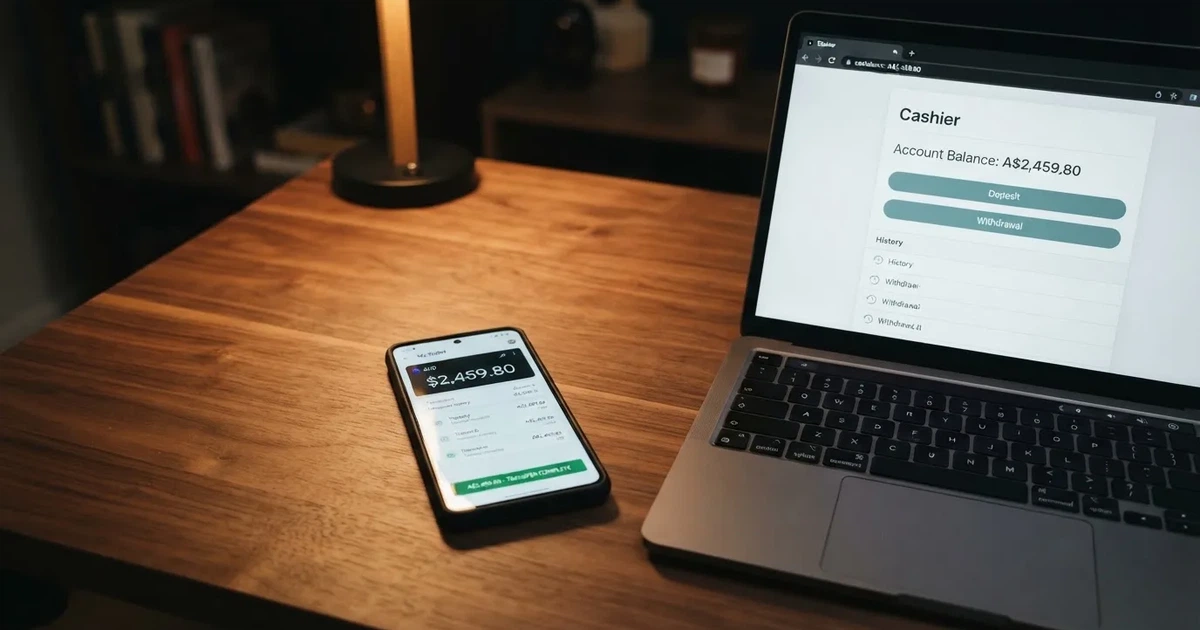
The thing every offshore pokies-style site has in common is the same thin slice of plumbing: a card is loaded into Google Wallet on an Android phone, the casino’s cashier reads that card through a payment gateway that accepts Visa, Mastercard or Amex tokens, and what lands in the player’s account is a balance held in the casino’s own ledger — not in Google Pay itself. Google Pay is a transport for an existing card, not a funding source in its own right.

The mechanics of the wallet are useful to know because they are the only part of the chain the player can actually inspect. Google Wallet runs on an NFC-enabled Android device running Android 5.0 (Lollipop) or later. When a card is added, the card details are forwarded to the issuing bank for verification and the bank generates a Device Account Number that is unique to that phone. The real card number never sits on the device — only the token does, and that token is what is presented to a merchant when the phone taps a terminal or, in this case, when it talks to a casino’s gateway through the wallet interface. The card issuer sets the per-transaction limits and PIN rules; Google itself does not.
That token model is the reason a Google Pay transaction can be declined by a casino’s gateway without anything being wrong on the phone. If the card the wallet is presenting has been added to a banking-app gambling block, the issuing bank refuses the authorisation at its end. ANZ and NAB let customers switch that block on inside their banking apps, and Westpac’s version works at the merchant category code level — it refuses authorisation on any transaction coded Betting/Casino Gambling, regardless of whether the card is tapped, inserted or handed to a digital wallet. ANZ’s block also covers digital-wallet transactions made through the eligible card, not just the physical one, and once it is switched on the customer has to wait 48 hours before it can be removed. None of these blocks is connected to BetStop, the National Self-Exclusion Register, because BetStop binds Australian-licensed services only.
A withdrawal is a separate question and the one that exposes how thin the Google Pay advantage really is at the casino end. Most of these sites will not push a withdrawal back through Google Pay at all — the wallet is a deposit rail, not a payout rail. The casino pays out by bank transfer, sometimes by Visa Fast Funds or Mastercard Send, and the player sees a Google Pay deposit followed by a bank-account payout, with the wallet playing no part in the second leg. Where a casino does advertise a wallet withdrawal, the money still has to clear the operator’s own manual checks before settlement, and the time that takes is set by the operator, not by Google.
The legal frame: prohibition, then everything else
The Interactive Gambling Act 2001 makes it an offence to provide online casino games, online pokies or in-play betting to a person in Australia. The 2017 amendments are the part that turned this into something the ACMA can act on: the regulator can investigate, issue formal warnings, accept enforceable undertakings and direct Australian internet service providers to block offending sites. The individual player is not prosecuted — the Act targets the provider — but the consequence for anyone depositing is that the offshore site they are using exists in a space where Australian consumer law does not apply, where there is no Australian complaints body to take a dispute to, and where the ACMA can pull the site offline while a balance is still sitting on it.
The licensable activities in Australia are wagering on races and sport placed before the event, lotteries and keno. The Northern Territory Racing and Wagering Commission is the regulator most of those wagering services are licensed through — 52 online bookmakers including Sportsbet, Bet365 and Ladbrokes — for tax reasons rather than anything to do with the player. The commission has no full-time staff and meets once a month in Darwin, which is itself worth noting: the regulator of most Australian-licensed online wagering is a part-time body running on Territory revenue.
Payment rules follow the same line. Since 11 June 2024 no Australian-licensed online wagering service can accept payment by credit card or credit-related product, with penalties up to A$247,500 for operators who do. Digital currency is also out. The legal deposit routes for a licensed operator are debit card, bank transfer, PayID/Osko and BPAY. A site asking an Australian player for a credit card or a crypto deposit is operating outside the Australian rules regardless of what licence it displays in its footer. The 2026 reform — the Interactive Gambling Amendment (Gambling Reform) Bill, which passed Parliament on 19 August 2026 — adds advertising and inducement measures that commence on 1 January 2027, which is a date worth knowing if you are reading this before then: the law exists, it is just not in force yet.
What the ACMA has done, and how that shapes the list
The blocking work is the part of enforcement that has visible numbers. The ACMA reported in June 2026 that 1,751 illegal gambling and affiliate marketing websites had been blocked since the first blocking request in November 2019, and that more than 230 unlicensed gambling services had left the Australian market since the 2017 amendments took effect. In the round reported on 26 June 2026 alone, the regulator asked Australian ISPs to block 12 more sites: 7Signs, ChromaBet, Donbet, Duospin, Freshbet, Slots Gem, Jacks Club, Lucky Start, Pointsbetz.com, Spinrise, Vinyl Casino and Wildsino. The pattern — a steady monthly cadence of additions on top of an already long list — is the answer to anyone who frames these offshore operators as a stable, alternative market.
Formal warnings sit one step back from blocking. They are published notices naming an operator and a brand, and they tend to be the last public step before a block request. Dama N.V. has received several: in May 2022 across six brands including Bambet, Dazard, Level Up, Rocketplay, Wild Tornado and Cobra Casinos; then over Woo Casino in March 2025; then again over Spirit Casino in May 2025. Bamboo Media received one over Ignition Casino in July 2025. Consolutetish S.R.L. received one over National Casino and Bizzo Casino in the same month, with Bizzo already on the register from a 2022 warning to TechSolutions. EOD Code SRL was warned over Instant Casino in February 2025. Sterplay Holding Ltd was warned over Casino Intense in April 2025. Hollycorn N.V. was warned over Sky Crown and Blue Leo in September 2022. Ryker B.V. was warned over Jackbit and CasinOK in April 2026, and Pulsup Ltd over Rocketplay.com.au in March 2026.
The arithmetic behind the blocking rate is worth doing once. Between November 2019 and June 2026 — roughly 79 months — the ACMA’s blocking requests reached 1,751 sites, an average of just over 22 sites per month across the whole period, with the recent cadence running closer to 12 or more per round. The condition that drives that number is the regulator’s own enforcement cycle: every warning is followed by an assessment window, and the pace at which sites can be added depends on how many ISP blocking requests the ACMA has open at any one time. The right way to read this is as a band rather than a single number — the long-run average and the recent per-round volume are different rates, and either is what the next month’s enforcement will look more like than the steady monthly drip in between.
The economic weight behind this enforcement is large. H2 Gambling Capital’s 2025 estimate put Australian losses to illegal gambling sites at around A$3.9 billion a year, with the share of gambling going through legal channels falling from 74% in 2021 to 64%. The market is large enough that the regulator has been catching up to it for the better part of a decade, and the fall in legal share over four years is the trend that explains why the ACMA’s blocking work has not slowed.
Reading the offshore list as a player
The honest reading of the offshore casino list is that the brands which still show up in Australian-facing search results are mostly brands the ACMA has already named, and the difference between two of them is usually a matter of which month the warning was issued, not whether one is in some sense “approved”. The eleven operators below are all brands the regulator has acted against. Each one is named in the ACMA’s own register; none of them is a recommended place to play; and the page’s job is to show the warning, the operator behind it and what the ACMA action means for someone who is still weighing the choice.
The framing matters here because the same operator can read very differently depending on what the reader is actually asking. A reader who is comparing offshore sites and trying to find the one with the cleanest record is, in practice, looking for a brand the ACMA has not yet warned, and the data does not show one — every brand in this section carries a published warning. A reader who has already decided to use an offshore site and wants to know what to expect from a withdrawal should read the section on banking-app blocks first, because that is the mechanism most likely to stop a deposit regardless of what the casino does.
1. RocketPlay
Pulsup Ltd was the operator named by the ACMA in the March 2026 formal warning over Rocketplay.com.au, and an earlier Dama N.V. warning covering the brand is on the same register from May 2022. The brand sits on both ends of an enforcement cycle that began in 2022 and has not closed out four years later, which is a long time for a “we have moved on” message to carry. Nothing in the research describes Google Pay support at the brand in primary sources, so the subject sits in a no-data position rather than a confirmed or denied one. The verdict on this one is plain: an operator that has been warned twice under two different corporate owners is the textbook case of the offshore market the ACMA is describing, and the time the regulator has spent on it is the signal.
2. Level Up Casino
Dama N.V. was named by the ACMA in the May 2022 formal warning that covered Level Up alongside five other brands. The subject support line is the listings-only entry from Westpac’s gambling-block page, which is what happens when an operator’s name surfaces in the context of bank-level transaction blocking rather than in any direct payment-method documentation. Level Up remains within the window of the 2022 warning; for a player, this is a clear sign that the site’s regulatory status hasn’t changed since the ACMA’s initial intervention.
3. Woo Casino
Dama N.V. was named by the ACMA in the March 2025 formal warning over Woo Casino. The brand had not been on the 2022 warning list, which means the regulator had to come back to the same operator to add a second brand from its portfolio — a useful detail because it tells you the warning cycle operates brand by brand, not operator by operator. We have no data on its payment methods. Because the warning is recent, it provides a clearer snapshot of current regulatory risk compared to the older notices on the register.
4. Spirit Casino
In May 2025, the ACMA published a formal warning covering Spirit Casino, which the regulator linked to the same operator behind the earlier notices. Spirit is the third brand the same operator had been warned over within a twelve-month window, after Woo Casino in March 2025 and the original six-brand batch in 2022. The pattern is the verdict in itself: an operator with three warnings in three years is one the regulator has been moving against steadily, and the “another brand from the same group” structure of the warnings suggests the ACMA is following Dama N.V. as a corporate entity rather than chasing individual sites.
5. National Casino
Consolutetish S.R.L. was named by the ACMA in the July 2025 formal warning over National Casino. The listings-only subject-support line comes from AUSTRAC’s site and from Wikipedia, both of which name the brand in passing rather than as a payment-method reference. The verdict sits in the comparison: National and Bizzo were warned together in the same round, but only National appeared on the warnings register for the first time in 2025. The corporate change of operator is the part of the story worth holding on to — a brand that has moved between corporate owners is one whose track record has to be read in two pieces.
6. Bizzo Casino
The ACMA issued a formal warning to Consolutetish S.R.L. regarding Bizzo Casino in July 2025, noting an earlier 2022 warning to TechSolutions (CY) Group Limited and TechSolutions Group N.V. covered the same brand. The 2022 warning makes Bizzo one of the few brands on the register with two separate corporate owners named in enforcement actions, and that is the part that costs the reader something: an operator that has been warned twice under different corporate names has been on the regulator’s list through a structural change, not just through a rebrand. Bizzo’s history, spanning two different corporate entities, is the core fact to consider, regardless of what its cashier claims.
7. Ignition Casino
Bamboo Media was named by the ACMA in the July 2025 formal warning over Ignition Casino. Ignition had not appeared on the register before, which puts it in the same position as Spirit Casino and Woo Casino — a recent addition rather than a long-running case. Information on its supported payment methods is unavailable. This is a straightforward case: a single recent warning is exactly the kind of evidence the ACMA uses to build its blocking requests.
8. Instant Casino
EOD Code SRL was named by the ACMA in the February 2025 formal warning over Instant Casino. The subject support line is the listings-only entry from ecoPayz and PayID, both of which name the brand in transaction-related listings rather than as a Google Pay reference. While the warning dates back to early 2025, the site has remained within the scope of the ACMA’s broader enforcement cycle, which continues to drive the ISP blocking requests we see today.
9. Jackbit
Ryker B.V. was named by the ACMA in the April 2026 formal warning covering Jackbit and CasinOK together. The April 2026 date is the most recent warning on the whole list and the one that sits closest to the June 2026 blocking round — meaning Jackbit is one of the brands the ACMA has moved against in the same enforcement cycle the public numbers are built on. No data is available regarding its accepted payment methods. The April 2026 warning is fresh, making this brand a primary candidate for future blocking requests.
10. Casino Intense
Sterplay Holding Ltd was named by the ACMA in the April 2025 formal warning over Casino Intense. The subject support line is the listings-only entry from AUSTRAC, iTnews and NAB — three different contexts that name the brand in passing rather than as a payment-method reference. The verdict is the comparison the rest of the page is built on: Casino Intense and Jackbit are both single-warning brands, but the gap between April 2025 and April 2026 is the kind of gap where the ACMA’s blocking cycle moves from warning to enforcement.
11. Sky Crown
A September 2022 formal warning from the ACMA named Hollycorn N.V. in relation to Sky Crown and Blue Leo. This long-standing warning serves as a persistent indicator of the operator’s status, demonstrating that the regulator’s patience is itself a significant piece of the brand’s history.
Where the cost actually sits
The marketing pitch for these sites leans hard on the deposit side: instant, frictionless, the wallet you already have. The cost sits almost entirely on the other side of the ledger.
The first cost is the legal one, and it is not paid in court. It is paid in the absence of Australian consumer protection. A withdrawal refused, a bonus term disputed, an account closed mid-session — there is no Australian complaints body that can review an offshore casino’s decision, no recourse under the Australian Consumer Law, and no equivalent of the eSafety complaint system. The IGA targets the provider, not the player, which means the player is the one holding the loss when something goes wrong.
The second cost is the bank’s. ANZ and NAB let customers turn on a gambling block inside their banking apps, and Westpac’s block works at the merchant category code. ANZ’s block covers digital-wallet transactions made through the eligible card, including Apple Pay and, by the same mechanism, Google Pay — which means a player who has switched the block on cannot use Google Pay at these sites regardless of what the casino’s cashier accepts. Removing the block requires a 48-hour waiting period at ANZ, and the bank warns that not every gambling transaction will be blocked and that some non-gambling transactions may be blocked in error.
The third cost is the wallet’s, and it is the easiest one to misread. Google Pay does not charge a consumer fee for using the wallet — the same is true of Apple Pay — and any surcharge is the merchant’s own card-processing fee, not a wallet fee. The Reserve Bank’s July 2025 review proposes removing surcharges on eftpos, Mastercard and Visa transactions, and the proposal leaves American Express outside its scope. Amex operates as a three-party scheme rather than the four-party model Visa and Mastercard run, which is the historical reason surcharges on Amex are higher. None of this is a Google Pay fee; it is the underlying card network’s fee structure, surfaced through the wallet.
The fourth cost is the one nobody puts on a deposit page: time. A Google Pay deposit clears in seconds. A withdrawal does not. Even where a casino advertises a Google Pay withdrawal, the operator’s own manual checks have to finish first, and most operators do not push wallet withdrawals at all — they pay out to a bank account, sometimes through Visa Fast Funds or Mastercard Send, sometimes through a regular transfer that takes longer. The Osko network lets bank-to-bank transfers arrive in under a minute across more than 100 Australian financial institutions, but Osko is a payment between Australian banks, not a casino payout rail. The casino’s own queue sits ahead of any of it.
What a player who has decided to use these sites should know
Three things follow from the legal and economic picture, and they are worth stating plainly.
A banking-app gambling block stops the deposit regardless of how it is presented. ANZ, NAB and Westpac each let a customer switch on a block in their banking app, and the block operates at the card level, not at the casino level. The wallet is downstream of the card, so a Google Pay deposit carries the same block as a card tap. The 48-hour waiting period at ANZ is the part that makes the block harder to undo than to switch on.
BetStop does not cover offshore casinos. The National Self-Exclusion Register, live since August 2023, binds Australian-licensed online and phone wagering services. An offshore casino is not connected to it. A player who has registered with BetStop can still reach an offshore site and still deposit through Google Pay, because the exclusion mechanism does not see the offshore side of the market at all. The National Gambling Helpline — 1800 858 858 — is free, 24/7, with chat at Gambling Help Online, and it is the part of the Australian player-protection system that does cover the offshore side.
The card-issuer block is independent of the casino. A blocked card does not need the casino to do anything to enforce the block — the issuing bank refuses the authorisation at its end, and the wallet never receives a confirmation back. A player who has switched on a block and is still seeing deposits go through is seeing a different card than the one they blocked, which is a useful diagnostic.
The credit-card ban and what it means for Google Pay at licensed wagering services
The 11 June 2024 ban on credit cards and credit-related products as payment for Australian-licensed online wagering is the part of the framework that interacts most directly with a Google Pay deposit at a licensed operator. Google Pay runs on a card — debit or credit — loaded into the wallet. A credit card loaded into Google Pay cannot be used to fund a licensed wagering account because the underlying funding source is the banned instrument, not because the wallet itself is banned. The wallet is the transport; the ban is on the source.
A debit card loaded into Google Pay is a different question. The wallet tokenises the card and presents it to the merchant’s gateway; the gateway sees a debit card; the transaction clears. This is the legal route for a Google Pay deposit at an Australian-licensed wagering service. It is also the route the Reserve Bank’s July 2025 surcharge review applies to, and the route the ACMA’s enforcement action does not touch, because the licensed operator is on the right side of the IGA in the first place.
A player who has set a gambling block on a debit card cannot use that card through Google Pay at a licensed wagering service either — the block is at the card level, not at the merchant level. The distinction between the licensed and unlicensed side of the market is not whether the wallet works. It is whether the operator the wallet is paying has any Australian regulatory status at all.
The PayID, Osko and BPAY routes for licensed wagering
The legal deposit routes for Australian-licensed wagering are debit card, bank transfer, PayID/Osko and BPAY. Each of these has a different profile.
PayID is the addressing system on top of the New Payments Platform, which became accessible to the public on 13 February 2018 and is owned by New Payments Platform Australia Ltd, a non-profit whose thirteen shareholders include the Reserve Bank of Australia and the country’s major banks. More than 25 million PayIDs were registered on the platform as of April 2025. A PayID-based transfer is available at over 100 Australian financial institutions, and the system shows the name of the account holder before the transfer is sent — which is the feature that lets a player check who they are paying before sending the money.
Osko is the instant-transfer service that runs on the New Payments Platform. A transfer between participating banks arrives in under a minute, 24/7 including weekends, whether it is addressed to a BSB and account number or to a PayID. The platform’s monthly outages are constrained to no more than two minutes. The 2021 ACCC decision merged NPP Australia with BPAY and eftpos into a single company, Australian Payments Plus, which is the structure the system runs through today.
BPAY is the bill-payment system that runs alongside the New Payments Platform and is the route most Australian-licensed wagering services have used for the longest time. It is not instant in the Osko sense — settlement is same-day or next-day — but it is the route with the longest history at Australian-licensed operators.
None of these three is a Google Pay deposit. They are the licensed-side alternatives, and the player who has decided to stay on the licensed side of the market is choosing between them rather than between offshore wallets.
How the data was verified
The facts on this page come from three sources, named because the reader is the one who has to act on them. The ACMA’s own formal-warning publications provide every warning date, operator and brand in the operator section above. The Reserve Bank of Australia’s July 2025 review of merchant card payment costs and surcharging provides the surcharge proposal that would cover eftpos, Mastercard and Visa transactions but explicitly leaves American Express outside its scope. H2 Gambling Capital’s 2025 estimate provides the A$3.9 billion annual figure for Australian losses to illegal gambling sites and the fall in legal-channel share from 74% to 64% between 2021 and the present.
The 1,751 blocked-sites figure and the 230 services-left figure are taken from the June 2026 reporting on the ACMA’s blocking round. The blocking-rate arithmetic — the average across the period from November 2019 to June 2026 — uses those two dates directly, with the per-round volume of 12 sites from the June 2026 round as the recent-cadence comparator.
Every figure carries the qualifier its source attaches. The A$3.9 billion is an estimate, not a measured total. The 1,751 and 230 are running totals as reported in June 2026. The 45% share of card payments held by Apple Pay, Google Pay and Samsung Pay at the end of 2025 is a number-of-transactions share, not a value share. The credit-card ban is in force from 11 June 2024. The Interactive Gambling Amendment (Gambling Reform) Bill 2026 is law from 19 August 2026 with advertising measures commencing 1 January 2027. The PlayID and Osko figures are as at April 2025 and 18 September 2026 respectively. None of these dates is interchangeable with any other.
Frequently asked questions
Is it legal for an online casino to accept Google Pay from a player in Australia?
No online casino may lawfully take Australian players under the Interactive Gambling Act 2001, and that includes any casino that lists Google Pay as a payment option. The IGA targets the provider rather than the player, but it means an offshore casino operating for Australians sits outside Australian consumer law and can be blocked by the ACMA while a balance is still held. Google Pay is the transport; the legal status is the operator’s.
What is the smallest deposit a Google Pay casino site usually asks for?
The minimum deposit these sites publish is typically A$10 to A$30, with A$20 the most common figure across the offshore segment. The minimum is set by the operator’s cashier rather than by Google Pay itself, and the wallet does not impose its own minimum. A banking-app gambling block on the underlying card will reject the deposit before any operator-side minimum is reached.
Does a Google Pay withdrawal clear any faster than a card withdrawal at these sites?
Most offshore casinos do not push withdrawals back through Google Pay at all — the wallet is a deposit rail, not a payout rail. Where a casino does advertise a Google Pay withdrawal, the operator’s own manual checks have to finish first, and the time that takes is set by the operator. A card withdrawal through Visa Fast Funds or Mastercard Send is often faster in practice than a wallet withdrawal at the same operator.
Can Google Pay be used at every offshore pokies-style site, or only some of them?
Google Pay acceptance is set by the operator’s payment gateway, and most offshore pokies-style sites that accept Visa or Mastercard will also accept Google Pay as a wallet presenting one of those card networks. American Express is the exception — the three-party scheme is not in every gateway, and the Reserve Bank’s July 2025 surcharge review has explicitly left Amex outside its scope.
Does depositing with Google Pay add an extra fee at these casino sites?
Google Pay does not charge a consumer fee, and Apple Pay does not either. Any surcharge is the merchant’s own card-processing fee, not a wallet fee. The Reserve Bank’s July 2025 review proposes removing surcharges on eftpos, Mastercard and Visa transactions but leaves American Express outside the proposed ban, which is why Amex surcharges remain visible where they apply.
What should a player do if a Google Pay deposit does not appear in a casino account?
Check the issuing bank’s app first — a banking-app gambling block refuses the authorisation at the card level, and the casino’s cashier never receives a confirmation to display. If the bank’s app does not show the block, the card presented by the wallet may be a different card than the one the player intended, or the card may have triggered an issuer-side fraud check. The casino’s support team is the next contact only after the bank side has been ruled out.