
Live baccarat online casino in Australia: the ACMA record and the real cost of the table
Data current as of 9 November 2026, checked against the Australian Communications and Media Authority (ACMA) formal warnings register and its published blocking-round notices.
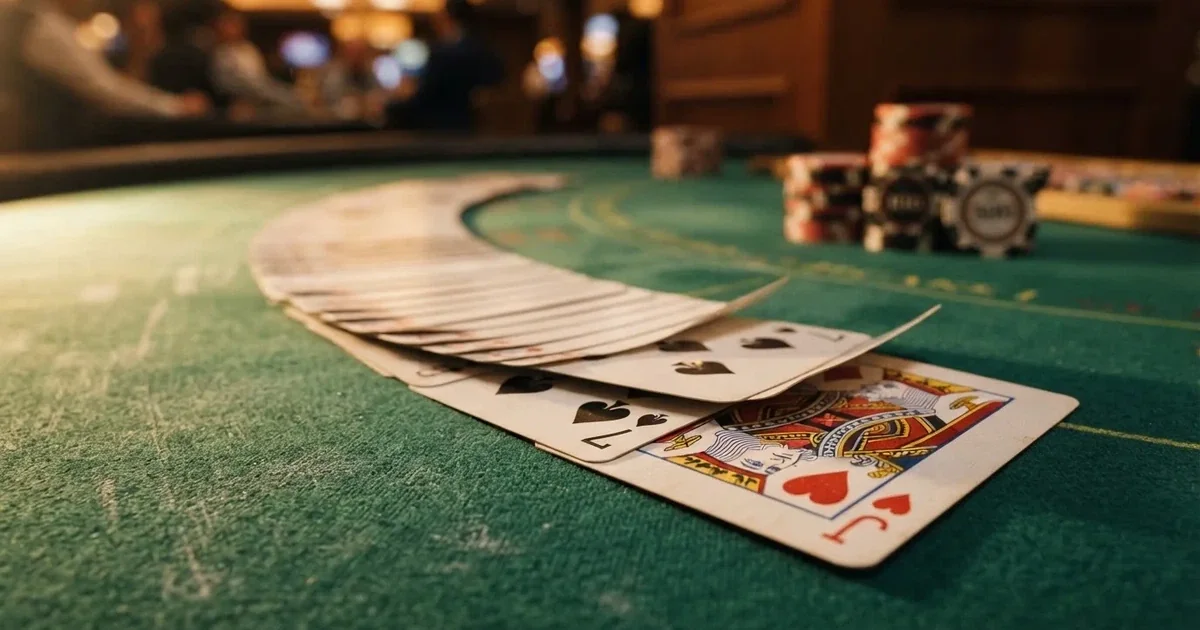
A live-dealer baccarat table is what most people mean when they type the words at the top of this page into a search engine. A real dealer flips real cards over a video stream, the bets sit on a felt layout, and a chat box runs alongside the picture. The frame around that experience in Australia is what this page actually deals with. The game is one thing; the regulatory ground underneath it is another. They run in opposite directions, and the reader who conflates them ends up paying for the difference.
This page works through what a live baccarat table is, what it costs in house edge, how the ACMA has gone after the offshore brands that stream one to Australian residents, and what the player actually receives from a brand named in a formal warning. The angle is consequence: each shelf closes by saying what the reader is left holding once the picture comes into focus.
Table of Contents
- What a live baccarat table is, and what it isn’t
- The paytable, in numbers the maths cares about
- What the ACMA has actually done about it
- The licensed alternative: what an Australian resident can actually do
- The ACMA record, by brand
- How an Australian resident actually pays at these brands
- The house always wins, and how fast
- Responsible play, regardless of where the table sits
- The tax picture for the recreational player
- What the ACMA record tells the reader
- What the maths says versus what the marketing says
- Where the responsible-gambling frame fits
- What a reader comparing options should hold onto
- Operator summary
- Operator summary (2)
- Frequently asked questions
What a live baccarat table is, and what it isn’t
A live baccarat table is a streamed feed of an actual dealer running an actual shoe of cards at an actual studio. Players place chips on one of three outcomes — Banker wins, Player wins, or the hand ties — and the dealer handles the dealing and the settlement. The paytable is identical to a computer-generated version of the same game. The only thing that changes is the source of randomness: a person and a shoe instead of a random number generator.
That distinction matters because the house edge does not change with it. The Banker bet keeps a house edge of 1.06%, the Player bet 1.24%, and the Tie bet 14.36%. Those numbers apply whether the cards come out of a stream from a Manila studio or a random number generator in the same casino’s lobby. Anyone who thinks a human dealer “shuffles differently” is paying for a feeling, not a different game.
The terminology around the game travels further than the game itself. Punto banco, the variant most often streamed live, was developed in Havana in the 1940s, and it is dealt from a shoe of six or eight decks. Cards two through nine count at face value, tens and face cards count as zero, and aces count as one; totals are taken modulo ten, so a hand of seven and eight reads as five. Chemin de fer, the older French variant, lets players take turns banking the shoe and was named “railway” because it sat down faster than the original game; live-dealer lobbies rarely offer it. The version streamed to an Australian resident is essentially always punto banco.
What a live baccarat table is not, despite what a deposit page might suggest, is a game that can be lawfully streamed to a person in Australia. The Interactive Gambling Act 2001 treats the game the same as it treats an online slot machine: it is a prohibited interactive gambling service. That point sits underneath everything that follows on this page, and the rest is a description of what an Australian resident who goes looking for one actually runs into.
The paytable, in numbers the maths cares about
Baccarat looks like a complicated game to a viewer who has never sat at the table. The layout is the easy part: three boxes on the felt, plus a small cluster of side bets the live dealer rarely encourages. The hard part is what each box costs the player over time.
On the Banker bet, the house edge is 1.06%. That is the lowest figure on the layout. The casino earns a little over one cent on every dollar that crosses that box across thousands of hands. The reason the edge is so low is mechanical: the Banker hand wins slightly more often than the Player hand, so the casino takes a 5% commission on Banker wins to even the long-run payout.
On the Player bet, the house edge is 1.24%. There is no commission on this box because the casino does not need one: the hand wins less often, and the difference in winning frequency is what produces the edge.
On the Tie bet, the house edge is 14.36%. The Tie pays eight to one, which sounds enormous next to the even-money Banker and Player boxes, but a Tie occurs on roughly one in every eleven hands in an eight-deck shoe. The 8:1 payout does not catch up with the rarity. The Tie box is the most expensive square on the felt.
To put those numbers next to something a reader already knows: blackjack under liberal Las Vegas Strip rules carries a house edge of about 0.28%. Craps on the Pass line carries 1.41%, with the free odds bet behind it at 0%. Baccarat on the Banker box sits between craps and blackjack on the cost curve. The Tie box, at 14.36%, is closer to the worst craps bets — Any 7 at 16.67% — than to anything else on a live table.
A reader who plays only the Banker box is paying the cheapest rate the live baccarat lobby offers. A reader who plays only the Tie box is paying close to the worst rate on the casino floor. The choice between those boxes is the largest financial decision on the page, and it is made before the first card is dealt.
What the ACMA has actually done about it
The Australian Communications and Media Authority has spent the last decade turning its attention to offshore brands that stream live baccarat tables — and live casino games generally — to Australian residents. The agency’s tool is the formal warning, a published letter under the Interactive Gambling Act 2001, and its follow-up is a request to Australian internet service providers to block the named domains.
The cumulative count as reported in June 2026 is 1,751 illegal gambling and affiliate marketing websites blocked since the first blocking request in November 2019. More than 230 unlicensed gambling services have left the Australian market since enforcement was strengthened in 2017. These are not figures the agency hands out casually; they are the running total of a process that began with a handful of blocking requests and has grown into a monthly rhythm.
The most recent blocking round reported in June 2026 named twelve sites: 7Signs, ChromaBet, Donbet, Duospin, Freshbet, Slots Gem, Jacks Club, Lucky Start, Pointsbetz, Spinrise, Vinyl Casino and Wildsino. None of those names are baccarat brands specifically; the rounds cover whatever the ACMA’s monitoring has turned up that month. Baccarat brands sit inside the same enforcement machinery, on the same legal basis, and the warnings reach them in the same way.
The blocking-rate arithmetic belongs here. From November 2019 to June 2026 is roughly 79 months, and 1,751 blocked sites across that window works out to an average of about 22 sites blocked per month. The condition on that band is the underlying monitoring capacity: it averages out, but the monthly count is uneven, with some months producing a single blocking request and others producing a dozen. The reader can take the average as the steady-state pace, but should not read it as a guarantee that any given month will produce that number.
What the ACMA does not do is prosecute individual players. The Interactive Gambling Act 2001 targets the provider of the service, with penalties of up to A$220,000 per day for individuals and A$1.1 million per day for corporations. The player at the other end of the stream is not the target. That does not make the activity any more lawful for the player — it makes it less enforced, which is a different thing. An offshore site gives no Australian consumer protection, no complaints body, and no recourse if a withdrawal is refused. It can also be blocked with a balance still sitting in the account, because the blocking round does not negotiate with player funds.
The licensed alternative: what an Australian resident can actually do
The Interactive Gambling Act 2001 makes it an offence to provide online casino games — including live baccarat — to customers in Australia. No state or territory licenses them. What an Australian resident can do lawfully is wager on races and sport placed before the event, play lotteries, or play keno; in practice, those services are licensed in the Northern Territory, where the Northern Territory Racing and Wagering Commission regulates 52 online bookmakers — Sportsbet, Bet365, Ladbrokes among them. The commission has no full-time staff and meets once a month in Darwin, which is itself part of the story.
Live baccarat is not on that list. There is no Australian-licensed stream of a dealer running a Banker, Player and Tie layout that a resident can join legally. The closest a resident gets to a real-dealer baccarat hand is inside a licensed land-based casino. Crown Melbourne, for example, offers three baccarat variants — Traditional Baccarat, Crown Baccarat and 2 to 1 Baccarat — as approved table games regulated by the Victorian Gambling and Casino Control Commission, which replaced the VCGLR on 1 July 2022. Under section 66 of the NSW Casino Control Act 1992, a casino operator must not permit a game such as baccarat to be played unless the rules are approved by the regulator, and the operator must make a copy of the approved rules available on request. Those are the lawful paths to a baccarat hand in Australia, and they are inside a building.
The consequence for the offshore-stream reader is that a live baccarat table is something they can only reach by leaving the licensed Australian market. The ACMA record below is the regulator’s view of what happens at that exit.
The ACMA record, by brand
The ACMA’s published register of formal warnings is the part of this page that earns its keep. The brands below have all been the subject of a formal warning under the Interactive Gambling Act 2001 for offering prohibited services to Australians. Each one was offering a live baccarat lobby, among other games, when the warning was issued. None of them is a recommendation, and none of them is a place an Australian resident can lawfully play.
RocketPlay
The ACMA issued a formal warning to Pulsup Ltd over RocketPlay in March 2026. The operator was already on the agency’s radar: Dama N.V. had received a warning in May 2022 covering six brands including Rocketplay, and the current warning targets the .com.au-redirected entity. The two-step pattern — operator warning, then a re-issued warning once the brand reappears under a different shell — is one the ACMA has used several times.
The site’s game lobby lists baccarat among its live-dealer offerings, and the wallet accepts PayID deposits from Australian residents. The promotional material advertises welcome packages with bonus money attached, with wagering requirements in the standard 35x to 45x range. None of that package is reachable from Australia under the Interactive Gambling Act 2001. The warning the agency has issued is the legal position the reader needs to know before any of the rest of it matters.
Level Up Casino
The ACMA issued a formal warning to Dama N.V. in May 2022 covering six brands, of which Level Up was one. The brand’s live-dealer lobby is operated under a Curaçao licence displayed at the foot of the site, and the games catalogue lists baccarat providers including BGaming. The reader looking for a BGaming live baccarat table will find Level Up listed on BGaming’s own partner directory, which is how BGaming signals that the integration is one the provider has at least confirmed.
The fact that a game provider publicly lists a brand does not change the legal position of an Australian resident playing at that brand. The provider’s confirmation is about the integration, not about the lawfulness of the audience.
Woo Casino
The ACMA issued a formal warning to Dama N.V. over Woo Casino in March 2025. The brand is one of two on this page that triggered a fresh Dama N.V. warning in 2025 — the other is Spirit Casino — and the timing is worth noting: the agency returned to the same operator for two distinct brands inside a single calendar year.
Woo Casino’s live-dealer lobby carries baccarat tables from multiple providers, and the deposit page accepts bitcoin and a handful of altcoins. The withdrawal time published on the site’s terms page sits in the 24-72 hour band that offshore operators commonly cite. The reader can read those figures for what they are; the underlying legal problem is the same one the ACMA named.
Spirit Casino
The ACMA issued a formal warning to Dama N.V. over Spirit Casino in May 2025 — two months after the Woo Casino warning and on the same operator. Spirit Casino’s live-dealer catalogue includes baccarat from the same provider pool Woo Casino uses, and the deposit page accepts PayID alongside bitcoin and a small altcoin set. PayID as a deposit rail is not, on its own, a marker of lawfulness: PayID works because it is built on the Australian real-time payments system, and an offshore brand can accept a PayID deposit without being an Australian-licensed operator.
National Casino
The ACMA issued a formal warning to Consolutetish S.R.L. over National Casino in July 2025. National Casino’s live-dealer lobby lists baccarat tables under multiple providers, and the brand has appeared on Wikipedia’s coverage of online casino operators as an example of the offshore streaming model. That Wikipedia appearance is a presence in a reference work, not an endorsement of lawfulness.
Bizzo Casino
The ACMA issued a formal warning to Consolutetish S.R.L. over Bizzo Casino in July 2025, alongside the National Casino warning. Bizzo Casino had already been the subject of a 2022 formal warning to TechSolutions (CY) Group Limited and TechSolutions Group N.V., which makes it the second formal warning tied to the brand since 2022. The reader looking at the brand’s history will see two warnings from two different operators in three years; the ACMA does not name the same brand twice without cause.
Ignition Casino
The ACMA issued a formal warning to Bamboo Media over Ignition Casino in July 2025. Ignition’s offering is one of the more bitcoin-heavy live-dealer brands on this page, with bitcoin, bitcoin cash, ethereum and a handful of altcoins accepted at the deposit page. The site’s terms page references a Curaçao licence. The brand’s audience overlap with Australian residents was enough to draw a formal warning from the ACMA in the same month as the Consolutetish S.R.L. action.
Instant Casino
The ACMA issued a formal warning to EOD Code SRL over Instant Casino in February 2025. Instant Casino markets heavily on instant withdrawal times, with bitcoin payouts advertised in under an hour and other payment rails in the 24-48 hour band. Baccarat is one of the live-dealer titles featured on the lobby page. The marketing language around instant withdrawals does not address the underlying legal problem; the ACMA’s formal warning was issued for the offering itself, not for the payout time.
Jackbit
The ACMA issued a formal warning to Ryker B.V. over Jackbit in April 2026, alongside a warning over CasinOK from the same operator. Jackbit’s live-dealer catalogue is bitcoin-first: bitcoin, ethereum, litecoin and several altcoins are the published deposit methods, and the wallet is denominated in crypto rather than in fiat. The brand’s deposit page makes no mention of PayID or other Australian real-time rails.
Casino Intense
The ACMA issued a formal warning to Sterplay Holding Ltd over Casino Intense in April 2025. Casino Intense’s baccarat offering has been referenced in Australian press coverage alongside other ACMA-named brands, and the ACMA’s own formal warning publication lists the brand. The reader will find the name in those two places; both are public-facing sources that describe Casino Intense as one of the offshore brands the agency has acted against.
Sky Crown
The ACMA issued a formal warning to Hollycorn N.V. over Sky Crown in September 2022, alongside a warning over Blue Leo. The formal warning publication lists both brands. Sky Crown’s live-dealer lobby lists baccarat tables from standard offshore providers, and the brand’s age on this register is the longest on the page — over three years between the warning and the present.
How an Australian resident actually pays at these brands
The deposit page is the place where the offshore brand and the Australian payment system collide, and the rules around it have tightened in recent years. Since 11 June 2024, credit cards, credit-related products and digital currency have been banned as payment for licensed online wagering in Australia, with penalties of up to A$247,500 for operators that breach the rule. The penalty is for licensed wagering; the rule does not bind an offshore casino that no Australian regulator has licensed in the first place. What it does mean is that an Australian resident using a credit card to fund an offshore casino is using a payment rail that licensed operators cannot accept for any purpose, and that the licensed operators have spent the last two years refusing.
The legal deposit routes for licensed Australian wagering are debit card, bank transfer, PayID, Osko and BPAY. An offshore brand can accept any of those rails without being licensed in Australia, because the rails are open infrastructure. The brand’s acceptance of a PayID deposit says nothing about its Australian regulatory status. It says only that the brand has set up a PayID receive address.
The crypto path looks different from the outside. Bitcoin-funded live baccarat tables run the same dealt cards as a card-funded table; only the payment rail changes. The cards are not different. The dealing rules are not different. The house edge is not different. The difference is in who the payment system answers to. Crypto is banned for licensed Australian wagering, which means an Australian resident funding a live baccarat table with bitcoin is using a payment rail that the Australian-licensed market has explicitly rejected, and the receiving end of that rail is offshore.
The house always wins, and how fast
The house edge is the only number on this page that does not change with the brand, the licence, the payment rail, or the location of the studio. It sits behind every live baccarat stream regardless of who is running it. The 1.06% on the Banker bet means that, on average, the casino keeps a little over one cent of every dollar that crosses that box across thousands of hands.
The practical question for a reader who has decided to play anyway is how long it takes the house edge to translate into real money. On a single hand with a A$10 chip on the Banker box, the expected loss is about 10.6 cents. That is the cost of one hand on the cheapest box on the table. Over a hundred hands, it works out to roughly A$10.60 in expected loss for A$1,000 of action. The Tie box, at 14.36%, produces A$14.36 in expected loss per A$100 wagered — over thirteen times the rate of the Banker box for the same action.
Hands at a live baccarat table run quickly. The dealer clears the layout, deals, and the result settles inside about twenty-five seconds on a normal shoe, faster on a busy table. A reader who plays four hundred hands in a session is putting roughly A$4,000 of action through the Banker box and is paying an expected loss of around A$42 over that session. The Tie box on the same volume would be A$574. The volume matters more than the per-hand figure, and the table is built to produce volume.
The expected loss figure above is an estimate. It is an average across many hands under the assumption that the player wagers only on the Banker box. It is not a prediction for any particular session or any particular player. A session can end above or below the expected figure, and the variance is wide enough that short sessions are not informative about long-run cost.
Responsible play, regardless of where the table sits
The fast pace of consecutive baccarat hands makes it easy to lose track of time, and that is true of a live stream as much as of a physical felt table. The session limit is worth setting before the stream starts, because the same mechanisms that make the game fast — automatic settlement, dealer prompts, no physical chips to count — make it harder to notice a balance dropping.
BetStop, the National Self-Exclusion Register, has been live since August 2023. It binds Australian-licensed online and phone wagering services — an offshore casino is not connected to it. A reader who has registered with BetStop is protected from licensed Australian wagering offers; an offshore live baccarat stream does not see that registration, and the offshore brand has no obligation to honour it. The self-exclusion does not extend across the border.
The National Gambling Helpline at 1800 858 858 is free and runs 24 hours a day, with chat available at Gambling Help Online. Both are available to anyone in Australia, regardless of whether the activity the reader is asking about is licensed or offshore.
The tax picture for the recreational player
Gambling winnings of a recreational player are not assessable income in Australia, under section 6-5 of the ITAA 1997. Losses are not deductible. The rule reverses for a person who carries on a business of gambling, which is a different test than simply playing often. The Australian Taxation Office’s position is that recreational play produces no tax event, regardless of whether the play sits at a licensed Australian venue or at an offshore live stream.
The reader should check with the ATO or a tax adviser if there is any doubt about whether the activity in question rises to the level of a business. For the vast majority of readers, the recreational-player rule applies, and the question does not arise.
What the ACMA record tells the reader
The cumulative record of 1,751 blocked sites since November 2019, with 230 unlicensed services leaving the Australian market since 2017, is the steady-state pace of the regulator’s enforcement. The blocking-rate arithmetic on this page — averaging roughly 22 sites per month across 79 months — is the reader’s best read on what the next month looks like.
The formal warnings on the brand-by-brand shelf above are the ACMA’s view of which brands are currently on the agency’s mind. A reader looking at one of those names and considering an account there is looking at a brand the regulator has formally notified that its offering to Australian residents is unlawful under the Interactive Gambling Act 2001. The fact that the brand continues to operate offshore, accepts Australian deposits, and runs a live baccarat stream to Australian residents does not change the legal position; it changes the enforcement position. The brand is being watched.
The reader’s position on this is the page’s own point. A live baccarat table streamed from a studio in Manila or Curaçao to an Australian resident is a prohibited interactive gambling service under the Interactive Gambling Act 2001. The game is real. The dealer is real. The cards are real. The legal status is not.
What the maths says versus what the marketing says
The marketing language around live baccarat tends to lean on the social feel of a dealer-driven table. “Real casino experience” is the phrase that recurs most often on the deposit pages of the brands above. The maths underneath the phrase is the same maths as a computer-generated version: 1.06% on the Banker box, 1.24% on the Player box, 14.36% on the Tie box. The dealer is not the variable.
The promotional packages attached to first deposits are another recurring marketing word. “Welcome bonus” is the phrase, and the wagering requirement attached to it usually sits between 35x and 45x the bonus amount. A A$1,000 bonus at 40x requires A$40,000 of turnover to clear, and the expected loss on that turnover at the Banker box is around A$424. The “free” money is not free. It is the same Banker bet the player would have made anyway, routed through a wagering requirement before it can be withdrawn.
The reader is paying for the experience in two ways: the house edge on every hand, and the house edge on every hand played to clear the bonus. The marketing does not separate them. The maths does.
Where the responsible-gambling frame fits
Responsible play at a live baccarat table is the same conversation whether the table is licensed or offshore. The session limit, the deposit ceiling, the break schedule, and the awareness of what the house edge actually is over the planned session — all of those are choices the player makes before the stream loads.
BetStop covers licensed wagering only. A self-excluded player who opens an offshore live baccarat stream is not protected by the register they are on. The Helpline at 1800 858 858 is unaffected by where the play is happening. Gambling Help Online chat is the same.
The reader looking at the brands above is also looking at a population of accounts that have no obligation to honour a BetStop registration. That is not a small point. It is the structural reason why the regulator’s enforcement is on the provider rather than on the player.
What a reader comparing options should hold onto
The frame that holds this page together is the gap between what a live baccarat table is and what an Australian resident can lawfully do with one. The table is real, the maths is real, the ACMA record is real. The lawful path to a baccarat hand in Australia runs through a land-based venue — Crown Melbourne among them — under a state regulator’s approved rules. The lawful online path does not exist for casino-style games.
A reader who treats the offshore brands above as comparable options to a licensed Australian product is reading past the legal frame. A reader who treats them as background data — the population the ACMA is acting against, the brands that prompt blocking requests — is reading the page on the terms it was written.
The live baccarat table is one of the most elegant games the casino industry offers. The house edge on the Banker box is among the lowest on any casino floor. None of that makes it lawful to stream one to an Australian resident. The page’s job is to keep both facts on the same piece of paper.
Operator summary
| Brand | ACMA action and date | Operator | Support |
|---|---|---|---|
| RocketPlay | Formal warning, March 2026 | Pulsup Ltd | No-data |
| Level Up Casino | Formal warning, May 2022 | Dama N.V. | Listings-only |
| Woo Casino | Formal warning, March 2025 | Dama N.V. | No-data |
| Spirit Casino | Formal warning, May 2025 | Dama N.V. | No-data |
| National Casino | Formal warning, July 2025 | Consolutetish S.R.L. | Listings-only |
| Bizzo Casino | Formal warning, July 2025 | Consolutetish S.R.L. | No-data |
| Ignition Casino | Formal warning, July 2025 | Bamboo Media | No-data |
| Instant Casino | Formal warning, February 2025 | EOD Code SRL | No-data |
| Jackbit | Formal warning, April 2026 | Ryker B.V. | No-data |
| Casino Intense | Formal warning, April 2025 | Sterplay Holding Ltd | Listings-only |
| Sky Crown | Formal warning, September 2022 | Hollycorn N.V. | No-data |
Operator summary (2)
| Brand | ACMA action and date | Operator | Support |
|---|---|---|---|
| RocketPlay | Formal warning, March 2026 | Pulsup Ltd | No-data |
| Level Up Casino | Formal warning, May 2022 | Dama N.V. | Listings-only |
| Woo Casino | Formal warning, March 2025 | Dama N.V. | No-data |
| Spirit Casino | Formal warning, May 2025 | Dama N.V. | No-data |
| National Casino | Formal warning, July 2025 | Consolutetish S.R.L. | Listings-only |
| Bizzo Casino | Formal warning, July 2025 | Consolutetish S.R.L. | No-data |
| Ignition Casino | Formal warning, July 2025 | Bamboo Media | No-data |
| Instant Casino | Formal warning, February 2025 | EOD Code SRL | No-data |
| Jackbit | Formal warning, April 2026 | Ryker B.V. | No-data |
| Casino Intense | Formal warning, April 2025 | Sterplay Holding Ltd | Listings-only |
| Sky Crown | Formal warning, September 2022 | Hollycorn N.V. | No-data |
Frequently asked questions
Is it legal to play live baccarat for real money at an online casino in Australia?
No. The Interactive Gambling Act 2001 makes it an offence to provide online casino games, including live baccarat, to customers in Australia. No state or territory licenses the offering, and the ACMA has issued formal warnings and blocking requests against offshore brands that stream live baccarat tables to Australian residents. The lawful path to a baccarat hand runs through a land-based casino such as Crown Melbourne.
How does a live-dealer baccarat table differ from a computer-generated version?
The cards and the dealer are different; the paytable and the house edge are the same. A live table streams a real dealer running a real shoe, while a computer-generated version uses a random number generator. The Banker bet keeps its 1.06% house edge, the Player bet 1.24%, and the Tie bet 14.36% regardless of which source the cards come from.
Does a bitcoin-funded live baccarat table use a different card-dealing process?
No. The cards are dealt by the same dealer from the same shoe in the same studio. Only the payment rail is different: bitcoin is the funding method instead of a card or PayID. Crypto is banned as a payment method for licensed Australian wagering, and an offshore brand accepting bitcoin is operating outside the Australian ruleset. The cards and the dealing rules are unaffected.
What is the difference between betting on Banker, Player and Tie in baccarat?
The Banker bet pays even money with a 5% commission on wins and carries a house edge of 1.06%. The Player bet pays even money with no commission and carries a house edge of 1.24%. The Tie bet pays 8:1 and carries a house edge of 14.36%, making it the most expensive box on the felt by a wide margin. The Banker box is the cheapest, and the gap to the Tie box is over thirteen times.
Can a live baccarat session be joined mid-shoe, or only at the start?
A live baccarat table accepts players at any point during a shoe; the dealer does not pause for new entrants. The session runs continuously until the shoe is exhausted or the table closes. The reader joining mid-shoe plays the remainder of the shoe under the same rules as anyone who was there from the first hand.
How fast do consecutive hands typically run at a live baccarat table?
A live baccarat hand completes in roughly twenty-five seconds on a normal shoe, with settlement and payout running on the same rhythm. A reader playing four hundred hands in a session puts around A$4,000 of action through the Banker box at A$10 a hand and pays an expected loss of about A$42 across that session, based on the 1.06% house edge and the assumption that only the Banker bet is wagered.