
Fast payout online casinos for Australian players: what the speed claim leaves out in 2026
The phrase “fast payout online casino Australia” sets up an expectation for a clean comparison: ten offshore brands, ranked by how quickly they send the winnings back to a bank account. For an Australian reader, the comparison cannot be made honestly — and the speed is the second problem, not the first. The Interactive Gambling Act 2001 makes it an offence to provide online casino games to anyone physically in Australia. No state or territory issues a licence for it. The Australian Communications and Media Authority enforces that prohibition by issuing formal warnings and asking ISPs to block sites; by the end of June 2026, 1,751 illegal gambling and affiliate marketing websites had been blocked since the first blocking request in November 2019, and more than 230 unlicensed services had withdrawn from the Australian market since 2017. A reader looking for these sites is asking which of those offshore brands pays out fastest; the right starting point is the one that official list leaves off.

This page was reviewed against the ACMA register and the IGA as it stood on 5 November 2026.
Table of Contents
- What “fast payout” actually means on a settlement that no Australian bank can verify
- The legal shelf: why the casino comparison cannot be made for Australia
- What the ACMA blocking record actually contains
- The eleven brands the ACMA has warned, and what their payout claims cannot change
- Responsible play: what BetStop covers, and what it does not
- Cryptocurrency and the offshore side: what changes, and what does not
- The market the legal side has already taken from the illegal side
- Tax, winnings, and what an Australian player actually owns at the other end
- Where this leaves a reader who arrived looking for a ranked shortlist
- A short note on what an offshore casino can quote, and what it cannot
- Frequently asked questions
What “fast payout” actually means on a settlement that no Australian bank can verify
Settlement speed on an offshore casino site is a fact about the operator’s own cashier, not about the receiving end. The receiving end is an Australian bank account, and Australian retail payments have their own clocks, which do not bend to whatever time the casino quotes.

Osko, the instant-transfer layer of the New Payments Platform, settles between participating Australian banks in under a minute, around the clock, including weekends — addressed to a BSB and account number or to a PayID. A PayID transfer shows the name of the account holder before the money is sent; AP+ warns that being asked to send money to a PayID on an illegal gambling site is “almost certainly a scam.” PayID-based instant transfers are available at over 100 Australian financial institutions, and more than 25 million PayID identifiers were registered on the platform by April 2025. The NPP became accessible to the public on 13 February 2018; participants are required to keep monthly outages to under two minutes. None of this is true of an offshore casino’s “instant” claim. The casino’s instant payout puts money onto a card or e-wallet it controls; from there, an Australian bank may take a business day, and the receiving bank has no way to confirm where the funds came from.
BPAY is the older rail: a bill-payment service in online banking, run by Australian Payments Plus, owned equally by ANZ, Commonwealth Bank, National Australia Bank and Westpac through Cardlink Services Limited. BPAY has been live since 1997 and is available at over 140 banks, but it is a bill-paying tool — a payer enters the Biller Code and the Customer Reference Number printed on the bill. It is not a payout rail for a casino, and no casino cashier is going to “BPAY a refund” to a customer. Mentioning it here is honest because the reader who thinks BPAY is on the casino’s side is wrong.
The banks themselves have built another layer over the rails. Westpac’s gambling block operates at card level, refusing authorisation of transactions registered under the merchant category code “Betting/Casino Gambling” on eligible personal credit and debit cards. Commonwealth Bank lets customers apply a gambling lock to eligible cards via the CommBank app, with the same caveat that not every gambling transaction will be stopped. ANZ’s gambling transaction block, activated in the ANZ app, blocks gambling transactions made through a digital wallet such as Apple Pay on an eligible card — not just on the physical card — and removing the block once it is on requires a 48-hour waiting period. By the end of 2025, Apple Pay, Google Pay and Samsung Pay together accounted for around 45% of all card payments in Australia by number, so the digital-wallet coverage is not a narrow edge case. Under the Interactive Gambling Act as amended in 2023, Australian-licensed online wagering services cannot accept payment by credit card or credit-related products, a restriction that constrains gambling use of linked wallets too. A reader who has turned these blocks on will find that “instant payout” stops being a meaningful comparison the moment the card declines.
The cards the operator can quote do not include Amex
American Express sits outside the standard four-party card networks. Visa and Mastercard run on a four-party model; Amex runs closer to a three-party scheme, issuing cards and processing transactions itself. Amex was established in 1850 as a freight-forwarding company and issued its first charge card on 1 October 1958. None of that heritage tells an Australian player whether a casino cashier accepts it. The Reserve Bank of Australia’s July 2025 review proposes removing surcharges only on eftpos, Mastercard and Visa card transactions, and explicitly leaves American Express outside the scope of the proposed surcharge ban — which is why Amex surcharges, where they appear, tend to be larger and harder to challenge. An offshore casino that quotes “fast payout to Amex” is quoting a payout rail that Australian card-issuing terms have already singled out.
The legal shelf: why the casino comparison cannot be made for Australia
The Interactive Gambling Act 2001, strengthened by the Interactive Gambling Amendment Act 2017, makes it an offence to provide online casino games, online pokies or in-play betting to a person in Australia. No state or territory issues a licence for online casino games. What is licensable is wagering on races and sport placed before the event, lotteries and keno; in practice that wagering is licensed by the Northern Territory, where the Racing and Wagering Commission regulates 52 online bookmakers including Sportsbet, Bet365 and Ladbrokes for tax reasons, has no full-time staff and meets once a month in Darwin. The individual player is not prosecuted under the IGA — the Act targets the provider — but the offshore operator is the thing that an Australian player is sending money to.
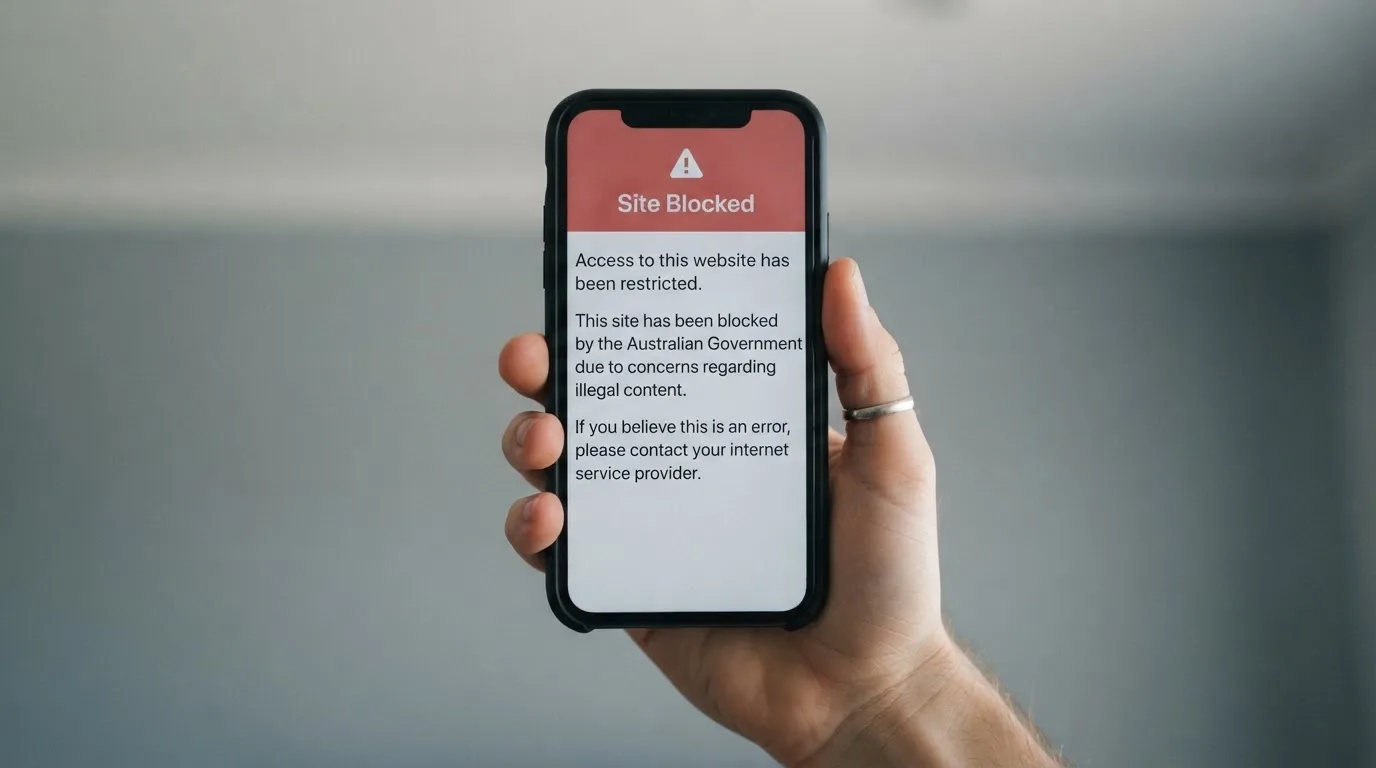
Enforcement sits with the ACMA, which investigates, issues formal warnings and directs ISPs to block illegal services. In a single round reported on 26 June 2026, the ACMA asked Australian ISPs to block twelve more sites: 7Signs, ChromaBet, Donbet, Duospin, Freshbet, Slots Gem, Jacks Club, Lucky Start, Pointsbetz, Spinrise, Vinyl Casino and Wildsino. The blocking rate — 1,751 illegal sites blocked over the period from November 2019 to the end of June 2026 — works out as a band rather than a single figure. At a steady 100 sites a month across that stretch the rate is roughly that; in practice the ACMA’s blocking has accelerated over time, and recent rounds have run to a dozen or more sites each. The honest reading is that the ACMA moves in waves, not on a metronome, and the cumulative total is the figure to remember rather than any per-month average.
Payment-side enforcement: the credit-card ban and what counts as a credit-related product
The Interactive Gambling Act as amended in 2023 prohibits Australian-licensed online wagering services from accepting payment by credit card or other credit-related products; that ban took effect on 11 June 2024, with penalties of up to A$247,500 for operators. A legal deposit into a licensed wagering account is debit card, bank transfer, PayID/Osko or BPAY. A site asking an Australian for a credit card or for a crypto deposit is operating outside the Australian rules — not at the edge of them. The implication for “fast payout” is that the cleanest rails (debit card, PayID/Osko) are the same rails the licensed side already uses; the offshore side can quote any rail it likes, but an Australian player has no Australian complaints body to escalate to when the rail does not deliver.
The 2026 reform landscape adds another moving part. The Interactive Gambling Amendment (Gambling Reform) Bill 2026 passed Parliament on 19 August 2026; its advertising and inducement measures commence on 1 January 2027. That is law with a start date, not law in force today: a 2026 reader should not assume the inducement rules have started, only that they have been enacted and are about to come on.
What the ACMA blocking record actually contains
The blocking list is the only public record of which offshore operators have been judged to be serving Australians in breach of the IGA. It is also the closest thing Australia has to a “who has been warned” register, and it sits next to a formal-warning register that names the operator company behind the brand. The two are not the same — a brand blocked on one date may have a separate formal warning under a different operator name — but together they draw the perimeter of what an Australian reader is being asked to send money to.
| Brand | ACMA action and date | Operator named by the ACMA | Subject support |
|---|---|---|---|
| RocketPlay | Formal warning, March 2026 (and earlier Dama N.V. action, May 2022) | Pulsup Ltd (Rocketplay); Dama N.V. (earlier) | Listings reference only |
| Level Up Casino | Formal warning, May 2022 | Dama N.V. | — |
| Woo Casino | Formal warning, March 2025 | Dama N.V. | — |
| Spirit Casino | Formal warning, May 2025 | Dama N.V. | — |
| National Casino | Formal warning, July 2025 | Consolutetish S.R.L. | Listings reference only |
| Bizzo Casino | Formal warning, July 2025 (and earlier 2022 warning to TechSolutions) | Consolutetish S.R.L.; TechSolutions (CY) Group Limited and TechSolutions Group N.V. (earlier) | Listings reference only |
| Ignition Casino | Formal warning, July 2025 | Bamboo Media | — |
| Instant Casino | Formal warning, February 2025 | EOD Code SRL | Listings reference only |
| Jackbit | Formal warning, April 2026 | Ryker B.V. (over Jackbit and CasinOK) | — |
| Casino Intense | Formal warning, April 2025 | Sterplay Holding Ltd | Listings reference only |
| Sky Crown | Formal warning (PDF published September 2022) | Hollycorn N.V. (Sky Crown and Blue Leo) | — |
Two patterns stand out in that table rather than any single row. One is operator reuse: Dama N.V. appears over four of the listed brands, Hollycorn N.V. over at least one, and Consolutetish S.R.L. and TechSolutions over a fifth. The same operator company reappears under different brand names, which is the standard structure for an offshore casino group. The other is that every entry is a formal warning, not a prosecution — the IGA’s enforcement teeth are administrative, not criminal, and the consequence for a blocked site is that Australians cannot reach it at all.
The eleven brands the ACMA has warned, and what their payout claims cannot change
Each of the eleven brands in the table above is the subject of a formal ACMA warning for offering prohibited interactive gambling services to Australians. None of them holds an Australian licence to offer online casino games, because no Australian licence exists for that product. What follows is what the ACMA record itself says about each, framed as the operational choice an Australian reader is being asked to make — not a ranking, and not a recommendation to play.
RocketPlay
Two warnings sit behind this brand: one to Pulsup Ltd in March 2026 over Rocketplay, and an earlier one to Dama N.V. in May 2022 that covered Rocketplay among six brands. A reader weighing RocketPlay is weighing a brand that the regulator has formally warned twice, under two different operator names, in four years. The “fast payout” question does not reach the regulator’s record; the regulator’s record reaches the question.
Level Up Casino
The May 2022 warning to Dama N.V. covered Level Up alongside five other brands. Three years on, Level Up is still listed among Australian-facing offshore casino brands. Dama N.V.’s repeated presence across the warning list is the structural fact here — one operator company, several skins.
Woo Casino
The ACMA issued a further formal warning to Dama N.V. over Woo Casino in March 2025. Woo Casino’s case is the same Dama N.V. cluster as Level Up, but the later date matters because the IGA’s enforcement tools expanded between 2022 and 2025, and the warning was issued in that expanded regime.
Spirit Casino
A second Dama N.V. brand, formally warned in May 2025. The pattern is the point: Spirit Casino is a sibling of Woo Casino and Level Up under the same operator, and the same warning machinery that caught one caught the others.
National Casino
The ACMA warned Consolutetish S.R.L. over National Casino in July 2025. This is the newer operator company in the list, and the only warning on file. The closure of the brand is the same as every other row — an offshore casino cannot be licensed in Australia.
Bizzo Casino
Consolutetish S.R.L. was warned over Bizzo Casino in July 2025, but the brand had already been the subject of a 2022 formal warning to TechSolutions (CY) Group Limited and TechSolutions Group N.V. Two operators, two warnings, three years apart — and the brand still being marketed at Australians in 2025.
Ignition Casino
The ACMA warned Bamboo Media over Ignition Casino in July 2025. Bamboo Media is the only operator company in this list that has not been the subject of earlier warnings; the action is the only data point.
Instant Casino
The ACMA warned EOD Code SRL over Instant Casino in February 2025 — the earliest warning in this list by date. It is also one of the brands whose payout rail an Australian reader might encounter with a PayID option, which is exactly the case where AP+ warns that a PayID request from an illegal gambling site is “almost certainly a scam.”
Jackbit
The ACMA warned Ryker B.V. in April 2026 over Jackbit and CasinOK together, naming both brands in one action. Two brands, one operator, one warning — the standard offshore-group shape.
Casino Intense
The ACMA warned Sterplay Holding Ltd over Casino Intense in April 2025. Casino Intense is the only brand in this list whose ACMA action names a single brand rather than a list.
Sky Crown
The ACMA’s formal warning to Hollycorn N.V., published as a PDF in September 2022, covers Sky Crown and Blue Leo together. Hollycorn N.V. is the operator; Sky Crown is one of the two skins named in that single warning. The Hollycorn cluster elsewhere on the warning list covers other brands, so this is the same structural fact as Dama N.V., with a different company name.
Responsible play: what BetStop covers, and what it does not
The Australian player-protection stack has three parts: BetStop, the National Self-Exclusion Register; the bank-level gambling blocks; and the National Gambling Helpline. Each covers a different layer, and none of them covers an offshore casino.
BetStop has been live since August 2023 and binds Australian-licensed online and phone wagering services. An offshore casino is not connected to it. A self-excluded Australian can still reach an offshore site, still deposit to it, still lose on it; BetStop simply is not on that side of the law. For a reader who has self-excluded from licensed Australian wagering and is reading this page looking for “fast payout” alternatives, the offshore route is the gap BetStop was not built to close.
The bank blocks are the layer that does bite — at the card, not at the site. Westpac, ANZ and Commonwealth Bank all offer gambling-block toggles, with the caveats noted above: not every gambling transaction will be stopped, some non-gambling transactions may be blocked in error, and an ANZ block carries a 48-hour cool-off before it can be removed. These blocks work because they sit at card authorisation: when a transaction arrives tagged with the betting/casino gambling merchant category code, the issuer declines it before the funds leave the account. They are the most reliable layer for an Australian player who has decided the casino side is not for them.
The National Gambling Helpline on 1800 858 858 is free, available 24/7, with chat via Gambling Help Online. These resources are there to help, not to facilitate payments. They are the part of the picture that the “fast payout” promise leaves out.
Cryptocurrency and the offshore side: what changes, and what does not
The Interactive Gambling Act as amended in 2023 prohibits licensed Australian wagering services from accepting digital currency as payment. Crypto on an Australian-facing casino is therefore not an Australian rail — it is a rail running on the offshore side, with no Australian bank in the loop and no Australian consumer protection if the funds go missing. The speed claim still attaches to the operator’s own cashier; the absence of an Australian bank in the loop means there is no PayID minute-counter to fall back on either. A reader who has come to this page looking for “fast payout crypto casino” is asking for the fastest version of the same off-rails product.
The structural answer is the same one the rest of the page arrives at: an Australian bank cannot confirm where a crypto deposit came from, an offshore casino cannot connect to BetStop, and the ACMA’s blocking record is the closest thing to a public register of who has been warned for serving Australians. None of that changes when the payment method changes. What changes is the audit trail: a crypto transfer leaves a blockchain record, not an Australian bank record, and AUSTRAC’s threshold-transaction-report rule, which requires reporting of transfers of A$10,000 or more, applies only to physical cash. Ordinary electronic bank transfers are not subject to that per-transaction reporting rule regardless of amount. The crypto transfer is a different instrument under a different regime; it is not a faster Australian bank transfer.
The market the legal side has already taken from the illegal side
H2 Gambling Capital’s 2025 estimate is that Australians lose about A$3.9 billion a year to illegal gambling sites, and that the share of gambling going through legal channels fell from 74% in 2021 to 64% in 2025. Two directions are clear: the illegal share has grown, and the legal share has shrunk. A reader looking for a “best fast payout” list is at the receiving end of that shift. The legal channels in Australia — licensed bookmakers, lotteries and keno — are the product a reader can actually use, while the offshore sites are the ones that fall outside the rules. The 11-point gap between 74% and 64% is the space the offshore side has filled.
The number that should sit beside that gap is the blocking record: 1,751 sites blocked since November 2019, 230-plus services having left the Australian market since enforcement was strengthened in 2017. Those are not numbers that describe a market the regulator has failed to touch; they are numbers that describe a market the regulator has touched repeatedly. A reader who interprets “fast payout” as a competitive signal — the operator that pays fastest is the most professional — is reading the wrong meter. The meter the ACMA reads is whether the site is licensed to serve Australians at all, and the answer is no, for every brand on the warning list.
Tax, winnings, and what an Australian player actually owns at the other end
Recreational gambling winnings in Australia are not assessable income under section 6-5 of the ITAA 1997, and losses are not deductible. The model assumes a recreational player; a person who carries on a business of gambling is a different case and the ATO, not this page, is the source for it. For the typical Australian punter, the end-of-year tax position is unaffected by whether the winnings came from a licensed wagering account or an offshore casino — but the practical difference is in the disputes layer, not the tax layer. An offshore casino gives no Australian complaints body and no recourse if a withdrawal is refused. A licensed Australian wagering service sits inside state and territory dispute mechanisms. The “fast payout” comparison collapses to that distinction under any kind of dispute.
Where this leaves a reader who arrived looking for a ranked shortlist
A reader who came to this page for a Top-10 of fast-payout casinos in Australia has not been handed one, and the reason is not editorial caution — it is the IGA. The Interactive Gambling Act 2001 prohibits offering online casino games to anyone in Australia, and no state or territory licenses the product. Every brand in the table above has been the subject of an ACMA formal warning for doing exactly that. The “fast payout” angle is the second question, and it never reaches a clean answer because the first question has not been answered.
The answer is found in the Australian gambling product that is licensed: wagering on races and sport placed before the event, lotteries and keno. These are the legal services that Australian consumers use.
For a reader who is reading this page from outside Australia, the offshore brands on the warning list are part of a wider international market; the ACMA warnings are a record of what the regulator judged to be targeting Australians specifically, and they do not necessarily reflect the regulator’s view of the same brands in other jurisdictions. The legal reality on this page is the Australian one.
A short note on what an offshore casino can quote, and what it cannot
An offshore casino cashier can quote any payout rail it likes — Visa, Mastercard, a bank wire, an e-wallet, a PayID-style identifier where the receiving bank permits it. What it cannot quote is the part of the rail the casino does not control: the receiving bank’s processing window, the issuer’s gambling-block decision, and the AUSTRAC or banking-disputes path the player can use if the funds do not arrive. The “instant” in “instant payout” is the casino’s promise, not the Australian bank’s. A reader who has the bank’s gambling block on will not see the instant arrive; the block will decline the deposit before the payout is even attempted.
That is the structural reason a “fast payout” comparison cannot be done honestly for Australia: the comparison needs the casino’s side and the bank’s side to be in the same frame, and the IGA keeps them out of it. The bank is Australian, regulated and reachable through Australian consumer law; the casino is offshore, unregulated for Australian purposes and unreachable through any Australian complaint mechanism. The speed difference between the two is real, but it is the speed difference between a regulated Australian rail and a rail with no Australian regulator behind it.
Frequently asked questions
What counts as a fast payout time for a casino transaction?
A casino’s “fast payout” claim usually refers to the casino’s own processing window, often quoted in hours or minutes; the bank or e-wallet leg of the transfer is a separate delay the casino does not control. From an Australian bank account, the cleanest comparable figure is Osko’s under-a-minute settlement between participating banks, which is the rail the casino does not run.
How quickly does an Osko bank transfer arrive between Australian banks?
Osko settles in under a minute, 24/7 including weekends, addressed either to a BSB and account number or to a PayID; the New Payments Platform became accessible to the public on 13 February 2018 and participants must keep monthly outages to under two minutes. More than 25 million PayIDs had been registered by April 2025.
Is it legal for an online casino to offer fast payouts to players in Australia?
No. The Interactive Gambling Act 2001 prohibits offering online casino games to anyone in Australia, and no state or territory licenses that product; the ACMA enforces the prohibition by issuing formal warnings and asking ISPs to block sites. An offshore casino offering fast payouts to Australian players is operating in breach of the IGA, whatever rail it uses.
Do faster payout claims make an offshore casino any safer to use?
No. A fast payout claim describes the operator’s cashier, not the regulator behind it; the ACMA’s blocking record (1,751 sites blocked since November 2019) is independent of any operator’s payout speed. Safety for an Australian player comes from the Australian regulator, not from the speed of the rail.
What payment method typically settles quickest into an Australian bank account?
Osko via PayID or BSB and account number settles in under a minute between participating banks; that is the Australian rail. An offshore casino’s payout rail is the casino’s, and it sits on top of (or instead of) the Australian rail, depending on the operator’s cashier.