
Casino promo codes in Australia: what the inducement is, what it costs, and what the regulator has done about it
A casino promo code is a short string a player types at signup, deposit or cashier to unlock a bonus that a site’s standard welcome page does not show. The marketing pitch, in every banner, is that the code carries something extra — extra free spins, an extra match, an extra no-deposit chip — that the same site gives away only to people who know the string. The premise of this page is straightforward: in Australia, the codes are issued almost entirely by offshore operators that cannot lawfully take a real-money bet from a person located here. The bonus on offer is real money the operator is offering to risk on a game the operator is not allowed to offer. That tension runs through every block that follows.
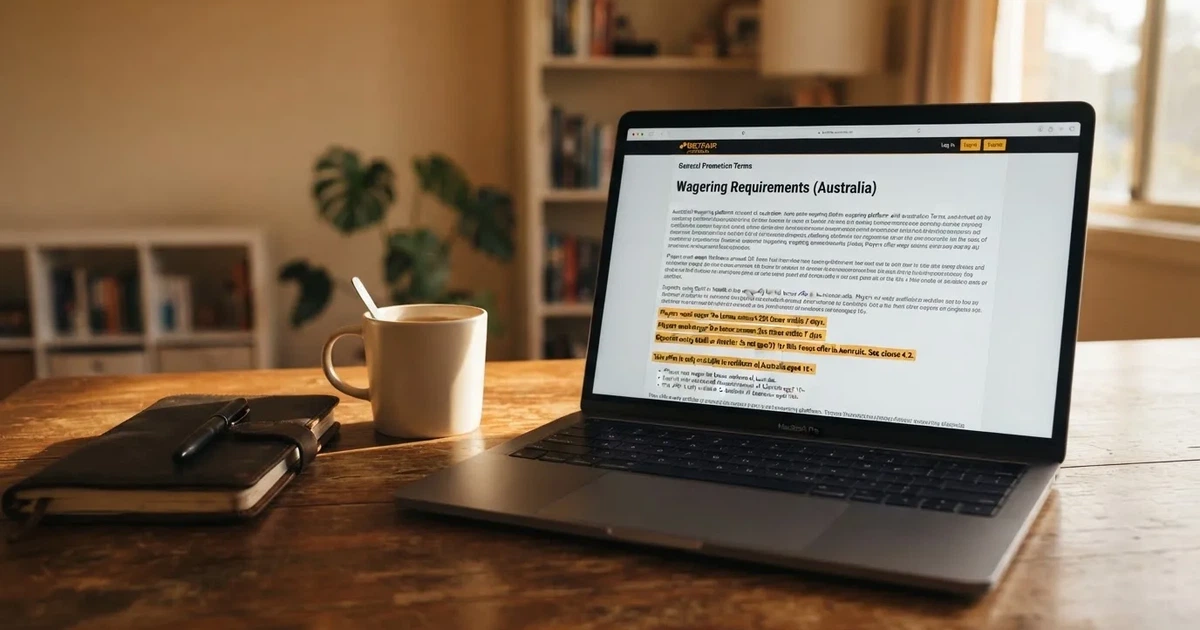
30 October 2026 — Australian Communications and Media Authority (ACMA) register and operator formal-warning notices.
Table of Contents
- What a casino promo code actually is, and why an Australian player meets one
- The legal frame: the Interactive Gambling Act, the prohibition, and what “licensed” actually means offshore
- How the ACMA has acted against the brands the promo codes lead to
- The blocking rate: how fast the regulator is actually clearing the backlog
- Why a promo-code offer is more than a marketing decision for an Australian player
- What the responsible-gambling supports cover, and where they stop
- The featured set: eleven brands, one prohibition, eleven formal warnings
- The brands, individually
- The calculation, worked
- What this page does and does not do
- Frequently asked questions
What a casino promo code actually is, and why an Australian player meets one
A promo code is a coupon, in form if not in name. The site attaches an offer to the string and the string to a signup, a deposit or a specific game. A new account holder enters the code in the cashier, the bonus lands in a separate balance, and the wagering conditions attached to that balance dictate when any of it can be withdrawn. The mechanism is the same one a bricks-and-mortar pub uses for a free drink voucher, except the “drink” is real-money credit at an offshore casino and the “pub” is licensed somewhere the ACMA cannot reach.

The standard inducement architecture, from the research on the subject, lines up like this. A welcome bonus is matched to a first deposit, often at 100% up to a stated cap, and the code is the channel through which the matched amount is unlocked. Free spins come as a fixed bundle — sometimes fifty, sometimes two hundred — attached either to a named title or to a publisher’s catalogue. No-deposit codes exist but are uncommon and almost always capped at a small dollar figure with an unfavourable withdrawal ceiling. Cashback, reload and tournament-entry codes exist too. Each of them carries conditions.
The same terms that make a code worth claiming are also the terms that make a code worth reading. Wagering requirements turn the bonus balance into real money only after the player has wagered the bonus amount a fixed number of times — research on these operators routinely shows multiples in the 35× to 50× range, with 40× common. A maximum-bet cap, often A$5 to A$10 per spin or hand while the bonus is active, prevents a single lucky round from clearing the playthrough in one go. Game weighting cuts slots to 100% contribution, often down to 10% or zero for table games. A maximum cashout ceiling sometimes applies to free-spin winnings specifically. A short expiry window — seventy-two hours is common — puts a clock on the playthrough before any of it lapses. None of these are negotiable after the fact; they are written into the terms the player accepts by entering the code.
That whole package is the inducement. The page is not about whether the inducement is good value at the cashier. It is about what is true on the ground in Australia when a punter types the code in: what licence sits behind the brand, what consumer protection comes with it, and what the regulator has already done about it.
The legal frame: the Interactive Gambling Act, the prohibition, and what “licensed” actually means offshore
Australia’s online gambling is governed by the Interactive Gambling Act 2001, strengthened by the Interactive Gambling Amendment Act 2017. The Act makes it an offence for a provider to offer online casino games, online pokies or in-play betting to a person physically in Australia. No state or territory licenses those products; what is licensable is wagering on racing and sport placed before the event, lotteries and keno. Online casino is the product the promo code unlocks, and it is the product the Act prohibits.
The individual player is not the target of the Act. The criminal liability sits with the provider — the corporate entity running the site, the payment processor moving the money, the affiliate marketing the offer to Australian eyeballs. A punter who types in a code does not face an Australian prosecution for having done so. What the punter gives up, in exchange for the absence of prosecution, is the protection that comes with a licensed service: an Australian complaints body, a regulator that can compel a payout, a self-exclusion register the operator is connected to, and a deposit limit that cannot be quietly raised.
In practice the licensing on most offshore casino sites is a Curacao or Kahnawake number, and the regulator behind that number has neither the standing nor the willingness to arbitrate an Australian complaint. Some sites display a Malta Gaming Authority seal — Malta has a more developed dispute process, but it sits outside any treaty obligation to Australian players. None of these licences authorise the site to take a bet from a person in Australia. The licence is a permission to operate in the licensing jurisdiction; it is not a permission to offer prohibited gambling to Australians.
The Interactive Gambling Amendment (Gambling Reform) Bill 2026 passed Parliament on 19 August 2026, and its advertising and inducement measures commence on 1 January 2027. This is law with a start date: it is not yet in force, and the operator behaviour and enforcement totals cited on this page reflect the regime as it stood at the ACMA reporting round in late June 2026.
How the ACMA has acted against the brands the promo codes lead to
The Australian Communications and Media Authority does not ban offshore sites by name; it issues formal warnings under the Interactive Gambling Act and, when warnings are ignored, directs Australian internet service providers to block the offending domains. The pattern of formal warnings over the past four years shows how the regulator has come to treat the casino-promo-code segment specifically: as one continuous inducement problem, in which the operator name rotates and the underlying offer does not.
The warning record on the brands featured on this page, in the order it was published, is the most useful thing a reader can carry out of this section. Dama N.V. was warned in May 2022 over six casino brands including Bambet, Dazard, Level Up, Rocketplay, Wild Tornado and Cobra Casinos. Hollycorn N.V. was warned in September 2022 over Sky Crown and Blue Leo. TechSolutions Group was warned in 2022 over Bizzo Casino. EOD Code SRL was warned in February 2025 over Instant Casino. Dama N.V. was warned again in March 2025 over Woo Casino, and in May 2025 over Spirit Casino. Sterplay Holding Ltd was warned in April 2025 over Casino Intense. Consolutetish S.R.L. and Bamboo Media were both warned in July 2025 — Consolutetish S.R.L. over National Casino and Bizzo Casino, and Bamboo Media over Ignition Casino. Ryker B.V. was warned in April 2026 over Jackbit and CasinOK. Pulsup Ltd was warned in March 2026 over RocketPlay. The pattern is not a series of one-off slips; it is a single market, treated as one enforcement problem across multiple corporate shells.
The blocking record, in cumulative terms, is the figure that puts the warning record in proportion. By the ACMA’s round reported on 26 June 2026, a total of 1,751 illegal gambling and affiliate marketing websites had been blocked since the first blocking request in November 2019. More than 230 unlicensed gambling services had left the Australian market since enforcement was strengthened in 2017. The round itself asked Australian ISPs to block 12 more sites: 7Signs, ChromaBet, Donbet, Duospin, Freshbet, Slots Gem, Jacks Club, Lucky Start, Pointsbetz, Spinrise, Vinyl Casino and Wildsino. The blocking rate — the working pace at which illegal sites have been removed from Australian reach over the lifetime of the regime — is the most informative single number a reader can take from the regulatory shelf. It is worked through in full in the next section.
The blocking rate: how fast the regulator is actually clearing the backlog
The arithmetic behind the regulatory shelf is a rate, not a count. The blocking figure in research is 1,751 sites since November 2019; the round reported on 26 June 2026 brings the running total to that figure. Worked against the elapsed time from the first blocking request to the round’s date, the rate is roughly 1,751 sites over roughly 79 months — a pace of around 22 sites per month on average, with notable bunching in the years when the ACMA’s enforcement programme was first resourced.
The figure is informative in two ways. The first is what it says about the pace: 22 sites a month is not a flood, and it is not a trickle either. It is roughly the rate at which one enforcement team can identify an operator, document the breach, issue the warning and then run the blocking process when the warning is ignored. The second is what it says about the shape of the market behind the figure: a single blocking round can name a dozen fresh sites, which means the operators behind the codes are not a stable population. Each blocked domain is, in practice, two or three new domains the operator stands up to replace the old one. The H2 Gambling Capital 2025 estimate that Australians lose about A$3.9 billion a year to illegal gambling sites, and that the share of gambling going through legal channels fell from 74% in 2021 to 64%, is consistent with that picture. The blocking rate is high enough that the regulator is keeping up with the visible part of the market; the legal-channel share is falling anyway, which means the visible part is not the whole part.
A caveat the rate cannot speak to: every block lands on a site the regulator has already named in a warning. The warnings, in turn, are issued at the ACMA’s discretion and reflect priorities, not a complete census of the offshore casino market reaching Australians. The figure is the rate of acted-against sites, not the rate of all sites. It is also a single-direction count: a site that is blocked today and comes back next week under a new name counts twice. The honest reading is that the regulator’s pace is faster than the marketing of new brands, but slower than the marketing of new domain names.
Why a promo-code offer is more than a marketing decision for an Australian player
A code at an offshore site looks, on the surface, like a choice the player could decline. The structural reading is closer to a choice the player is asked to make without enough information to make it well. The site will not tell a player, in the terms page, that the ACMA has previously issued a formal warning against the operator; the terms page does not carry a country-of-residence disclosure the regulator can act on; and the bonus terms themselves are written so that the maximum-bet cap, the wagering multiple, the game weighting and the cashout ceiling all stand between the bonus and a withdrawal. The information asymmetry is the offer’s load-bearing feature.
Two practical consequences follow. The first is on the deposit itself. Under the Interactive Gambling Act as amended in 2023, Australian-licensed online wagering services cannot accept payment by credit card or other credit-related products — a restriction that also constrains gambling use of linked digital wallets such as Apple Pay. Credit cards are out for the legal side of the market. The offshore side of the market has no equivalent rule. A punter who funds an offshore casino with a credit card is using a payment method that the licensed side of the same market is forbidden to accept, on a site the regulator is trying to block. The bank may not even let the transaction through: Westpac’s gambling block refuses authorisation of transactions registered under the merchant category code for betting and casino gambling on eligible personal credit and debit cards; ANZ’s gambling transaction block, activated in the ANZ app, also blocks gambling transactions made through a digital wallet on an eligible card; Commonwealth Bank’s gambling lock, applied via the CommBank app, automatically blocks most gambling transactions though the bank cannot guarantee all gambling-related purchases are stopped. ANZ’s block requires a 48-hour waiting period to remove, and the bank warns that not all gambling transactions will be blocked and that some non-gambling transactions might be blocked in error. These are the bank-side tools a punter can switch on without telling the casino. A bank that has blocked the transaction cannot refund a deposit that never went out.
The second is on the payout side. Offshore casinos advertise payout times in hours, sometimes minutes. The reality, when a withdrawal hits a payment rail that works the way Australian payments work, is different. With Osko, a bank transfer between participating Australian banks arrives in under a minute, 24/7 including weekends, whether it is addressed to a BSB and account number or to a PayID. Paying to a PayID shows the name of the account holder before the transfer is sent, and AP+ warns that being asked to transfer money to a PayID on an illegal gambling site almost certainly means a scam site. PayID-based instant transfers are available at over 100 Australian financial institutions, and more than 25 million PayID identifiers had been registered on Australia’s New Payments Platform as of April 2025. The payments infrastructure is fast and it is widely deployed. What the infrastructure does not do is arbitrate a dispute between an Australian punter and an offshore operator when the operator declines a withdrawal — and offshore operators reserve the right to decline a withdrawal when wagering requirements are not met, when bonus abuse is alleged, or when a maximum cashout ceiling is reached. The dispute ends with the operator, because the dispute always ends with the operator.
What the responsible-gambling supports cover, and where they stop
Australian responsible-gambling supports were built for the licensed side of the market and stop where the licensed side stops. The National Gambling Helpline is 1800 858 858, free, 24/7, with web chat at Gambling Help Online. BetStop, the National Self-Exclusion Register, has been live since August 2023 and binds every Australian-licensed online and phone wagering service. A punter who signs up to BetStop and then types a code into an offshore casino is dealing with an operator that has no obligation to check BetStop, no obligation to refuse the deposit, and no obligation to honour the self-exclusion. BetStop covers what it was designed to cover; offshore casino play is not what it was designed to cover.
The same boundary runs through every state-level support: each state and territory has its own counselling service and, in most cases, its own venue-based self-exclusion scheme. State-level self-exclusion, like BetStop, runs against Australian-licensed operators. An offshore casino sits outside both schemes. The minimum age for any Australian gambling product is 18; an offshore site does not verify age the way a licensed Australian operator does.
The honest framing for a reader on this shelf is that the responsible-gambling supports are real and well-funded, and they are not connected to the offshore casino market the promo codes lead to. If a punter is using an offshore site and wants the support of an Australian self-exclusion register, the support will come from BetStop for the licensed side of the market; the offshore side will not be touched by it.
The featured set: eleven brands, one prohibition, eleven formal warnings
The brands in this section are not a ranking. They are the brands the ACMA itself has acted against. Each one is an operator that, at the time of its warning, was offering online casino products to people in Australia. Each one was offering — or was advertised in connection with — casino promo codes of the kind this page is about. The table below is a record of enforcement, in the order the ACMA published it. No bonus terms are given, because the only sources for bonus terms were affiliate marketing pages and this page is not built from those.
| Brand | ACMA action and date | Operator named by the ACMA | Subject support |
|---|---|---|---|
| RocketPlay | Formal warning, March 2026 | Pulsup Ltd | listings-only |
| Level Up Casino | Formal warning, May 2022 | Dama N.V. | listings-only |
| Woo Casino | Formal warning, March 2025 | Dama N.V. | — |
| Spirit Casino | Formal warning, May 2025 | Dama N.V. | — |
| National Casino | Formal warning, July 2025 | Consolutetish S.R.L. | listings-only |
| Bizzo Casino | Formal warning, July 2025 (earlier 2022) | Consolutetish S.R.L. (earlier TechSolutions) | listings-only |
| Ignition Casino | Formal warning, July 2025 | Bamboo Media | — |
| Instant Casino | Formal warning, February 2025 | EOD Code SRL | listings-only |
| Jackbit | Formal warning, April 2026 | Ryker B.V. | — |
| Casino Intense | Formal warning, April 2025 | Sterplay Holding Ltd | listings-only |
| Sky Crown | Formal warning, September 2022 | Hollycorn N.V. | — |
The em-dash cells in the Subject support column carry no information because none of the consulted sources covered those brands on the subject. That absence is itself informative — the brands with no listings-only record on the subject are, on this evidence, the ones the affiliate marketing pages cover least. The brands with a listings-only record are the ones the affiliate marketing pages cover most. The pattern is consistent with how the inducement market works: the louder the marketing, the more warnings the operator tends to attract.
The brands, individually
RocketPlay
Pulsup Ltd was the operator named by the ACMA in the March 2026 formal warning over RocketPlay. Dama N.V. was the operator named in the May 2022 warning over an earlier incarnation of the same brand. The corporate shell behind the site has rotated; the offering and the inducement structure have not. RocketPlay sits at the loud end of the marketing, which is the end of the marketing where formal warnings accumulate. The verdict on the brand is the one the regulator has already written: the same offer to the same Australian audience from a differently-named corporate shell is not a clean record, it is a continued record.
Level Up Casino
Dama N.V. was warned in May 2022 over Level Up Casino alongside five other brands. Dama N.V. has been the most-warned operator in this set: the same corporate entity accounts for six of the warnings on the ACMA’s record, spanning 2022 to 2025. The brand’s marketing has not moderated in step with the warnings; the warnings have not stopped the marketing. That is the picture the ACMA’s own publications show, and it is the picture a player should hold when reading the bonus terms.
Woo Casino
Dama N.V. was warned in March 2025 over Woo Casino. The 2025 warning came three years after the 2022 warning over the same operator. Three years is enough time for a brand to walk away from the Australian market; three years is also enough time for a brand to keep marketing the same offer and accept the next warning. The ACMA’s record is unambiguous about which of those Woo Casino did.
Spirit Casino
Dama N.V. was warned in May 2025 over Spirit Casino. Spirit Casino is, on the ACMA’s record, the second 2025 warning issued to Dama N.V. — the same operator, two months apart, two different brands. The cumulative weight of the warnings, rather than any single one, is the relevant fact.
National Casino
Consolutetish S.R.L. was warned in July 2025 over National Casino. The 2025 warning is the first formal warning on National Casino on the ACMA’s record. That is a fresh row in the table rather than a continuing row, and the verdict is the same: a brand newly named in a formal warning is a brand that was, at the time of the warning, offering prohibited gambling to Australians.
Bizzo Casino
Consolutetish S.R.L. was warned in July 2025 over Bizzo Casino; Bizzo Casino had already been the subject of a 2022 formal warning to TechSolutions Group Limited and TechSolutions Group N.V. The brand has cycled through two operators in three years. A brand that has cycled through two operators in three years is, by definition, not a stable corporate proposition for an Australian player to deal with.
Ignition Casino
Bamboo Media was warned in July 2025 over Ignition Casino. Ignition Casino is the only brand on the ACMA’s record attributed to Bamboo Media, and the warning is the only formal action on file for the brand.
Instant Casino
EOD Code SRL was warned in February 2025 over Instant Casino. The brand carries a single formal warning on the ACMA’s record. The “Instant” in the brand name is a marketing word the offer itself cannot honour — Instant payouts are a function of the payment rail the player uses to receive funds, not a property the operator controls, and on this side of the market the payment rail is an Australian one the operator has no standing with.
Jackbit
Ryker B.V. was warned in April 2026 over Jackbit (and CasinOK). The 2026 warning is the most recent formal action on the brand on the ACMA’s record. Jackbit is one of two brands covered by the April 2026 warning, and the verdict on the brand sits in the verdict on Ryker B.V.: a single operator carrying two brand names under one warning is a single proposition, not two.
Casino Intense
Sterplay Holding Ltd was warned in April 2025 over Casino Intense. The warning is the only formal action on the brand on the ACMA’s record. “Casino Intense” is a brand name, not a description of the operator’s regulatory standing; the standing is what the ACMA’s warning describes, and it is on file.
Sky Crown
Hollycorn N.V. was warned in September 2022 over Sky Crown (and Blue Leo). The 2022 warning is the oldest formal action on the brand on the ACMA’s record. Sky Crown has had four years between warning and the current round, and the brand is still on the operator’s published list. The pattern is the same as the others: a warning does not retire a brand, it retires a domain name, and the next domain is up within months.
The calculation, worked
The blocking rate is the primary measure of activity on the regulatory shelf. The running total of blocked sites is 1,751; the date of the first blocking request is November 2019; the ACMA’s reporting round carrying the running total is the round reported on 26 June 2026. From the first blocking request to the reporting round is roughly 79 months. Worked at the running total over the elapsed period, the rate lands at roughly 22 blocked sites per month on average across the lifetime of the regime, with the visible bunching in the years when the ACMA’s enforcement programme was first resourced.
The band, rather than the single figure, is the honest framing: the rate is around 20 to 25 sites per month across the lifetime of the regime, with a working assumption that the rate is highest in the years when enforcement was first resourced and settles into a steady-state figure closer to the long-run average. A reader who wants to know how fast the regulator is clearing the backlog can carry the band with them. A reader who wants to know whether the regulator will block the brand they are looking at this month cannot carry any number — the regulator’s blocking is published in rounds, not on a schedule, and the rounds do not name every site the regulator has under review.
What this page does and does not do
This page does not recommend an operator. It does not provide a code. It does not describe the value of any specific bonus, because the only sources for those values were affiliate marketing pages, and this page is not built from those. The list of brands in the featured set is the ACMA’s own list of brands it has issued formal warnings against for offering prohibited gambling products to Australians. A brand on the list is a brand a player has a regulator-confirmed reason to be cautious about; a brand not on the list is a brand the regulator has not, on the public record, named.
A reader who has come to this page looking for a code to type in will find one, eventually, on an offshore site — the marketing pages for the same subject carry dozens. What this page adds to the search is the regulator’s record of those sites, the legal frame those sites operate outside, the responsible-gambling supports those sites are not connected to, and the rate at which the regulator is clearing the visible part of the market. The decision about whether to type the code in is the player’s. The information that decision should rest on is what this page has tried to lay out.
Frequently asked questions
How does a casino promo code differ from a permanent welcome offer?
A welcome offer is the bonus the site shows by default to a new account holder. A promo code is a string that unlocks a different offer — usually the same underlying bonus with an additional bundle of free spins, a higher match percentage or a small no-deposit chip attached. The wagering conditions, max-bet cap, game weighting and cashout ceiling are typically the same in either path; the code is the channel, not a different deal.
Are promo-code offers from offshore casino sites subject to any Australian consumer protection?
No. The Interactive Gambling Act 2001 prohibits the offer of online casino games to people in Australia. Offshore sites are not licensed in Australia, are not connected to BetStop, and have no obligation to arbitrate a dispute through an Australian complaints body. A withdrawal that the operator declines ends at the operator.
What’s a common maximum-bet restriction attached to promo-code winnings?
A maximum-bet cap applies while the bonus balance is active, most commonly in the A$5 to A$10 per spin or hand range. The cap exists so a single round cannot clear the playthrough in one spin; breaching it can void the bonus and any winnings tied to it.
Can a promo code be combined with another offer at the same offshore site?
Almost always no. The standard terms forbid stacking: a bonus code cannot be used alongside another active bonus, and switching from one bonus to another forfeits the first. Some sites run a manual exception for VIP players, but the exception is on the operator’s discretion, not on the terms page.
Why do promo codes often carry a short expiry window?
The expiry window — seventy-two hours is common, sometimes seven days — is a turnover mechanism. It converts the bonus balance into real money only if the player wagers it quickly enough; an unused bonus lapses. The clock is part of the inducement, not a courtesy.
What should an Australian do before entering any personal details on an offshore promo page?
The minimum checks before any signup are: confirm that the site is not on the ACMA’s blocked or warned list; confirm that the operator behind the brand is not the subject of a formal warning on the ACMA’s register; fund the account with a payment method the player can revoke independently of the casino (a debit card rather than a credit card, a PayID rather than a wire); and set a deposit limit at the bank level using the gambling block on the card, because the offshore operator has no Australian deposit-limit obligation. The licensed Australian side of the market — Sportsbet, Bet365, Ladbrokes and the rest — is regulated by the Northern Territory Racing and Wagering Commission and is the only side of the market that offers Australian consumer protection.
Casino promo codes in Australia — More on this topic at casino live dealer .
See also Casino VIP programs in Australia in 2026 .