
No KYC Casinos in Australia: What the Marketing Does Not Say
A “no KYC” casino advertises that it will let an Australian punter deposit, play and withdraw without showing a passport, a driver’s licence or a proof of address. That pitch is doing real work for the operator — it shortens sign-up, it skips a step most Australian banks already police at their end, and it puts a friendly label on a category of site that, in this country, sits squarely outside the law. The label is not the problem. The site behind it is. This page looks at what a no-KYC pitch actually means, what it does not mean, and what it costs the punter who takes it at face value.

Current as of 9 November 2026 against the Australian Communications and Media Authority’s published formal warnings and blocking actions.
Table of Contents
- What a no-KYC casino actually is — and is not*
- The legal position an Australian punter actually sits in
- Responsible gambling: where the perimeter actually helps
- Crypto and the pitch that surrounds it
- Landscape
- Payment Methods
- Eleven brands, eleven different reasons to read the small print
- Reading the brand write-ups as a set
- What the punter is actually buying
- Where to get help if gambling is becoming a problem
- What the ACMA’s enforcement record actually costs the punter
- The punter’s honest decision tree
- Frequently Asked Questions
What a no-KYC casino actually is — and is not*
“Know your customer” is the identity check a regulated operator runs before it lets a customer move money: name, date of birth, address, sometimes source of funds. In Australia the equivalent sits inside the licensed bookmaker’s onboarding flow, governed by the Anti-Money Laundering and Counter-Terrorism Financing Act and policed by AUSTRAC. Offshore, the term gets reused as marketing copy, and the meaning drifts.

What “no KYC” usually describes in practice is a tiered setup. Small deposits and small withdrawals go through with only an email address and a crypto wallet. The same site, on the same day, may demand a full identity file the moment the punter asks for a larger payout, hits a fraud flag, or tries to move funds back to a bank account rather than back to crypto. The promise is partly real and partly a deferred cost. The marketing page leads with the part that flatters the punter; the small print is where the actual rule lives.
Two consequences follow from that, and they are the ones this page keeps returning to. First, the very quality the pitch is selling — silence on who the punter is — is the same quality that strips the punter of the protections a licensed Australian bookmaker has to provide. There is no local complaints channel to write to, no Australian regulator to escalate to, no BetStop registration that binds the site, and no chargeback route the punter’s bank is obliged to honour. Second, the absence of any check does not somehow place the site inside the Australian regulatory perimeter. The Interactive Gambling Act 2001, as amended in 2017 and again in 2023, makes the provision of online casino games to a person in Australia an offence. The site that asks for no documents is the same site the ACMA has been moving against; the absence of identity verification does not change the category the site sits in.
The label is not the product
The KYC label is what the punter sees. The product the punter is buying is an offshore casino account that cannot be licensed in Australia. KYC is a feature of the wrapper, not the wrapper itself. Stripping it out does not import the site into the Australian framework — it removes the only friction that framework would otherwise impose.
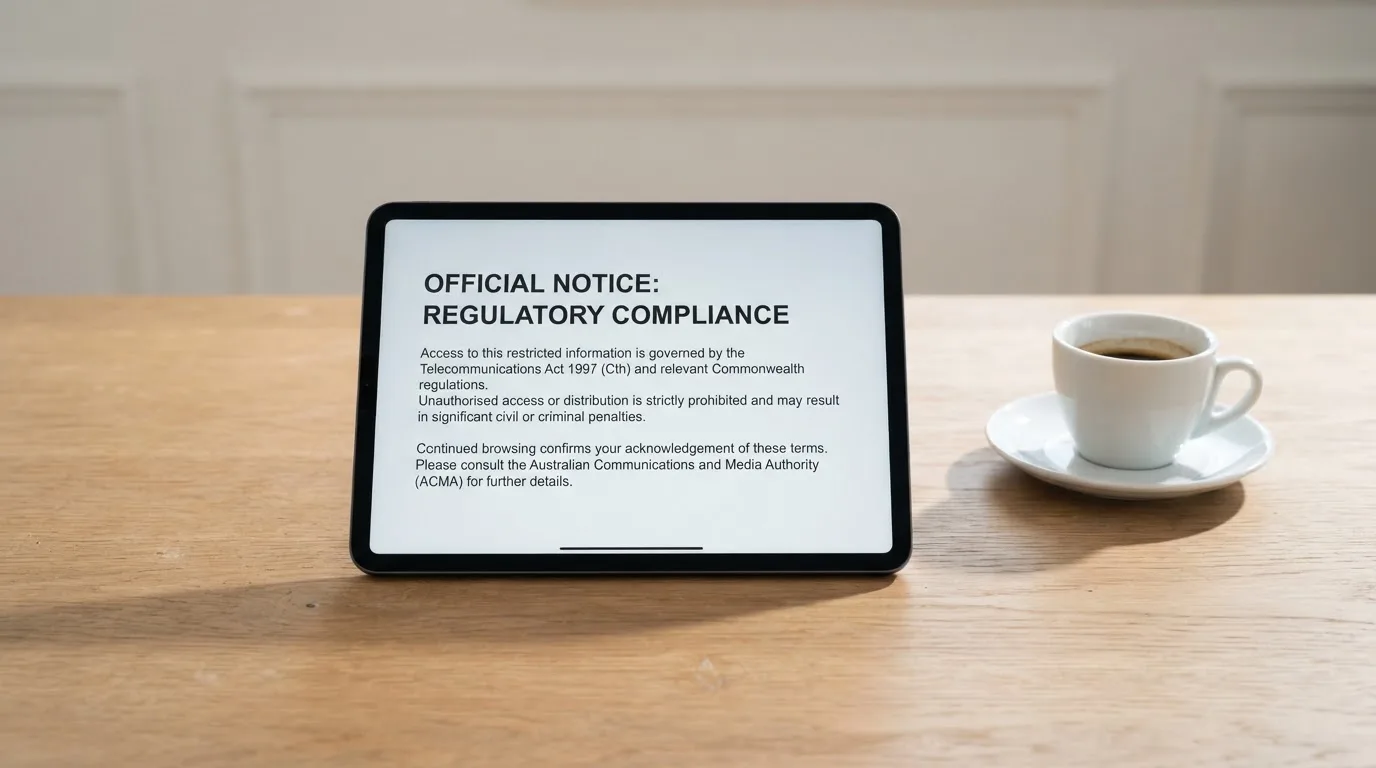
The legal position an Australian punter actually sits in
The Interactive Gambling Act 2001 does not name “no-KYC casinos” as a separate category. It names “prohibited interactive gambling services”: online casino games, online pokies, in-play betting on a sporting event. No state or territory issues a licence for any of them. Wagering on races and sport placed before the event is licensable, and is in practice licensed by the Northern Territory Racing and Wagering Commission — a body with no full-time staff that meets monthly in Darwin and supervises fifty-two online bookmakers including Sportsbet, Bet365 and Ladbrokes for tax reasons rather than as a substantive consumer-protection regime. Casino games are not on that list. They are not on any list.
Enforcement runs through the ACMA, which can investigate, issue formal warnings and direct Australian internet service providers to block offending domains. By the ACMA’s own count in June 2026, 1,751 illegal gambling and affiliate marketing websites had been blocked since the first blocking request in November 2019, and more than 230 unlicensed gambling services had left the Australian market since enforcement was strengthened in 2017. A round reported on 26 June 2026 alone asked ISPs to block twelve more sites — 7Signs, ChromaBet, Donbet, Duospin, Freshbet, Slots Gem, Jacks Club, Lucky Start, Pointsbetz, Spinrise, Vinyl Casino and Wildsino. The block list is the visible shape of the perimeter, and it grows every quarter.
The individual punter is not prosecuted. The Interactive Gambling Act targets the provider, not the customer. That is the one piece of good news in this picture, and it is also the piece most likely to be misread. Not being prosecuted is not the same as being protected. An offshore site gives the punter no Australian complaint avenue, no right of action under Australian consumer law, and no guarantee the site will still be reachable when the punter wants to withdraw. The site can be blocked with the punter’s balance still sitting inside it, and there is no Australian body the punter can call to ask for that balance back.
H2 Gambling Capital’s 2025 report puts the annual cost of illegal gambling to Australians at roughly A$3.9 billion a year, and estimates that the share of gambling going through legal channels fell from 74 per cent in 2021 to 64 per cent. The decline is real, and the marketing that draws it is the same marketing this page is about.
A note on VPNs
A site that bills itself as “VPN-friendly” is signalling that it will not block access when an Australian IP address is detected. That signal tells the punter nothing useful. The site is already operating outside the IGA by serving Australian customers at all; whether it politely pretends not to notice an Australian IP address does not change that. Routing around an Australian IP does not route around Australian law, and it does not route around the ACMA’s blocking list. The block works at the domain level. The VPN does not unbrick the domain.
Responsible gambling: where the perimeter actually helps
An offshore no-KYC casino is not connected to BetStop, the National Self-Exclusion Register that went live in August 2023. BetStop binds Australian-licensed online and phone wagering services: an Australian punter who has self-excluded through BetStop is locked out of those services, and the services are obliged to honour the registration. An offshore casino is not on that list and has signed no such obligation. A punter who has registered with BetStop and then opens an offshore account has not excluded themselves from that account; they have simply moved their play somewhere the register does not reach.
A second layer sits one step back, at the Australian bank. Westpac’s gambling block refuses authorisation of transactions registered under the merchant category code “Betting/Casino Gambling” on eligible personal credit and debit cards. ANZ’s gambling transaction block, switched on in the ANZ app, blocks gambling transactions made through a digital wallet such as Apple Pay on an eligible card, not only the physical card; once turned on, removing it again requires a 48-hour waiting period. Commonwealth Bank offers a comparable gambling lock through its app. None of these tools blocks every offshore casino — the banks themselves warn that not every gambling transaction will be caught and some non-gambling ones may be blocked in error — but they are the layer of friction the Australian banking system can apply, and it is a layer that does not exist for the offshore crypto deposit that bypasses the card network altogether.
The right place to start, if gambling is becoming a problem, is the National Gambling Helpline on 1800 858 858 — free, 24 hours a day, with chat through the Gambling Help Online service. That line is the one piece of the Australian framework an offshore site cannot reroute.
What self-exclusion cannot do across borders
Self-exclusion is a contract between a punter and a licensed venue. The licensed venue honours it because the regulator obliges it to. An offshore venue has signed no contract, recognises no regulator, and answers to no Australian body. The punter who treats self-exclusion as a complete answer is treating a domestic tool as a global one.
Crypto and the pitch that surrounds it
A great many of the offshore casinos that market themselves as “no KYC” sit on a crypto rail: Bitcoin, Ethereum, USDT, occasionally Litecoin. The pitch is that the wallet does the verifying, and the punter stays anonymous. Two of those three claims are accurate in the technical sense and the third is misleading in the way that matters.
The wallet does identify the punter. Bitcoin and Ethereum are public ledgers. Every transaction is recorded, addressable and traceable. A punter who sends Bitcoin to an offshore casino from a wallet they have ever used elsewhere has just linked those two addresses on a chain any blockchain-analytics firm can read. The punter’s name is not on the chain; the punter’s history is. AUSTRAC’s threshold-transaction-report rule applies only to physical cash transfers of A$10,000 or more — ordinary electronic transfers are not subject to that per-transaction reporting, regardless of amount — but AUSTRAC’s reporting regime around digital currencies is its own matter, and the exchange that on-ramps or off-ramps the punter’s crypto sits inside Australian AML obligations whether or not the casino does.
The crypto rail does speed things up. Bitcoin and Ethereum transactions settle in minutes to tens of minutes rather than the days an Australian bank transfer to an offshore merchant can take, and the fee is the network fee rather than a correspondent-bank haircut. The speed is real. The anonymity is overstated, and the licensing status of the site behind the rail is unchanged.
A side-effect for the punter using Australian rails
Most no-KYC casinos still accept Australian deposit methods alongside crypto: BPAY and PayID show up on the Australian-facing landing pages, and Osko can land a bank transfer in under a minute, twenty-four hours a day, including weekends. PayID-based instant transfers are available at over a hundred Australian financial institutions, and a PayID transfer shows the name of the account holder before the transfer is sent. A punter who is being asked to PayID an Australian BSB and account number that has no obvious connection to a gambling business is, by Australian Payments Plus’s own warning, “almost certainly” looking at a scam. That warning applies to illegal gambling sites specifically, and it predates the current wave of offshore marketing.
A bank that sees a stream of gambling-coded transactions from a customer’s account may itself apply a gambling block — Westpac’s, ANZ’s, Commonwealth Bank’s. The punter who chose the offshore site for speed and discretion may find, a few weeks in, that their own bank has chosen discretion on their behalf.
Landscape
The table maps the eleven brands the ACMA has issued formal warnings over for offering prohibited interactive gambling services to Australians. None of these brands holds an Australian licence; the formal warning is the ACMA’s stated record that the site has been serving Australian customers in breach of the Interactive Gambling Act. The brands themselves appear in the order research records them; the order is not a ranking of any kind.
| Brand | ACMA action and date | Operator named by the ACMA | Subject support |
|---|---|---|---|
| RocketPlay | March 2026 (also May 2022 under Dama N.V.) | Pulsup Ltd | Listings only — payment-method mentions on Gambling Insider; no live data for the no-KYC claim |
| Level Up Casino | May 2022 | Dama N.V. | Listings only — payment-method mentions on Westpac; no live data for the no-KYC claim |
| Woo Casino | March 2025 | Dama N.V. | No data on this subject in the consulted sources |
| Spirit Casino | May 2025 | Dama N.V. | No data on this subject in the consulted sources |
| National Casino | July 2025 (earlier 2022 under TechSolutions) | Consolutetish S.R.L. | Listings only — ACMA, AUSTRAC and BetStop register entries; no live data for the no-KYC claim |
| Bizzo Casino | July 2025 (earlier 2022 under TechSolutions) | Consolutetish S.R.L. | Listings only — payment-method mentions on Gambling Insider; no live data for the no-KYC claim |
| Ignition Casino | July 2025 | Bamboo Media | No data on this subject in the consulted sources |
| Instant Casino | February 2025 | EOD Code SRL | Listings only — payment-method mentions on EcoPayz and PayID; no live data for the no-KYC claim |
| Jackbit | April 2026 | Ryker B.V. | No data on this subject in the consulted sources |
| Casino Intense | April 2025 | Sterplay Holding Ltd | Listings only — AUSTRAC, BetStop register and Gambling Insider entries; no live data for the no-KYC claim |
| Sky Crown | September 2022 | Hollycorn N.V. | No data on this subject in the consulted sources |
Two patterns sit in the table. The first is the recurrence of Dama N.V., which appears as the named operator for four of the eleven brands and across three separate ACMA actions spanning 2022 to 2025. The second is the gap between the marketing claim and the consulted sources: the “Subject support” column records what the listings say, and what the listings say, for most of these brands, is nothing about a verified no-KYC flow. The brand’s landing page is not in this column.
Payment Methods
| Method | Suitability | Note |
|---|---|---|
| Bank Transfer | Licensed | Instant via Osko |
| PayID | Licensed | Instant verification |
| BPAY | Licensed | Bill payment service |
The blocking rate is the cleanest measure of enforcement velocity the consulted record allows: the cumulative count of blocked domains the ACMA has reported, against the time that count has been accumulating.
The ACMA’s June 2026 report puts the cumulative count at 1,751 illegal gambling and affiliate marketing websites blocked since the first blocking request in November 2019. The arithmetic: 1,751 blocked domains over roughly seventy-nine months — late November 2019 to late June 2026 — works out to an average of around twenty-two blocks per month, or roughly one block every thirty-three hours, across the period the ACMA has been reporting.
That is the average. It is not the pace. The June 2026 round alone asked ISPs to block twelve more sites in a single reporting cycle, and earlier rounds in 2024 and 2025 produced comparable single-cycle tallies. The enforcement tempo has stepped up rather than held steady, and the recent reporting rounds read as quarterly pulses of roughly the same size rather than a smooth flow. A punter choosing an offshore site on the assumption that today’s choice will still resolve tomorrow is choosing against a metric that has been moving in one direction since 2019.
What the rate does and does not say
The rate measures blocks, not prosecutions, and not balances returned. A blocked domain is a domain the punter can no longer reach at the address the ACMA has asked ISPs to block; it is not a guarantee that the operator behind the domain has refunded any Australian balances the block stranded. The block stops the next deposit; it does not retrieve the last withdrawal. That is the gap the punter is choosing into.
Eleven brands, eleven different reasons to read the small print
The eleven brands the ACMA has warned are not interchangeable. They share an Australian legal status and they diverge in almost everything else. The write-ups below name what the ACMA record shows for each and where the marketing claim is most likely to mislead.
RocketPlay
The ACMA issued a formal warning to Pulsup Ltd over Rocketplay in March 2026, and an earlier warning to Dama N.V. covering RocketPlay among other brands in May 2022. Two operators, two warnings, the same Australian-facing brand. The licensing claim the site displays does not change that no Australian state or territory issues a licence for the product the site offers. The site’s record on Australian-facing payment methods is documented in listings only — no live data on the no-KYC claim itself. A punter drawn to the brand by the operator-rotation story is being drawn to a feature that has done nothing to alter the site’s standing with the ACMA.
Level Up Casino
The ACMA’s May 2022 warning to Dama N.V. listed Level Up among six brands — Bambet, Dazard, Level Up, Rocketplay, Wild Tornado and Cobra Casinos. The warning is the formal record; the listings on Westpac and elsewhere record the brand’s payment-method mentions, not its identity-check posture. A punter reading Level Up as a Dama N.V. brand is reading it correctly; a punter treating any Dama N.V. brand as a clean alternative is reading past the regulator’s own list.
Woo Casino
The ACMA issued a further formal warning to Dama N.V. over Woo Casino in March 2025, three years after the original Dama N.V. warning. The pattern is the one a punter should read carefully: an operator that has already been warned for one brand and then warned again for a sister brand has demonstrated, by the ACMA’s own action, that the warning did not change its Australian-facing conduct. The consulted sources carry no data on Woo Casino’s no-KYC claim; the marketing copy carries the claim; the regulator’s record carries the warning.
Spirit Casino
The ACMA issued a further formal warning to Dama N.V. over Spirit Casino in May 2025. The Dama N.V. cluster — Bambet, Dazard, Level Up, Rocketplay, Wild Tornado, Cobra Casinos, Woo Casino, Spirit Casino — now reads as one of the larger operator footprints the ACMA has named, and the May 2025 warning over Spirit is the third round of action against the same operator. There is no Australian licence behind any of these brands. There is no consulted-source record of a verified no-KYC flow at Spirit Casino. The punter is choosing into a brand the regulator has already named twice in three years.
National Casino
The ACMA issued a formal warning to Consolutetish S.R.L. over National Casino and Bizzo Casino in July 2025; National Casino is named in the ACMA’s record and in the listings on AUSTRAC’s and BetStop’s pages. The listings are the source the consulted record offers; the no-KYC claim itself is not in this column. A punter comparing National Casino to the licensed Australian bookmakers is comparing two different categories of site, and the comparison does not favour the offshore brand on any axis the ACMA regulates.
Bizzo Casino
The ACMA issued a formal warning to Consolutetish S.R.L. over Bizzo Casino in July 2025, and an earlier 2022 formal warning to TechSolutions (CY) Group Limited and TechSolutions Group N.V. over Bizzo. Two operators, two warnings, the same brand. The pattern is the same one RocketPlay shows: an operator rotation that does not change the regulator’s view of the site. The site’s payment-method mentions appear in listings on Gambling Insider; the no-KYC claim does not appear in the consulted record. A punter drawn in by the freshness of the Consolutetish S.R.L. wrapper is being drawn to a feature that has no record of moving the brand off the ACMA’s list.
Ignition Casino
The ACMA issued a formal warning to Bamboo Media over Ignition Casino in July 2025. The consulted sources carry no data on Ignition Casino’s no-KYC claim, on its payment methods, or on its standing in any of the registers the other brands appear in. A punter choosing Ignition on the basis of what the ACMA has published is choosing against a record the regulator has stated. A punter choosing Ignition on the basis of what the marketing page says is choosing without a consulted-source counterweight.
Instant Casino
The ACMA issued a formal warning to EOD Code SRL over Instant Casino in February 2025, one of the earlier 2025 actions and the warning the regulator has named on its own published list. The listings on EcoPayz and PayID record payment-method mentions; the no-KYC claim is not in the consulted record. A punter who treats Instant Casino as a January 2025 marketing launch is treating a brand that had already been warned in February 2025 as new. The regulator’s record is what the marketing page does not say.
Jackbit
The ACMA issued a formal warning to Ryker B.V. over Jackbit and CasinOK in April 2026, one of the most recent actions in the consulted record. The consulted sources carry no data on Jackbit’s no-KYC claim or on its payment methods; the ACMA’s record is the only consulted-source line on the brand. A punter drawn to Jackbit on the strength of the “no KYC” pitch is choosing a brand that is current on the ACMA’s warning list and that the consulted record cannot otherwise describe.
Casino Intense
The ACMA issued a formal warning to Sterplay Holding Ltd over Casino Intense in April 2025. The listings on AUSTRAC’s site, on the BetStop register and on Gambling Insider record the brand; the no-KYC claim is not in the consulted record. A punter using the BetStop register as a check on which offshore sites have been noticed by Australian regulators will find Casino Intense in the listings and will not find a verified no-KYC posture anywhere in the same consulted record.
Sky Crown
The ACMA issued a formal warning to Hollycorn N.V. over its Sky Crown and Blue Leo casino services in September 2022. Hollycorn is named as the operator; Sky Crown and Blue Leo are the brands. The consulted sources carry no data on Sky Crown’s no-KYC claim or on its payment-method coverage. The ACMA record is the consulted source, and it dates from 2022 — older than the 2025 actions but still the regulator’s stated view that the brand was serving Australian customers in breach of the IGA at that time. A punter choosing Sky Crown on the basis of a 2022 warning being old is choosing against a regulator whose most recent actions are the ones the consulted record is fullest on.
Reading the brand write-ups as a set
Three patterns carry across the eleven. The first is the operator-rotation pattern: RocketPlay and Bizzo Casino each appear under two different named ACMA warnings, and the rotation has not moved either brand off the regulator’s list. The second is the cluster pattern: Dama N.V. accounts for four of the eleven brands and three separate rounds of action — May 2022, March 2025 and May 2025. The third is the listings gap: for almost every brand in the table, the consulted sources record the brand’s appearance in payment-method listings and regulator registers, and do not record the verified no-KYC flow the marketing page claims. The marketing claim and the consulted record are not the same document, and the consulted record is the one the regulator has signed.
The brands are not ranked here. They are listed because the ACMA has named each of them in a formal warning. The order is the one research recorded, and the descriptions above stay close to the ACMA’s own record rather than to anything the marketing pages say.
What the punter is actually buying
Pull the threads together. The pitch is fast onboarding, no document checks, and a wallet-friendly payment rail. The product is an offshore casino account that sits outside every protection the Australian framework offers — no local complaints body, no BetStop binding, no chargeback route the punter’s bank is obliged to honour, and a regulator that can block the domain without refunding the balance. The crypto rail is fast, but it is not anonymous in the way the marketing suggests, and the licensing status of the site behind the rail is unchanged. The brand record shows two operator-rotation cycles and one operator with three warning rounds in three years, both patterns the regulator has already named.
The honest framing is this. A no-KYC pitch is a deferred identity check sold as an identity-check waiver. The “no documents” claim is, at the volumes the punter is likely to play and at the withdrawal sizes the punter is likely to request, partly true today and partly an eventuality. The “more private” claim is, in any blockchain-analytics sense, overstated. The “faster” claim is real, on the crypto rail. The “legal” claim is the one the ACMA’s record contradicts, and that is the claim the punter cannot afford to take at face value.
Where to get help if gambling is becoming a problem
The right place to start is the National Gambling Helpline on 1800 858 858 — free, 24 hours a day, with chat available through Gambling Help Online. BetStop, the National Self-Exclusion Register, is the Australian licensed industry’s self-exclusion tool, and it binds the licensed operators. An offshore no-KYC casino is not connected to BetStop and is not obliged to honour any exclusion the punter has registered. A bank-side gambling block — Westpac’s, ANZ’s or Commonwealth Bank’s — is the layer of friction the Australian banking system can apply at the card level. None of these tools is a complete answer on its own. The helpline is the one that takes a call.
What the ACMA’s enforcement record actually costs the punter
The blocking rate is not just a number. It is the cost the punter books when the domain they have deposited with gets added to the ACMA’s next round. The block stops the next deposit; it does not retrieve the last withdrawal. The punter’s balance sits at an offshore operator on the day the block lands, and the punter’s only path to it is the offshore operator’s own withdrawal process — which, on a domain the regulator has just asked ISPs to block, the offshore operator may or may not still be honouring. The cost is real, and it is borne by the punter who chose the offshore site for the same reasons the marketing page said to choose it.
A worked reading of the arithmetic
Take the ACMA’s June 2026 figure: 1,751 blocked domains since November 2019, a span of roughly seventy-nine months. That works out to an average of about twenty-two blocks a month across the period — a slow pulse by the standards of any individual reporting round, where single cycles of eight to twelve blocks are typical. The pulse is the long-run average; the recent rounds run faster than the average, and the ACMA’s own reporting style is closer to quarterly blocks of roughly a dozen each than to a continuous flow.
The right reading is a band, not a single figure. Across the long run, around twenty-two blocks a month; in any given quarter, somewhere between a handful and a round of fifteen, depending on what the ACMA has moved against that cycle. A punter’s working assumption should sit closer to the recent tempo than to the long-run average, because the recent tempo is the one the ACMA’s 2024 and 2025 reporting record shows.
The punter’s honest decision tree
The shape of the choice, stripped of the marketing. The punter who is comfortable with an offshore account, with no Australian complaint avenue, with a regulator that can block the domain without refunding the balance, and with an operator that has been warned and has kept serving them anyway, is choosing a product the Australian framework has stated is prohibited. The punter who would rather play inside the Australian framework should keep their play on licensed wagering — pre-event sports and racing — where BetStop binds, where the bank’s gambling block has a defined scope, and where a complaint has somewhere to land.
The label on the front of the site is not the issue. The site behind the label is.
Frequently Asked Questions
What does “no KYC” actually mean at an offshore casino, and why do sites advertise it as a feature?
“KYC” stands for “know your customer” — the identity check a regulated operator runs before letting a customer move money. At an offshore casino marketed as “no KYC”, the pitch is that a punter can sign up with an email and a crypto wallet, deposit, play and withdraw small amounts without uploading a passport or a driver’s licence. The feature is advertised because it shortens sign-up and removes a step most Australian banks already police. It is a real description of the onboarding flow, and it is also a deferred cost: the same site will typically demand documents the moment the punter asks for a larger payout or tries to move funds back to a bank account rather than back to crypto. The marketing leads with the part that flatters the punter. The small print is where the actual rule lives.
Does a no-KYC bitcoin casino claim make the operator any less illegal to use from Australia?
No. The Interactive Gambling Act 2001 makes the provision of online casino games to a person in Australia an offence. The IGA targets the provider, not the customer, and that is the one piece of the picture that runs in the punter’s favour. Nothing about the payment rail — bitcoin, Ethereum, USDT, anything else — changes the category the site sits in. A no-KYC bitcoin casino is still an offshore interactive gambling service the ACMA has standing to warn about and to block, and the bitcoin rail does not move it inside the Australian regulatory perimeter. The crypto is the payment method. The legal status is the site’s, not the wallet’s.
Why would a VPN-friendly, no-KYC crypto casino specifically target Australian search terms?
Because the Australian market is large enough to be worth targeting. H2 Gambling Capital’s 2025 report puts Australian losses to illegal gambling at roughly A$3.9 billion a year, with the legal-channel share down from 74 per cent in 2021 to 64 per cent. A site that bills itself as “VPN-friendly” is signalling that it will not block Australian IP addresses at the door — that signal tells the punter nothing about the site’s legal status. The Interactive Gambling Act does not require an Australian IP address for the offence to be made out; serving Australian customers is the offence, and routing around an Australian IP does not route around it. The VPN unbricks the punter’s browser. It does not unbrick the ACMA’s blocking list, which works at the domain level.
Is it legal for an Australian to play at a casino that markets itself as having no KYC checks?
The IGA does not prosecute the individual player; the offence sits with the provider. The punter is not the target of the enforcement. That is the one piece of good news. It is also the piece most likely to be misread. Not being prosecuted is not the same as being protected. An offshore site gives no Australian complaint avenue, no right of action under Australian consumer law, no BetStop binding and no chargeback route the punter’s bank is obliged to honour. The site can be blocked with the punter’s balance still on it, and there is no Australian body to call. The honest answer to the question is that the punter is not the regulator’s target, and is also not the regulator’s customer.
How does a no-KYC casino handle a big win if it never verified who the player is?
It runs the verification it skipped at sign-up. The “no KYC” pitch covers small deposits and small withdrawals, and the same site will typically demand a full identity file — passport or driver’s licence, proof of address, sometimes source-of-funds — the moment a withdrawal crosses an internal threshold or hits a fraud flag. The punter who marketed themselves as anonymous on the way in markets themselves as identified on the way out. The win is paid only after the check the marketing said would never happen, and the check happens on the operator’s schedule rather than on the punter’s. The deferred identity check is not a waived identity check; it is a queued one, and the queue sits on the operator’s side of the table.
What’s the practical difference between a “no KYC casino” and a “no KYC bitcoin casino”?
The first is a category; the second is a payment method inside the category. A “no KYC casino” is any offshore interactive gambling service that markets itself as skipping identity checks on sign-up. A “no KYC bitcoin casino” is the same kind of site with bitcoin — or Ethereum, or USDT, or another coin — as the deposit and withdrawal rail. The bitcoin rail is fast: transactions settle in minutes rather than the days an Australian bank transfer can take, and the fee is the network fee rather than a correspondent-bank haircut. The bitcoin rail is also not anonymous in the way the marketing suggests. Bitcoin and Ethereum are public ledgers. Every transaction is recorded and traceable, and a wallet that has ever been used elsewhere links the casino deposit to that history. The rail is faster. The licence status of the site behind the rail is unchanged.