
Big Red pokies online in Australia: a licensed machine theme has no lawful online home
A punter searching for “Big Red pokies online” lands on a search result that is, almost by construction, a dead end in Australia. The machine theme that gives Big Red its name — red dirt, kangaroos, scatter pays — exists on the licensed Australian pub, club and casino floor. As an online casino product offered to a person physically in Australia, it is a prohibited interactive gambling service under the Interactive Gambling Act 2001, with no operator licensed to provide it. The pages that advertise it anyway sit in the line of the Australian Communications and Media Authority’s blocking programme, and the brands behind them have been named in formal warnings that the ACMA has published on its own site.
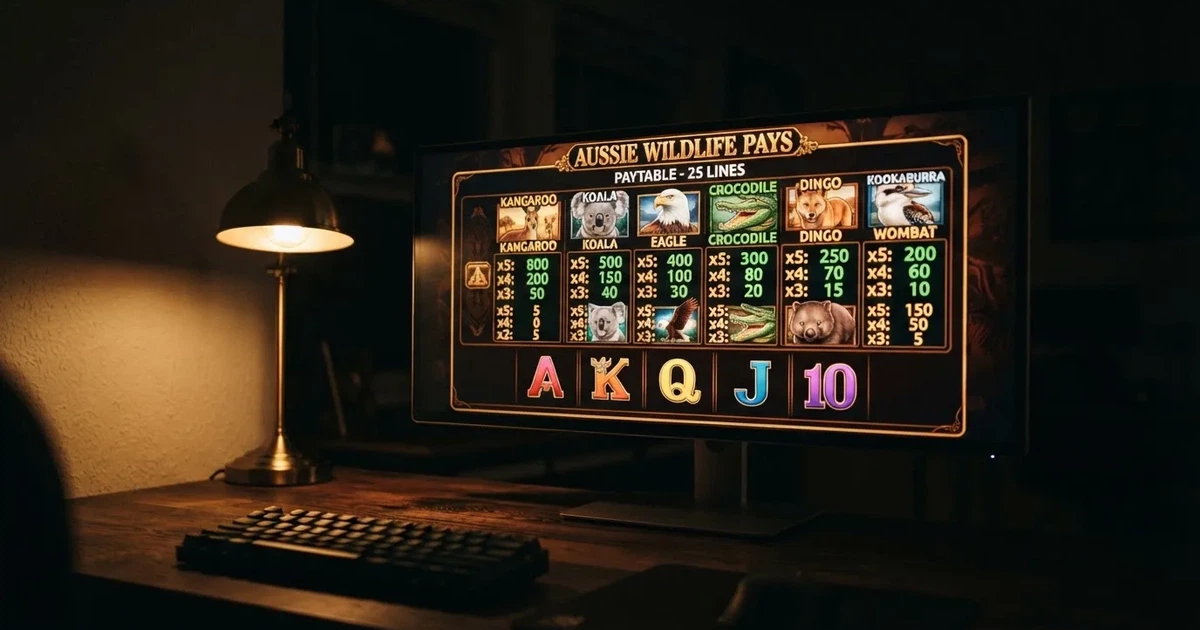
What follows lays out what that prohibition actually covers, what it costs a player who ignores it, and where the Big Red theme is and is not available. It is not a shortlist of places to play, because no such shortlist exists for the Australian reader. The data was checked against the ACMA’s formal-warning register and blocking-request list as of 9 November 2026.
Table of Contents
- What the law actually prohibits
- Where the licensed floor sits, and where the theme is actually found
- The mechanics behind the theme
- How the Big Red theme landed offshore in the first place
- Responsible play on the licensed floor, and outside it
- The brands named by the ACMA, and what their listings show
- How to read a “Big Red” listing, and what to look for instead
- Verdict on the subject as a whole
- Frequently asked questions
What the law actually prohibits
The Interactive Gambling Act 2001, tightened by the Interactive Gambling Amendment Act 2017, makes it an offence for an operator to provide online casino games, online pokies or in-play betting to a person physically in Australia. The relevant concept for this page is the prohibited interactive gambling service — casino-style games, slots in any of their names, table games streamed live — all of it. No state or territory licensing regime covers it. What Australia does license is wagering on racing and sport placed before the event, lotteries and keno, and in practice the Northern Territory Racing and Wagering Commission carries most of the online wagering licences — fifty-two of them, including Sportsbet, Bet365 and Ladbrokes. The commission that does this work has no full-time staff and meets once a month in Darwin.

The prohibition targets the provider, not the individual player. An Australian punter is not at risk of prosecution for opening an offshore casino on their phone. They are, however, exposed to the entire consumer-protection gap that the prohibition was designed to leave open for offshore operators: no Australian complaints body, no recourse if a withdrawal is refused, no balance protected if the ACMA directs Australian internet service providers to block the site. The site can be made unreachable in Australia with money still owed.
Enforcement sits with the ACMA, which can investigate, issue formal warnings, and ask ISPs to block illegal sites. The first such blocking request went out in November 2019. By the round reported in June 2026, the ACMA had directed ISPs to block a total of 1,751 illegal gambling and affiliate-marketing websites since that first request, and more than 230 unlicensed services had left the Australian market since enforcement was strengthened in 2017. The same June 2026 round added twelve more names to the block list — 7Signs, ChromaBet, Donbet, Duospin, Freshbet, Slots Gem, Jacks Club, Lucky Start, Pointsbetz.com, Spinrise, Vinyl Casino and Wildsino. The pace of these rounds has not slowed.
The cost of the prohibition’s failure is not abstract. H2 Gambling Capital’s 2025 report estimates that Australians lose about A$3.9 billion a year to illegal offshore gambling sites, and that the share of gambling going through legal Australian channels fell from 74% in 2021 to 64%. Each percentage point of that slide is money that left the regulated environment, where complaints can be made and self-exclusion holds, for an environment where it cannot.
What the 2026 reform changes, and what it does not
The Interactive Gambling Amendment (Gambling Reform) Bill 2026 passed Parliament on 19 August 2026. Its advertising and inducement measures commence on 1 January 2027 — law on the books now, but not yet in force at the time this page was written. The reform is not a legalisation of online casino games. It tightens the existing prohibition on inducements, advertising and certain bonus mechanics aimed at Australian customers. A reader who reaches a page like this in early 2027 will find inducements harder to find; the underlying prohibition on the product itself remains.
What a “Big Red” theme is, and what it isn’t
Big Red is an Aristocrat Leisure-designed pokie theme — Australian outback imagery, kangaroos and dogs, tree symbols, scatter pays, the kind of game a punter recognises from a pub in regional NSW as much as from a casino floor in Melbourne. It is a land-based electronic gaming machine, not an online product. There is no Aristocrat-licensed online casino game of this theme offered to Australians through any lawful Australian channel, because no such channel exists. The pages that surface in search results for the term “Big Red pokies online” are almost without exception offshore casinos hosting a clone or an unrelated game of the same name — and those operators are precisely the ones the ACMA’s blocking programme is built to make unreachable.
Where the licensed floor sits, and where the theme is actually found
If the question is where to find a Big Red-style pokie in Australia, the answer is the licensed venue floor: registered clubs, hotels and casinos, operating under state and territory regulation. Registered clubs operated Australia’s first legal poker machines from 1956, in New South Wales. Electronic gaming machines operate in every Australian state and territory today, and each jurisdiction separately regulates their design, number and operation.
New South Wales held 87,298 gaming machines outside casinos across 2,195 venues as at June 2023, with player losses of A$8.18 billion in 2022–23. Queensland had 21,122 gaming machines operating in 351 venues in October 2023. Victoria had 26,380 outside Crown Casino in 488 venues in 2021–22, under a 30,000-machine statewide cap. Tasmania’s machines were run under a monopoly licence held by the Federal Group from 1968 until legislation passed in November 2021 ended that monopoly and moved oversight to the Tasmanian Liquor and Gaming Commission. Western Australia banned poker machines in pubs and clubs when Crown Perth opened in 1985; Crown Perth’s own machine count has since grown from about 200 in 1985 to roughly 2,500, all approved by the state’s Gaming and Wagering Commission.
These machines have a minimum return-to-player set by jurisdiction, not by operator: 85% in New South Wales, the Northern Territory, Queensland and (generally) Victoria, with Crown Melbourne at 87%; 87% in the ACT and Tasmania; 87.5% in South Australia; and 90% in Western Australia. The differences look small but compound over time. A 90% minimum return is meaningfully cheaper for the punter than an 85% minimum return — the house edge is the same number, but the time a stake lasts is not. Tasmania also planned nation-leading mandatory pre-commitment cards for its machines, although implementation of the reform was delayed until late 2025.
In 2020–21 Australians bet almost A$150 billion through gaming machines and lost A$12.18 billion on them. The country has about 3% of the world’s pub and club poker machines with 0.3% of the global population. That ratio is the one fact a reader should hold onto when reading the rest of this page: the licensed floor is enormous, the offshore funnel that draws money out of it is also enormous, and the prohibition is the boundary between them.
The mechanics behind the theme
A Big Red-style pokie is, mechanically, a five-reel slot with Australian-outback symbols and a free-games feature, traditionally with a free-spin retrigger and a gambling option to double a small win. The game does not differ from newer video slot themes on the underlying math: a return-to-player set by the operator within the state minimum, a house edge that is the complement of that figure, and a volatility profile that determines how often wins land and how big they tend to be.
Two older casino staples that share pub floors with the Big Red theme are worth comparing for the kind of volatility profile a punter walking up to a machine might meet. Baccarat has a house edge of 1.06% on the Banker bet, 1.24% on the Player bet and 14.36% on the Tie. The game is dealt from a shoe of six or eight decks, with cards 2-9 counting at face value, 10/J/Q/K at zero and aces at one, and hand totals taken modulo 10. Punto banco — the variant most played today — was developed in Havana during the 1940s and the casino banks the game at all times. Chemin de fer, the two-player variant, emerged in the late 19th century and takes its name from being quicker to play than baccarat banque. Crown Melbourne offers three baccarat variants — Traditional Baccarat, Crown Baccarat and 2 to 1 Baccarat — as approved table games regulated by the Victorian Gambling and Casino Control Commission, which replaced the VCGLR as Victoria’s casino regulator on 1 July 2022.
Blackjack, on the same floors, has a much lower house edge if the punter plays with discipline: about 0.28% under liberal Las Vegas Strip rules (dealer stands on soft 17, double on any two, double after split, resplit aces, late surrender) and about 0.43% under Atlantic City rules. The game’s predecessor was the English vingt-un, with a related veintiuno described in Miguel de Cervantes’ Rinconete y Cortadillo around 1601-1602; it was renamed “blackjack” around 1899 during the Klondike Gold Rush. Number cards count at their number, jack/queen/king at ten, and an ace at one or eleven. The dealer must keep drawing until reaching seventeen or higher. Variants on licensed floors include Spanish 21, Double Exposure, Blackjack Switch and Super Fun 21.
The point of these comparisons is not to recommend a table game over a slot. Both are licensed products. The point is that the licensed floor offers a range of mathematics that an offshore casino’s Big Red clone cannot replicate, because the offshore operator’s house edge is whatever the operator set it to — and is not constrained by an Australian state minimum.
How the Big Red theme landed offshore in the first place
The mechanics above are not proprietary. The licensed Australian machine market uses Aristocrat, IGT, Konami and Ainsworth themes. Once a theme is proven on a licensed floor, an offshore operator can produce a game of the same name, the same imagery, and a paytable calibrated to whatever return-to-player the operator chooses. That is what the search results for “Big Red pokies online” point to. The ACMA’s blocking programme is built to make those pages unreachable from an Australian IP, but the page is generated, the affiliate link is paid, and the money still flows.
The ACMA’s own formal-warning register is the cleanest source on how far this has gone. The 2025 and 2026 record names operator after operator. In May 2022 the ACMA warned Dama N.V. covering six casino brands: Bambet, Dazard, Level Up, Rocketplay, Wild Tornado and Cobra Casinos. The same Dama N.V. drew further warnings over Woo Casino in March 2025 and Spirit Casino in May 2025. In July 2025 the ACMA warned Bamboo Media over Ignition Casino and Consolutetish S.R.L. over National Casino and Bizzo Casino — the latter had already been the subject of a 2022 warning to TechSolutions. In February 2025 the ACMA warned EOD Code SRL over Instant Casino. In April 2025 the ACMA warned Sterplay Holding Ltd over Casino Intense. The ACMA also issued a formal warning to Hollycorn N.V. over Sky Crown and Blue Leo. In March 2026 the ACMA warned Pulsup Ltd over Rocketplay.com.au. In April 2026 the ACMA warned Ryker B.V. over Jackbit and CasinOK.
That is the visible record. The blocking rounds are a separate stream — twelve domains at a time, 1,751 since November 2019, and the pace has not slowed. The two streams together describe the same thing: a market that Australia does not license, that the ACMA moves against through formal warnings, and that an Australian punter can still reach through a VPN, a different DNS, or a momentary lapse in ISP enforcement. The cost of that access is borne by the punter, not by the regulator.
The blocking rate, as a band
Between November 2019 and the round reported on 26 June 2026, the ACMA directed ISPs to block 1,751 illegal gambling and affiliate-marketing websites — a span of roughly six and a half years. That is an average of around 269 blocked domains per year, or close to 22 a month across the entire programme. The rate has not been constant. Earlier years were slower as the regulator built the programme; later years have been faster, particularly as affiliate marketing sites — pages that exist only to funnel traffic to an offshore casino — were added to the block list. The June 2026 round alone added twelve, including Vinyl Casino, Wildsino and Pointsbetz.com, all of which were either freshly registered or had simply not yet appeared on the regulator’s radar.
Read as a band, the rate is somewhere between one and three formal blocking requests per month, on top of formal warnings that do not always lead to a block. It is a band, not a single figure, because the figure depends on which window you measure it across. The point is not the precise number. The point is that the ACMA’s enforcement is a sustained programme, not a one-off sweep — and that any operator visible on the ACMA’s register this month is likely to be the subject of a blocking request within a few months if it has not already been.
Responsible play on the licensed floor, and outside it
The protections that exist for an Australian punter run through the licensed environment and stop at its edge. BetStop, the National Self-Exclusion Register, has been live since August 2023. It binds Australian-licensed online and phone wagering services — sportsbook and racing, in practice. An offshore casino is not connected to it. Self-excluding on BetStop does not block an offshore site; it binds the licensed operators to honour the exclusion. State-level self-exclusion schemes exist for the venue floor, and the venue operators honour them on their own machines.
Help is available regardless of whether the play is licensed. The National Gambling Helpline is 1800 858 858 — free, twenty-four hours a day, every day — with chat at Gambling Help Online. Both cover the licensed floor and the offshore route, because the harm is the same and the help is the same. A punter who has lost money to an offshore casino that refuses a withdrawal has the same helpline as a punter who has run up venue-floor losses; what they do not have is the same complaint pathway back to the operator.
The credit-card ban matters here too. Credit cards, credit-related products and digital currency have been banned as payment for licensed online wagering since 11 June 2024, with penalties up to A$247,500 for operators. The legal deposit routes for licensed wagering are debit card, bank transfer, PayID/Osko and BPAY. A site asking an Australian for a credit card or a crypto deposit is operating outside the Australian rules — a useful tell in itself. The same sites are typically the ones the ACMA’s blocking programme targets.
Recreational gambling winnings are not assessable income for tax purposes (section 6-5 ITAA 1997) and losses are not deductible, unless the person carries on a business of gambling. The ATO’s position is the one to consult for an individual’s situation; the rule is the rule, not the advice.
The brands named by the ACMA, and what their listings show
What follows is not a ranking and not a shortlist of places to play. Each brand is here because the ACMA itself issued a formal warning over it for offering prohibited services to Australians. The page’s job is to name them and to say what the formal-warning record establishes about each — nothing more. Where the research sources carry a listing-side note about a Big Red-style title or a related theme, that note is reproduced as what those listings report, never as the operator’s own fact.
RocketPlay
The ACMA issued a formal warning to Pulsup Ltd over Rocketplay.com.au in March 2026. Dama N.V. was warned earlier over the same brand in May 2022. Rocketplay sits across two separate ACMA actions against two separate operators — a useful illustration of the fact that a brand name can persist across operator ownerships and that the formal-warning record tracks the operator, not just the front-of-house name. The ACMA’s stance is definitive: such services are prohibited in this market.
Level Up Casino
The ACMA warned Dama N.V. in May 2022, with Level Up one of six brands in the same notice. The operator is the one named in the formal warning; the brand is one of the six.
Woo Casino
Dama N.V. was warned again in March 2025, this time specifically over Woo Casino. The warning sits in the ACMA’s published register and is the formal record. As a prohibited interactive gambling service, this brand falls outside the Australian regulatory framework.
Spirit Casino
Dama N.V.’s third warning in this register came in May 2025, over Spirit Casino. The pattern is the operator, not the brand — but the ACMA’s register tracks each by name.
National Casino
Consolutetish S.R.L. was warned in July 2025 over National Casino. There is no valid Australian licence for these services, and the operator is not sanctioned to provide them. The site’s own listings reference Australian themes in passing; those listings do not, on their own, bring the operator within the Australian licensing regime.
Bizzo Casino
The same July 2025 warning covered Bizzo Casino. The ACMA had previously warned TechSolutions (CY) Group Limited and TechSolutions Group N.V. over Bizzo in 2022. The warning stack is one of the longest in the register — the same brand, two different operator-entities, two separate ACMA actions.
Ignition Casino
Bamboo Media was warned in July 2025 over Ignition Casino. The regulator has explicitly warned against this site for offering unlawful services to Australian residents.
Instant Casino
EOD Code SRL was warned in February 2025 over Instant Casino. Despite any claims of international licensing, these games are illegal under the Interactive Gambling Act.
Jackbit
Ryker B.V. was warned in April 2026 over Jackbit, in the same notice that also covered CasinOK. As this is an unlicensed operator, any deposit on this platform falls entirely outside the scope of Australian legal protections.
Casino Intense
Sterplay Holding Ltd was warned in April 2025 over Casino Intense. This brand is not authorised to operate in Australia, and the ACMA has flagged it accordingly.
Sky Crown
Hollycorn N.V. was the subject of a formal warning over Sky Crown and Blue Leo, published as a PDF in September 2022. The ACMA maintains this operator is not sanctioned for Australian service, rendering any games offered here illegal.
ACMA formal-warning register at a glance
| Brand | ACMA action | Operator named | Subject support |
|---|---|---|---|
| RocketPlay | Formal warning, March 2026 | Pulsup Ltd (also Dama N.V., May 2022) | — |
| Level Up Casino | Formal warning, May 2022 | Dama N.V. | listings mention Australian themes in passing |
| Woo Casino | Formal warning, March 2025 | Dama N.V. | — |
| Spirit Casino | Formal warning, May 2025 | Dama N.V. | — |
| National Casino | Formal warning, July 2025 | Consolutetish S.R.L. | listings mention Australian themes in passing |
| Bizzo Casino | Formal warning, July 2025 (also 2022) | Consolutetish S.R.L. (also TechSolutions) | — |
| Ignition Casino | Formal warning, July 2025 | Bamboo Media | — |
| Instant Casino | Formal warning, February 2025 | EOD Code SRL | — |
| Jackbit | Formal warning, April 2026 | Ryker B.V. | — |
| Casino Intense | Formal warning, April 2025 | Sterplay Holding Ltd | listings note Australian-adjacent content |
| Sky Crown | Formal warning, September 2022 | Hollycorn N.V. | — |
The em-dash cells are not an oversight. They are the honest answer: the ACMA’s published record does not connect the brand’s offerings to the licensed Australian venue floor, and the research sources do not carry a verified subject-side link for those rows. A row showing what the operator’s own listings claim about the Big Red theme would not be a research-backed fact and is not on this page.
How to read a “Big Red” listing, and what to look for instead
The reader who lands on this page has, in almost every case, come from a search result advertising a Big Red-style game on an offshore casino. The question they want answered is not “is this site licensed in Australia” — they know the answer is no, because the search result itself is the proof. The question is “what does the licensed Australian alternative look like.”
A licensed venue’s machine floor is the answer. A punter who wants the Big Red-style theme can ask a venue operator — club, pub, casino — whether Aristocrat’s Big Red theme is on their floor. The same venues are the ones bound by the state minimum return-to-player, the same state self-exclusion schemes, the same harm-minimisation requirements. The licensed floor is not perfect — the 2020–21 loss figure of A$12.18 billion against gaming machines is a sober reminder that the floor carries its own harms — but it is the only place in Australia where the money a punter loses comes back into a system that the punter can complain to.
A shortlist comparing offshore sites against the licensed floor is not a comparison that this page can make in good faith. The shortlist would be a list of operators the ACMA has acted against. That list is here, in the table above. The verdict on each is the same: every operator named is offering a product the ACMA has said is prohibited, and a balance on any of them is at the regulator’s mercy. The differentiation between the rows is the date and the operator-entity, not a quality judgement — there is no quality judgement to make, because the product itself is unlawful.
Verdict on the subject as a whole
A Big Red-style pokie is a licensed Australian venue product. As an online casino game offered to a person physically in Australia, it is a prohibited interactive gambling service under the Interactive Gambling Act 2001. The pages that advertise it anyway are the ACMA’s enforcement target — and the formal-warning register, with its twelve latest blocking requests and 1,751 since November 2019, is the regulator’s running record. The licensed floor offers the theme under state minimum returns-to-player, with state-level self-exclusion, and with the National Gambling Helpline one phone call away. The offshore route offers none of that, charges the punter the full cost of any unregulated house edge, and can be blocked with a balance still owed.
The reader who is looking for the theme itself should look at the licensed floor. The reader who is looking at an offshore site advertising it should know what the ACMA’s register says about that operator before opening an account — and should know that the operator’s own licence, whatever it displays, does not bring the product within Australian law.
Frequently asked questions
What style of pokies theme does “Big Red” typically refer to?
Big Red is an Aristocrat Leisure-designed pokie theme — Australian-outback imagery, kangaroos, dogs, tree symbols, a free-games feature and a gamble option — found on licensed pub, club and casino floors across the country. It is a land-based electronic gaming machine. There is no Aristocrat-licensed online version offered to Australians, because no such online channel is licensed in Australia.
Can an online version of a Big Red-style pokies game be legally played by someone in Australia?
No. Online casino games, including online pokies in any of their names, are a prohibited interactive gambling service under the Interactive Gambling Act 2001. The provider is the one the law targets, but the player using an offshore site gives up Australian consumer protection, complaints pathways and recourse if a withdrawal is refused, and the site can be blocked by the ACMA with a balance still owed.
Are classic Australian-themed pokies machines still found in licensed pubs and clubs?
Yes. New South Wales held 87,298 gaming machines outside casinos across 2,195 venues as at June 2023. Queensland had 21,122 machines across 351 venues in October 2023. Victoria ran 26,380 outside Crown Casino in 488 venues in 2021–22, under a 30,000-machine statewide cap. Every state and territory separately regulates the design and operation of these machines.
Why do offshore sites keep advertising Big Red-style games to Australian visitors?
Because the search demand is there and the ACMA’s blocking programme is the only Australian enforcement against it. The formal-warning register has named dozens of operator-entities since 2017, and 1,751 domains have been blocked since November 2019 — but the marketing pages keep being generated, the affiliate links keep being paid, and the ACMA keeps adding new names to its list.
Does the volatility of a Big Red-style machine differ from newer video slot themes?
The mathematical profile of a Big Red-style machine is not proprietary — any offshore operator can produce a game of the same name and imagery with whatever return-to-player and volatility they choose. The licensed Australian machine market uses Aristocrat, IGT, Konami and Ainsworth themes, all constrained by the state minimum return-to-player — 85% in NSW, the Northern Territory, Queensland and generally Victoria, 87% in the ACT and Tasmania, 87.5% in South Australia, and 90% in Western Australia.
How can someone confirm whether a specific pokies theme is on a licensed Australian venue’s floor?
Ask the venue operator directly. Clubs, hotels and casinos in NSW, Queensland, Victoria, Tasmania, the ACT and the Northern Territory publish their machine-floor information on request. Western Australia does not have poker machines outside Crown Perth, which has about 2,500 machines approved by the state’s Gaming and Wagering Commission. A licensed venue is bound by state minimum returns-to-player and by the state self-exclusion scheme, and the National Gambling Helpline (1800 858 858) is open twenty-four hours a day.