
New Australian online pokies in 2026: what is allowed, what is blocked, and what that means for the player
Anyone typing “new online pokies” into a search box wants a working shortlist. For an Australian reader, that shortlist starts with a problem rather than a recommendation. The Interactive Gambling Act 2001 makes it an offence to provide online casino games — including online pokies — to anyone in Australia, and no state or territory issues a licence for it. The page that follows lays out that gap plainly, names the operators the ACMA has acted against, and points to what a reader in Australia can actually do with a stake.
Data current as of 30 October 2026 and verified against the ACMA register of blocking actions and formal warnings.
Table of Contents
- The legal landscape for new online pokies in Australia
- How the ACMA enforces it: blocking requests and formal warnings
- The ACMA’s record on individual operators
- What an Australian player can actually do with a stake
- How money actually moves for new pokies, if it moves at all
- The games themselves: what “new” actually means
- Responsible gambling: what works and what doesn’t reach an Australian player
- Practical consequences of the legal frame
- The operators named by the ACMA: what the record shows
- The bigger Australian gambling picture
- Tax and what a recreational player needs to know
- Where this leaves an Australian reader
- Frequently asked questions
The legal landscape for new online pokies in Australia
Online pokies are the online version of the electronic gaming machines — poker machines, “pokies” — that operate in every Australian state and territory. The land-based machines are legal. Each state and territory regulates them separately, with their own design rules, return-to-player floors and venue caps. New South Wales runs 87,298 gaming machines outside casinos across 2,195 venues (June 2023). Queensland has 21,122 machines in 351 venues (October 2023). Victoria holds 26,380 outside Crown Casino in 488 venues (2021–22) under a 30,000-machine statewide limit. Crown Perth’s own count has grown from roughly 200 in 1985 to around 2,500 today. The online version of these machines is a different matter.

What the Interactive Gambling Act 2001 prohibits
The Interactive Gambling Act 2001, tightened by the Interactive Gambling Amendment Act 2017, makes it an offence to provide online casino games, online pokies or in-play betting to a person physically in Australia. No state or territory issues a licence for online casino games. What is licensable is wagering on races and sport placed before the event, lotteries and keno — and in practice even those are licensed by the Northern Territory, not by each state: the NT Racing and Wagering Commission regulates 52 of Australia’s online bookmakers — Sportsbet, Bet365, Ladbrokes among them — under a tax-driven arrangement, with a commission that meets once a month in Darwin and no full-time staff.
The IGA targets the provider, not the individual player. An Australian who opens an account on an offshore casino is not personally prosecuted. What they give up is the layer an Australian licence is built to provide: no Australian consumer protection, no complaints body, no recourse if a withdrawal is refused, and a real chance the site is blocked by the time they try to cash out.
What an Australian-licensed site can and cannot offer
Licensed Australian online wagering can take bets on racing, on sport before the event, on lotteries and on keno. It cannot offer online pokies, online blackjack, online roulette or online baccarat. Credit cards, credit-related products and digital currency are banned as payment for licensed online wagering since 11 June 2024, with penalties up to A$247,500 for operators. The legal deposit routes for licensed wagering are debit card, bank transfer, PayID/Osko and BPAY. A site asking an Australian for a credit card or a crypto deposit is operating outside the Australian rules.
The minimum age for any gambling activity in Australia is 18.
How the ACMA enforces it: blocking requests and formal warnings
The ACMA (Australian Communications and Media Authority) investigates complaints, issues formal warnings to providers, and directs Australian internet service providers to block illegal services. Two instruments matter, and the page reads more clearly once they are kept apart.
A formal warning is a written notice to the operator behind the site, naming the operator and the brand, and is published on the ACMA register. It is the ACMA’s first formal step under the IGA and precedes a blocking request when the operator doesn’t withdraw.
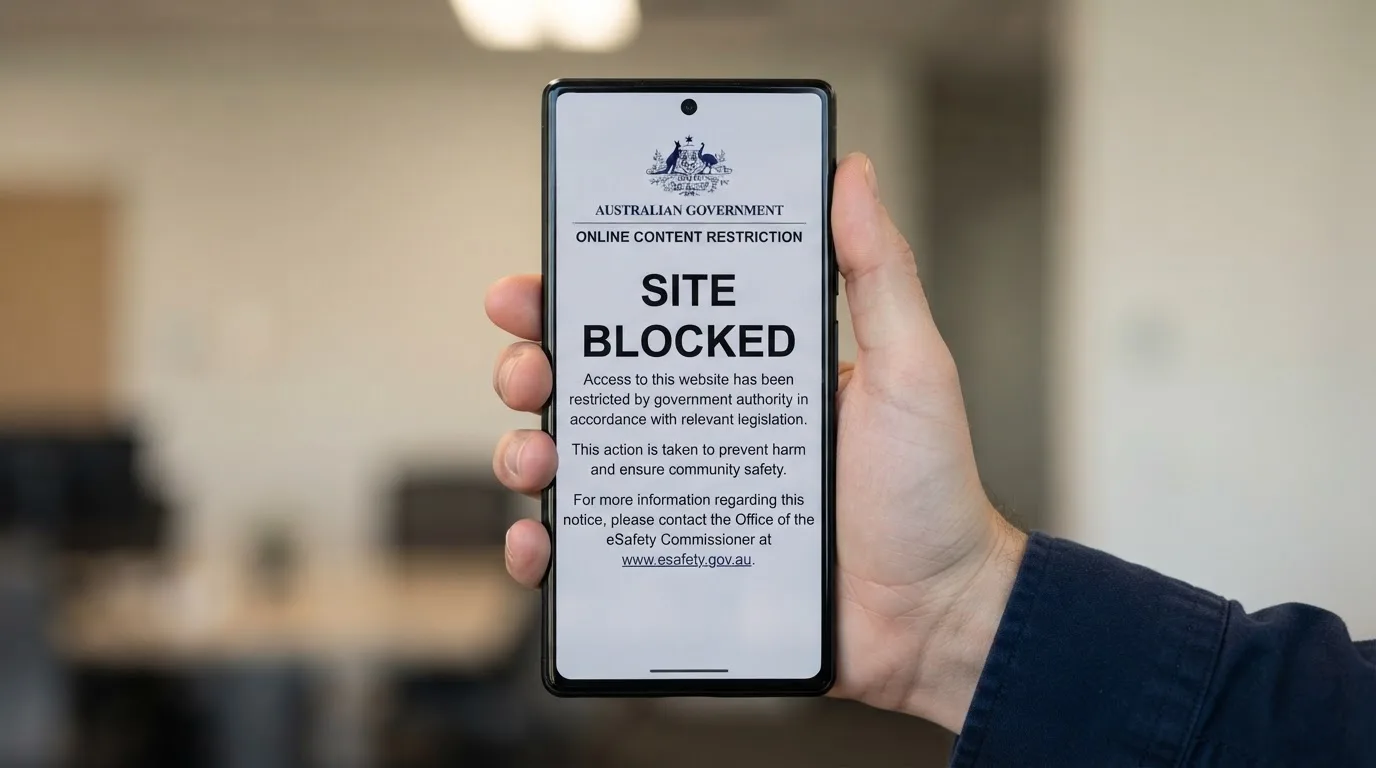
A blocking request is the later, harder step: the ACMA asks Australian ISPs to block the site at the network level. Once blocked, the site is unreachable from most Australian connections without a workaround.
The cumulative picture
As of June 2026, a total of 1,751 illegal gambling and affiliate marketing websites had been blocked since the first blocking request in November 2019. More than 230 unlicensed gambling services had left the Australian market since enforcement was strengthened in 2017. The latest round reported on 26 June 2026 added twelve more sites to the blocked list: 7Signs, ChromaBet, Donbet, Duospin, Freshbet, Slots Gem, Jacks Club, Lucky Start, PointsBetz, Spinrise, Vinyl Casino and Wildsino.
H2 Gambling Capital’s 2025 estimate puts Australians’ losses to illegal gambling sites at roughly A$3.9 billion a year, and the share of gambling going through legal channels fell from 74% in 2021 to 64%.
### Blocking statistics
| Statistic | Figure |
|---|---|
| Total sites blocked | 1,751 |
| Blocking window | Nov 2019 – June 2026 |
| Cumulative sites left market | 230+ |
Blocking rate as a measure of how this market is moving
The first blocking request under the current regime was issued in November 2019. By the end of June 2026, the cumulative count reached 1,751 sites blocked. That is roughly 265 blocked sites per year across the seven-year window, and the rate has climbed over time — the early rounds added handfuls, while recent rounds run into double digits per announcement. The rate matters less as a precise figure than as a direction: enforcement has moved from occasional warnings to a steady blocking rhythm, and offshore operators with an Australian customer base have been exiting rather than fighting it. A reader looking at a new offshore brand today is looking at a service the ACMA has had the legal tools to block for the entire life of the brand’s Australian-facing operation.
The ACMA’s record on individual operators
The ACMA’s formal-warning register reads like a ledger of the offshore brands that have drawn an Australian customer base. The pattern that runs through it is instructive: the same operator company can run multiple brands, the warnings land across years, and a brand warned in one round has often been a brand warned before under a different parent.
The Dama N.V. cluster
Dama N.V. is the operator behind the largest group of brands the ACMA has named. A May 2022 formal warning covered six Dama N.V. brands at once: Bambet, Dazard, Level Up, Rocketplay, Wild Tornado and Cobra Casinos. The ACMA issued further formal warnings to Dama N.V. over Woo Casino in March 2025 and over Spirit Casino in May 2025. Rocketplay drew a separate warning in March 2026, this time to Pulsup Ltd over Rocketplay.com. The picture across five years is one operator company being warned, withdrawing or rebranding, and reappearing under a related entity.
Bamboo Media and the Consolutetish cluster
In July 2025 the ACMA issued formal warnings to Bamboo Media over Ignition Casino and to Consolutetish S.R.L. over National Casino and Bizzo Casino. Bizzo Casino had already been the subject of a 2022 formal warning — that earlier round named TechSolutions (CY) Group Limited and TechSolutions Group N.V. as the operator.
Smaller but consistent cases
A February 2025 formal warning to EOD Code SRL covered Instant Casino. An April 2026 formal warning to Ryker B.V. covered Jackbit and CasinOK. An April 2025 formal warning to Sterplay Holding Ltd covered Casino Intense. A Hollycorn N.V. formal warning covered Sky Crown and Blue Leo. The cadence is steady: a handful of formal warnings per year, each naming the operator behind a brand an Australian player could plausibly encounter.
| Brand | ACMA action and date | Operator named by the ACMA | Subject support |
|---|---|---|---|
| RocketPlay | Formal warning, March 2026; earlier Dama N.V., May 2022 | Pulsup Ltd; Dama N.V. | — |
| Level Up Casino | Formal warning, May 2022 | Dama N.V. | BGaming lists the brand |
| Woo Casino | Formal warning, March 2025 | Dama N.V. | — |
| Spirit Casino | Formal warning, May 2025 | Dama N.V. | — |
| National Casino | Formal warning, July 2025 | Consolutetish S.R.L. | Wikipedia mentions the brand |
| Bizzo Casino | Formal warning, July 2025; earlier 2022 | Consolutetish S.R.L.; TechSolutions | — |
| Ignition Casino | Formal warning, July 2025 | Bamboo Media | — |
| Instant Casino | Formal warning, February 2025 | EOD Code SRL | — |
| Jackbit | Formal warning, April 2026 | Ryker B.V. | — |
| Casino Intense | Formal warning, April 2025 | Sterplay Holding Ltd | ABC News, acma.gov.au, Crown Melbourne cite the brand |
| Sky Crown | Formal warning published September 2022 | Hollycorn N.V. | — |
Eleven brands, and the same shape across them: an offshore operator with an Australian-facing site, a formal warning from the ACMA, and no Australian licence. Where research carries an outside listing that names the brand, the table records it; where it carries none, the cell stays empty rather than asserting a fact no source supplied.
What an Australian player can actually do with a stake
The shortlist that a “new pokies” search is really asking for runs, in practice, in three directions. Each has a different legal status.
Licensed Australian wagering — racing and sport
Australian-licensed bookmakers can take bets on horse and harness racing, on greyhound racing, and on sporting events before they start. The market is dominated by brands licensed through the Northern Territory — Sportsbet, Bet365, Ladbrokes among them. Deposits are debit card, bank transfer, PayID or BPAY. Withdrawals are paid back to an Australian bank account. The protections an Australian licence provides apply in full: a complaints body, dispute resolution, and BetStop self-exclusion binding across every Australian-licensed service the player uses.
Licensed Australian pokies — clubs, pubs and casinos
Pokies are legal in clubs, pubs and casinos in every state and territory except Western Australia, where the machines are banned outside Crown Perth. Each jurisdiction sets its own minimum return-to-player: 85% in NSW, the Northern Territory, Queensland and generally Victoria (87% at Crown Melbourne), 87% in the ACT and Tasmania, 87.5% in South Australia, and 90% in Western Australia. Registered clubs operated Australia’s first legal poker machines from 1956, in New South Wales. Tasmania held a monopoly licence with the Federal Group from 1968 until November 2021, when the legislation ended that monopoly and moved oversight to the Tasmanian Liquor and Gaming Commission; mandatory pre-commitment cards for the machines were planned to be nation-leading, but implementation was delayed until late 2025.
Offshore online casinos — illegal to offer, reachable from Australia
The third direction is the one this page is named after, and the one with the most risk and the least protection. Online casino games — online pokies included — are prohibited for people in Australia under the Interactive Gambling Act 2001. Offshore operators continue to take Australian customers, and the ACMA continues to issue formal warnings and block sites. An Australian player who uses one gives up the Australian consumer-protection layer, can find their site blocked with a balance still on the account, and has no path through an Australian complaints body if a withdrawal is refused.
How money actually moves for new pokies, if it moves at all
The shelf that asks about PayID and no-deposit bonuses for new pokies needs to be answered in the same key the rest of the page is in: what the law allows, and what the offshore sites offer despite the law.
PayID
PayID is an Australian payments rail that lets a transfer settle using a mobile number, email address or ABN instead of a BSB and account number. It runs on the New Payments Platform and settles through Osko, typically in under a minute. It is one of the four legal deposit routes for Australian-licensed wagering — debit card, bank transfer, PayID/Osko and BPAY. An offshore casino may accept PayID as a deposit route, and the deposit will reach the operator through the Australian banking system. What PayID does not change is the legal status of the operator: a PayID deposit into an account held by an offshore casino is still a deposit into a service prohibited under the IGA, and the consumer protections that apply to an Australian-licensed wagering deposit do not transfer.
No-deposit bonuses
“No-deposit” promotions are a marketing device used by offshore casinos to draw new sign-ups: a small credit or a handful of free spins offered without an initial deposit, in exchange for creating an account. The mechanics behind them are familiar across the offshore market — a credit that converts to withdrawable cash only after a wagering multiple, a maximum cashout ceiling, and an expiry window that runs to days rather than weeks. The promotional offer itself is not the legal problem; the legal problem is the underlying service the offer sits on. Reading a no-deposit offer as a way to evaluate an offshore casino is reading past the ACMA’s formal warning to the marketing the operator has put on top of it.
Withdrawal timing in practice
An offshore casino promising fast withdrawals is promising a payout from a bank account held outside Australia, in a currency the player converts back to Australian dollars. Where Australian-licensed wagering pays out to an Australian bank account through PayID or BPAY, the settlement is in Australian dollars and arrives through a regulated rail. The offshore path adds a currency conversion, a third-party payment processor, and the possibility that a blocked site has frozen withdrawals while the ACMA’s blocking round is processed.
The games themselves: what “new” actually means
A “new pokies” release in the licensed Australian market is a title approved by a state or territory regulator, installed on a venue floor, and made available to players through the venue’s network. The testing regime runs regulator by regulator: each jurisdiction sets the technical standards the machine must meet, and approval is granted before the title is rolled out to pubs, clubs or casinos. The lifecycle is short by gaming-industry standards — a “new release” usually means within the current calendar year on licensed floors.
Mechanics that travel across releases
What changes most often in new pokies releases is the visual and audio presentation: a new theme, a new art treatment, a new bonus round. The mathematics — the reel layout, the return-to-player, the volatility band, the maximum win ceiling — is more stable, because venues and regulators prefer numbers that have been tested and audited. A new release usually carries a return-to-player at or just above the minimum for its jurisdiction, with a volatility band that fits the venue mix the operator runs.
Baccarat and blackjack as the table-game benchmark
Two table games sit alongside pokies on Australian casino floors and give a useful frame for thinking about house edge. In baccarat the house edge is 1.06% on the Banker bet, 1.24% on the Player bet, and 14.36% on the Tie. Punto banco, the variant most played today, was developed in Havana during the 1940s and is dealt from a shoe of 6 or 8 decks. In blackjack the house edge is roughly 0.28% under liberal Las Vegas Strip rules and 0.43% under Atlantic City rules — among the lowest in a casino, which is why blackjack variants are a fixture of the table-game mix. Crown Melbourne runs three baccarat variants — Traditional Baccarat, Crown Baccarat and 2 to 1 Baccarat — under Victorian Gambling and Casino Control Commission approval.
Why this matters for an offshore “new pokies” search
The titles an offshore casino advertises as “new” are not approved by any Australian regulator. The return-to-player the operator publishes is the operator’s own figure, audited (if at all) by a testing house the operator chose. The volatility band is the operator’s own classification. None of it carries the weight of a regulator’s approval, and none of it has the consumer protection that follows from approval. A player comparing “new pokies” between an Australian-licensed venue and an offshore casino is not comparing two products in the same category.
Responsible gambling: what works and what doesn’t reach an Australian player
The safeguards available to an Australian player are built around Australian-licensed services. They do not, in the main, extend offshore.
BetStop, the National Self-Exclusion Register
BetStop went live in August 2023 and binds every Australian-licensed online and phone wagering service. A player who registers is excluded from opening new accounts and from using existing ones, and the exclusion holds across operators. What BetStop does not cover is an offshore casino. Registering with BetStop has no effect on an account held with a Dama N.V., Hollycorn N.V., Bamboo Media or any of the other operator entities the ACMA has named.
The National Gambling Helpline
The National Gambling Helpline — 1800 858 858 — is free, runs 24/7 and offers chat through Gambling Help Online. It is staffed by counsellors and is the right first call for anyone whose gambling has moved from entertainment into something they cannot control. The helpline’s reach is the helpline’s own; an offshore operator is not in a position to honour a self-exclusion request sent through it.
Pre-commitment and the Tasmanian reform
Pre-commitment cards let a player set a spending cap before they sit down at a machine, and the cap holds across sessions. Tasmania planned to make these mandatory and nation-leading, with implementation delayed to late 2025. The mechanism is a venue-level tool: it requires a card to be issued, accepted and enforced by the venue, which is feasible on a licensed floor and not feasible across offshore sites.
What an Australian player is actually choosing between
The choice a real Australian reader is making is not between offshore casinos. It is between gambling and not gambling, or between the Australian-licensed options on offer and the limits on those options. The licensed Australian wagering market is well-developed for racing and sport. The licensed Australian pokies market is well-developed for venue play, with state-by-state rules and venue caps. The online casino market — the one a “new pokies” search is asking about — is prohibited. Reading the choice as a comparison between offshore operators is reading past the legal frame the comparison sits inside.
Practical consequences of the legal frame
The legal position translates into four practical consequences for any Australian reader holding a balance, a deposit pending or an account with one of the operators the ACMA has named.
A blocked site can hold a balance
When the ACMA asks Australian ISPs to block a site, the block takes effect at the network level. An Australian player with an open account and a positive balance cannot reach the site to withdraw. The offshore operator may offer an alternative URL, an alternative brand or a withdrawal route by email. None of those routes carries Australian consumer protection. The balance is held by an offshore entity outside any Australian regulator’s reach.
A formal warning does not, on its own, end the service
A formal warning is the ACMA’s first step. It tells the operator to stop offering prohibited services to Australians. The operator can comply — and some do, withdrawing from the Australian market entirely. Or the operator can continue to take Australian customers, and the ACMA can issue a blocking request in a later round. The warnings across Dama N.V. and the related entities over five years are the case in point: the same operator company has been warned, has withdrawn or rebranded, and has been warned again.
A licence displayed by the site is not an Australian licence
An offshore casino typically displays a Curaçao, Malta or Kahnawake licence, issued by a regulator in another jurisdiction. None of those licences is an Australian licence. None of those regulators can enforce a complaint from an Australian player. The page on which the licence badge sits is part of the marketing the ACMA has acted against.
The protections that exist are not portable
BetStop, the National Gambling Helpline, the state-by-state self-exclusion arrangements, the regulator-approved return-to-player floors, the venue caps and the complaints bodies are all built for Australian-licensed services. None of them travels to an offshore operator. An Australian player using an offshore casino has the marketing the operator chooses to publish, and nothing else.
The operators named by the ACMA: what the record shows
The brands the ACMA has acted against are listed here in the order set by the register. Each one has the same legal status — prohibited in Australia, whatever licence the site displays. Where research carries an outside listing that names the brand, that listing is recorded as what those listings report; where research carries none, the brand is presented on its ACMA record alone.
RocketPlay
The ACMA issued a formal warning to Pulsup Ltd over Rocketplay.com.au in March 2026. An earlier warning, in May 2022, named Dama N.V. among six brands that included Rocketplay. Two warnings, two operator entities, the same brand, and a clear record of rebranding.
Level Up Casino
A May 2022 formal warning covered Level Up Casino as one of six Dama N.V. brands. BGaming lists Level Up Casino among the operators carrying its content, which is a content-distribution record rather than a regulatory one.
Woo Casino
The ACMA issued a formal warning to Dama N.V. over Woo Casino in March 2025. The ACMA’s warning confirms the provider’s status as a prohibited service, and the record stands without further operator detail.
Spirit Casino
The ACMA issued a formal warning to Dama N.V. over Spirit Casino in May 2025. The ACMA register lists the warning, and for Australian players, the service remains a prohibited offshore offer.
National Casino
The ACMA issued a formal warning to Consolutetish S.R.L. over National Casino in July 2025. National Casino is named on Wikipedia’s coverage of the offshore market; the ACMA record is the operative Australian-side document.
Bizzo Casino
The ACMA issued a formal warning to Consolutetish S.R.L. over Bizzo Casino in July 2025. A 2022 warning had earlier named TechSolutions (CY) Group Limited and TechSolutions Group N.V. as the operator behind Bizzo. Two operators, one brand, a four-year span.
Ignition Casino
The ACMA issued a formal warning to Bamboo Media over Ignition Casino in July 2025. The ACMA action underscores the prohibited nature of the service, and no further verifiable details are attached to the operator’s record.
Instant Casino
The ACMA issued a formal warning to EOD Code SRL over Instant Casino in February 2025. This action is part of the ongoing enforcement register, with no external listings adding to the profile.
Jackbit
The ACMA issued a formal warning to Ryker B.V. over Jackbit in April 2026. Official records confirm the warning status, and the operator maintains no additional verifiable profile.
Casino Intense
The ACMA issued a formal warning to Sterplay Holding Ltd over Casino Intense in April 2025. ABC News, the ACMA register and the Crown Melbourne site have all cited Casino Intense in their coverage of the offshore market.
Sky Crown
The ACMA issued a formal warning to Hollycorn N.V. over Sky Crown in September 2022, alongside Blue Leo. Sky Crown is presented on the ACMA record alone.
The bigger Australian gambling picture
A page about new online pokies sits inside a wider market. In 2020–21 Australians bet almost A$150 billion through gaming machines and lost A$12.18 billion on them. Australia has about 3% of the world’s pub and club poker machines with 0.3% of the global population. New South Wales recorded A$8.18 billion in player losses on poker machines in 2022–23.
These numbers are about the legal market. The illegal offshore market is layered on top: H2 Gambling Capital’s estimate of A$3.9 billion a year to illegal sites is a second A$3.9 billion, separate from the A$12.18 billion on legal machines. Reading the two numbers together gives the size of what an Australian player is actually spending across both layers.
The 2026 reform: the Interactive Gambling Amendment (Gambling Reform) Bill 2026 passed Parliament on 19 August 2026. Its advertising and inducement measures commence 1 January 2027. It is law with a start date, not yet in force on a 2026 page, and it sits alongside the existing IGA framework rather than replacing it.
Tax and what a recreational player needs to know
Gambling winnings of a recreational player are not assessable income under section 6-5 ITAA 1997, and losses are not deductible. A player whose gambling moves from recreational to professional — a business of gambling — sits in a different tax treatment, and the right step there is to check with the ATO rather than work from the recreational rule.
Where this leaves an Australian reader
The search that opens this page — “new online pokies” — sits on top of a prohibited product. The eleven operators above are the brands the ACMA has acted against, and the legal frame around them is the Interactive Gambling Act 2001. The licensed alternatives are racing and sport wagering with an Australian-licensed bookmaker, and pokies on a licensed venue floor. The protections an Australian licence provides are real and they do not extend offshore.
A reader who wants the protections reads this as a guide to the licensed market: the racing and sport wagering options, the venue-floor pokies, the state-by-state rules, the return-to-player floors and the responsible-gambling tools that apply. A reader who wants the offshore product reads this as the reason the ACMA has been issuing formal warnings and blocking sites for the last seven years, and as the reason the protections end where the offshore site begins.
Frequently asked questions
How much do Australians lose on gaming machines in an average year?
Australians bet almost A$150 billion through gaming machines in 2020–21 and lost A$12.18 billion on them. NSW alone recorded A$8.18 billion in player losses on poker machines in 2022–23. A separate estimate puts losses to illegal offshore sites at around A$3.9 billion a year. The two figures together cover the legal and illegal markets a player can reach from Australia.
What counts as a new pokies release versus an established one?
On a licensed Australian venue floor, “new” usually means within the current calendar year, after regulator approval and installation. Offshore, “new” is whatever the operator is currently promoting, with no Australian regulator in the loop. The test of newness is the test of who approved the release.
Is it legal for an online casino to offer new pokies titles to Australians?
No. The Interactive Gambling Act 2001, as strengthened by the Interactive Gambling Amendment Act 2017, makes it an offence to provide online casino games — including online pokies — to a person in Australia. The ACMA enforces this through formal warnings and blocking requests. The individual player is not prosecuted, but the protections an Australian licence provides do not transfer to an offshore site.
Can a new pokies bonus be claimed through a PayID deposit?
PayID is a legal deposit route for Australian-licensed wagering — racing, sport, lotteries, keno. It is not a deposit route the IGA covers for online casino games, because online casino games cannot be lawfully offered in Australia. A PayID deposit into an account held by an offshore casino is still a deposit into a prohibited service, and the consumer protections that apply to an Australian-licensed wagering deposit do not transfer.
Are new pokies titles tested before they appear on licensed club or pub floors?
Yes, regulator by regulator. Each Australian state and territory sets the technical standards a gaming machine must meet and approves the title before it is rolled out to licensed venues. The testing regime is the reason licensed-floor machines carry a return-to-player at or just above the jurisdictional minimum.
Why does Australia have such a large share of the world’s poker machines?
Australia has about 3% of the world’s pub and club poker machines with 0.3% of the global population. The legal machine count is the product of decades of state-by-state regulation: NSW alone runs 87,298 machines outside casinos across 2,195 venues, Queensland has 21,122 in 351 venues, Victoria holds 26,380 outside Crown Casino. Western Australia is the outlier, having banned machines in pubs and clubs when Crown Perth opened in 1985. The distribution is the result of historical licensing choices made jurisdiction by jurisdiction, not a single national decision.