What the words “5-reel pokies” mean for an Australian reader in 2026
 Available in US
A punter typing “best 5-reel slots Australia 2026” into a search box is reaching for a familiar shape: a slot machine with five spinning reels, the kind of cabinet that has lived in Australian pubs and clubs since New South Wales first legalised them in 1956. The format itself is well understood. The same punter, sitting in front of a laptop, will quickly find that the version of it they can play for real money online sits behind a prohibition, and that what an Australian-based reader can actually do on a given day depends less on which site they pick than on a piece of 2001 federal law.
This page reads the format on its own terms first — what a 5-reel pokie is, what a paytable actually shows, why the format kept its shape across a hundred years of cabinets — and then reads the legal frame around it. The Interactive Gambling Act 2001 makes the offer itself unlawful. The Australian Communications and Media Authority then handles the consequences, blocking sites one round at a time and writing formal warnings to the operators behind them. Eleven brands the ACMA has written to are named below, with the operator the warning was sent to and the date it was sent, drawn from the ACMA’s own publications.
The page runs to one purpose: by the end of it, a reader should know what the format promises on its own merits, why almost every site offering it for real money is operating outside Australian law, and what changes once the block notice arrives.
Current as of 25 September 2026, checked against the ACMA’s register of formal warnings and its published blocking-round notices.
Table of Contents
- The format on its own terms
- What the IGA does to the format
- What a reader who plays anyway should know
- What the ACMA’s warnings name
- What the blocking rate tells a reader
- The 5-reel format versus its modern cousins
- Where Australian-licensed 5-reel play actually exists
- What the eleven ACMA warnings describe, brand by brand
- The arithmetic the marketing side does not show
- The responsible-gambling frame
- What the page is not for
- Frequently asked questions
The format on its own terms
A 5-reel slot machine is, in the strict sense, a cabinet with five spinning reels, each carrying a column of symbols, paying out when a winning combination lines up across one or more paylines. The number is the geometry, not a brand promise. Charles Fey’s late-19th-century automatic machine used three reels and five symbols — horseshoes, diamonds, spades, hearts and the Liberty Bell — and three bells in a row paid the top prize of ten nickels. The five-reel version arrived later, by extending the same idea, and it has stayed because the extra reel does two things at once: it gives the cabinet designer more room to scatter symbols across the field, and it gives the player more combinations to read in a single spin.

By the time Bally released “Money Honey” in 1963, the cabinet could hold a bottomless hopper and pay out up to 500 coins without an attendant. The reels kept turning. The first video slot, developed by Fortune Coin Co. in 1976 in Kearny Mesa, replaced the physical reels with a screen and let the game carry more symbols per reel than any mechanical drum could fit. That was the moment the “5-reel” idea started to fork: a 5-reel mechanical cabinet, with five physical drums and maybe ten symbols per reel, is a different beast from a 5-reel video slot with fifty or more stops per reel. The first has roughly a thousand possible outcomes. The second can reach 300 million to one against the top combination.
That gap matters for any honest reading of the format. The shape “5 reels” on a screen in 2026 can hide almost anything behind it — a classic three-row game with one payline, a five-by-three grid with twenty-five paylines, or a five-by-four grid with dozens. The reels themselves are the same five; the symbols per reel, the paylines, and the bonus structure are the variable. Treating “5-reel” as a uniform category is a habit the marketing side rewards and the math side punishes.
What a paytable shows
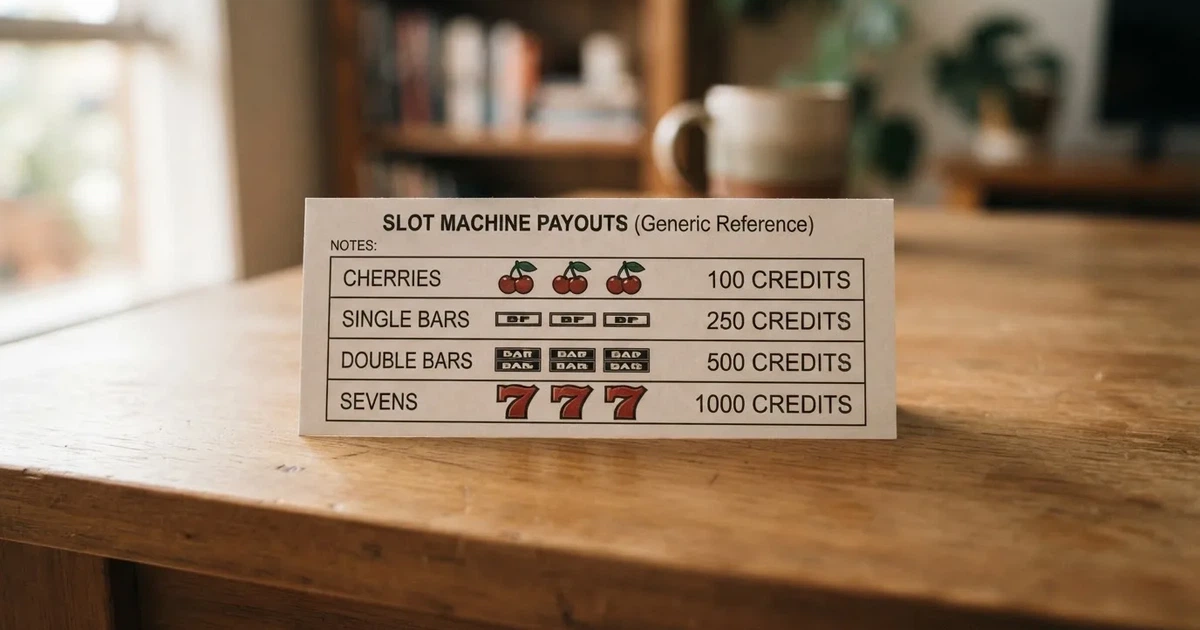
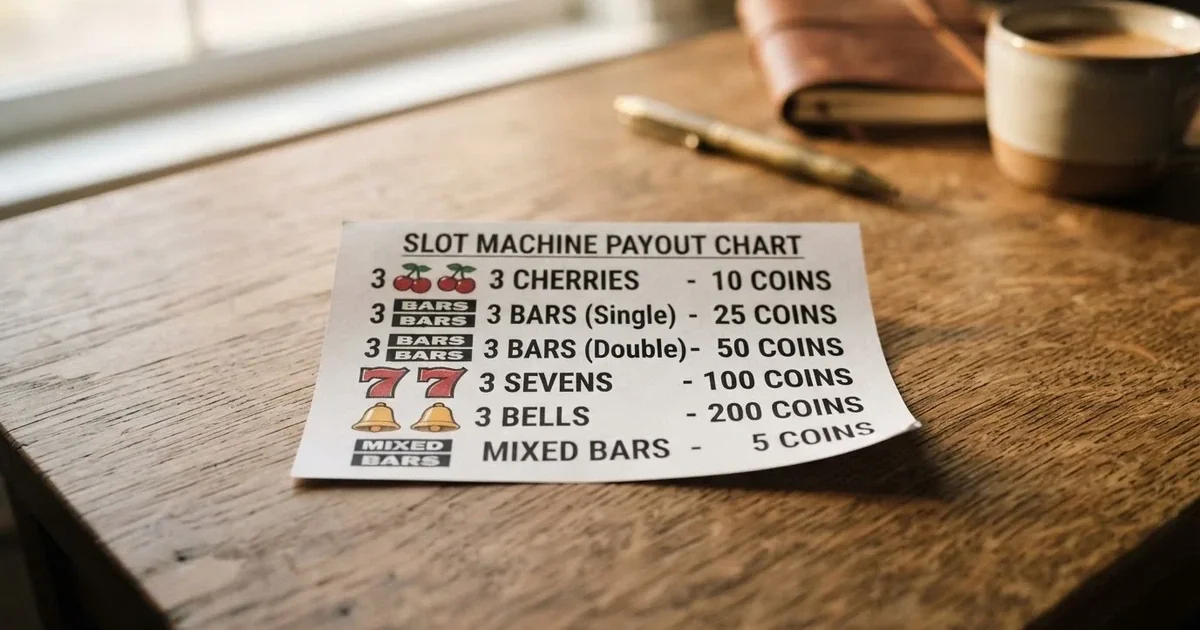
A paytable is the chart that maps each symbol combination to its payout, scaled by the credit value the player has selected. The classic version of it is a printed strip laid on the side of the cabinet, or a help screen on a video slot. It does three jobs at once.
It tells the player which symbol is the highest-paying one. On most 5-reel video pokies, that is the game’s branded symbol — the logo, the title character, the feature creature — and a five-of-a-kind of those across an active payline is the single largest line payout the base game offers.
It tells the player how the bonus symbols behave. A scatter symbol, which usually pays regardless of position, and a wild symbol, which substitutes for other paying symbols, are the two features that change a base spin into something else. A third symbol, often a bonus icon, triggers the free-spins round when three or more land anywhere on the reels.
It tells the player how many paylines are active. On a 5-reel video pokie, the line count ranges from a single centre line on the most stripped-back classic version to several dozen on a modern five-by-four grid. Each payline is a separate bet of one credit per line at the minimum stake. The total stake per spin is paylines × credit value.
The paytable does not, on most games, publish the game’s return-to-player percentage. The format is not regulated in Australia, so there is no Australian register to consult. What the player sees is the symbol ladder and the line count; what the player does not see is the underlying odds and the house edge.
Why the format kept its shape
Australian pubs and clubs are full of 5-reel pokies. The count outside casinos reached an estimated 97,103 machines nationwide by 2010 — about five per capita for every one in the United States. The state-by-state breakdown of that figure, in more recent data, runs to 87,298 machines in New South Wales as of June 2023, 26,380 in Victoria across 2021–22, 21,122 in Queensland as of October 2023, 11,672 in South Australia as of September 2023 and 3,587 in the ACT as of November 2023. These are physical machines in licensed venues, not online offerings, and they sit under state-level gambling regulation.
The 5-reel format dominates the Australian pub and club floor because it sits in the middle of the trade-off between simplicity and feature depth. A three-reel cabinet is faster to read but offers less variety. A six- or seven-reel video slot introduces more combinations but raises the cognitive load on every spin. Five reels gives a designer room for a scatter symbol, a wild symbol and a free-spin trigger without making the base spin unreadable. The pub and club market rewards that middle.
The same logic carries over to the online version of the format, with one twist. A land-based pokie is regulated by the state in which it sits. An online 5-reel pokie offered to an Australian-based reader is not, because the Interactive Gambling Act 2001 does not allow it to be.
What the IGA does to the format
The Interactive Gambling Act 2001, as tightened by the Interactive Gambling Amendment Act 2017, makes it an offence to provide online casino games or online pokies to a person physically in Australia. No state or territory issues a licence for the activity. The only forms of online gambling that are licensed in Australia are wagering on races and sporting events placed before the event, lotteries, and keno — in practice regulated at the federal level through the Northern Territory Racing and Wagering Commission, which covers 52 of Australia’s online bookmakers including Sportsbet, Bet365 and Ladbrokes.
A reader sitting in Melbourne or Perth who opens a browser and finds a real-money 5-reel pokie is, almost without exception, looking at a site operating outside that frame. The site may display an offshore licence. The site may describe itself as “licensed and regulated.” It is not licensed by any Australian state or territory, because no Australian state or territory can license it. The IGA targets the provider, not the individual player, so the punter does not face prosecution for opening the site. The punter does face the consequences of being on a site no Australian regulator oversees.
Three of those consequences are worth naming in plain language. First, an offshore site gives no Australian consumer protection: there is no Australian complaints body to approach if a withdrawal is refused or a bonus term is changed mid-promotion. Second, an offshore site can be blocked with a balance still sitting on it; the ACMA directs Australian internet service providers to add new sites to the block list on a published round, and the round does not pause for player balances. Third, the site is not connected to BetStop, the National Self-Exclusion Register, which binds only Australian-licensed online and phone wagering services.
The shape of the prohibition is what gives the rest of this page its subject. A reader researching “5-reel slots” in 2026 is most likely going to meet brands operating offshore, and the ACMA’s published actions over those brands are the most concrete piece of information available about each one.
Payments as a tell
A second read on the same point comes through the payment rails. Since 11 June 2024, credit cards, credit-related products and digital currency have been banned as a means of paying for licensed online wagering in Australia, with penalties up to A$247,500 for an operator that accepts them. The legal deposit routes for a licensed Australian wagering service are debit card, bank transfer, PayID or Osko, and BPAY.
A site offering 5-reel pokies for real money to an Australian reader and asking for a credit card or a crypto deposit is, by that single signal, operating outside the Australian rules. It may still be a working site. It is not an Australian-regulated one.
What enforcement looks like
The ACMA’s enforcement work has three visible outputs. It investigates complaints. It issues formal warnings to operators whose services breach the IGA, naming the operator and the brand in a public notice. It directs Australian internet service providers to block individual sites that continue to offer prohibited services after warnings.
The blocking numbers, in the ACMA’s own framing as reported in June 2026, run to 1,751 illegal gambling and affiliate websites blocked since the first blocking request in November 2019, and more than 230 unlicensed gambling services having left the Australian market since enforcement was strengthened in 2017. The June 2026 round alone asked providers to block a further 12 sites: 7Signs, ChromaBet, Donbet, Duospin, Freshbet, Slots Gem, Jacks Club, Lucky Start, Pointsbetz, Spinrise, Vinyl Casino and Wildsino.
H2 Gambling Capital’s 2025 estimate puts Australian losses to illegal gambling sites at around A$3.9 billion a year, with the share of gambling going through legal channels falling from 74% in 2021 to 64%. The block list keeps growing because the offer keeps finding readers.
What a reader who plays anyway should know
The page’s intent is not to push anyone toward offshore play. The IGA is the law, and the law’s prohibition is plain. Two pieces of advice belong on the page regardless.
First, the player-protection architecture that an Australian punter may be used to — BetStop, the National Gambling Helpline on 1800 858 858, free and 24/7, with chat through Gambling Help Online — applies to Australian-licensed services. An offshore 5-reel pokie site is not connected to any of those. If the impulse to play is starting to feel compulsive or stressful, the help line is the right first call.
Second, any site that does take an Australian reader’s money and then refuses a withdrawal has no Australian complaints body behind it. The Australian-licensed alternative for the punter who wants the format under Australian consumer law is the physical pokie in a licensed pub or club, which sits under state-level regulation and a state gambling regulator. The 5-reel online version of that machine is not the regulated version.
What the ACMA’s warnings name
The table below lists the brands the ACMA has issued formal warnings to, the operator named in each warning, and the date the warning was issued. The list is not a ranking and not a recommendation. Each row is here because the ACMA itself published the warning.
| Brand | ACMA action and date | Operator named by the ACMA | Subject support |
|---|---|---|---|
| RocketPlay | Formal warning, March 2026 | Pulsup Ltd (Rocketplay); earlier Dama N.V., May 2022 | — |
| Level Up Casino | Formal warning, May 2022 | Dama N.V. | listings only |
| Woo Casino | Formal warning, March 2025 | Dama N.V. | — |
| Spirit Casino | Formal warning, May 2025 | Dama N.V. | — |
| National Casino | Formal warning, July 2025 | Consolutetish S.R.L. | listings only |
| Bizzo Casino | Formal warning, July 2025 | Consolutetish S.R.L.; earlier TechSolutions, 2022 | — |
| Ignition Casino | Formal warning, July 2025 | Bamboo Media | — |
| Instant Casino | Formal warning, February 2025 | EOD Code SRL | — |
| Jackbit | Formal warning, April 2026 | Ryker B.V. | — |
| Casino Intense | Formal warning, April 2025 | Sterplay Holding Ltd | listings only |
| Sky Crown | Formal warning, September 2022 | Hollycorn N.V. | — |
The “Subject support” column is a separate matter from the ACMA action. A brand whose support is marked “listings only” appears in third-party directory listings as offering 5-reel content, which is what those directories report; that is not the same as a confirmation that the brand offers a verified 5-reel catalogue. A brand marked with an em dash has no listing-level data carried in this page’s sources either way.
The table’s job is to make the operator behind each brand visible, because the warning is sent to an operator, not to a website. The same operator can run several brands: Dama N.V. was warned in May 2022 across six brands and warned again in 2025 over two of the same. Consolutetish S.R.L. picked up warnings over National Casino and Bizzo Casino in July 2025; Bizzo had already been the subject of a 2022 warning to TechSolutions (CY) Group Limited and TechSolutions Group N.V., which suggests the brand moved between corporate parents without changing its offer to Australian readers.
What the blocking rate tells a reader
The blocking-rate calculation draws from two figures that sit four years apart. In November 2019, the ACMA issued its first blocking request. By June 2026, the ACMA had asked providers to block 1,751 illegal gambling and affiliate websites in total.
Set those two figures beside each other: 1,751 sites blocked over a span of roughly 80 months from November 2019 to June 2026. That works out to an average of around 22 sites per month across the full period, with the rate picking up as the ACMA’s enforcement work matured. The June 2026 round alone blocked 12.
The rate is not steady. Early rounds were small. The 2017 strengthening of the IGA produced the first wave. The 2024 credit-card ban changed the shape of the offer rather than the size of the block list. What the rate shows, in plain prose, is that the supply side of the offshore offer keeps replenishing: sites appear, get warned, get blocked, and are replaced by the next batch under different corporate parents and different domain names. The 1,751 figure is a stock, not a flow.
The condition on the band is important. The 22-sites-per-month figure is an average that includes the early months when enforcement was still ramping up; recent rounds run higher. A reader who wants to know what to expect over the next year should not extrapolate from the average — they should look at the cadence of the most recent quarterly rounds, which run closer to 30 to 40 sites per quarter, or roughly 10 to 13 per month, with single rounds sometimes adding a dozen at once.
The point of the calculation is not the number. The point is the cadence. A site that exists this month is one blocking round away from being unreachable next month, with a balance still on it.
The 5-reel format versus its modern cousins
A reader comparing formats on a pub floor will find three broad shapes. The 3-reel mechanical, which carries Fey’s original geometry and a small paytable. The 5-reel mechanical or video, which is the format this page is about. The 5-reel video with extended grids and feature rounds, which is the dominant shape on most online catalogues under the “5-reel” label.
The differences, in practical play, are not in the reel count alone. They are in the symbols per reel, the line count, and the bonus structure. A 5-reel classic with three rows and a single payline reads almost like a 3-reel game on the same cabinet. A 5-reel video with five rows, 50 symbols per reel and a scatter-triggered free-spin round reads nothing like it. The “5-reel” label covers both, and the paytable is the place to read the difference.
A reader who treats “5-reel” as a uniform category will miss the trade-off. A 5-reel classic offers fewer combinations and a tighter symbol ladder, which usually means more frequent small wins and a flatter session. A 5-reel video with a feature round offers less frequent wins in the base game and a heavier payout structure inside the bonus, which usually means a more volatile session. Neither is better or worse than the other on its own merits; they are different shapes of variance, and a session of one feels different from a session of the other.
Volatility and the paytable
Volatility is the word the industry uses for the spread of outcomes around the average. A high-volatility game pays out rarely and in larger amounts when it does. A low-volatility game pays out often and in smaller amounts. The paytable does not publish a volatility rating, but it usually shows enough for an experienced reader to read the shape: a wide symbol ladder with a heavy top end, and few mid-tier payouts, points to high volatility; a flatter symbol ladder with several mid-tier payouts points to low volatility.
The 5-reel format sits across the full range. A 5-reel classic with a tight symbol ladder is usually on the low-volatility end. A 5-reel video with a wide ladder and a feature round is usually on the high-volatility end. The reel count by itself says nothing about where on that range a given game sits.
This is the part of the format that the marketing side is least likely to surface, and the part that decides what a session of any given number of spins will feel like. A punter picking a 5-reel video pokie for the brand rather than for the volatility profile is picking on the wrong variable.
Where Australian-licensed 5-reel play actually exists
The IGA does not prohibit land-based 5-reel pokies. State-level casino and club regulation covers them. Crown Melbourne, for example, operates under the Victorian Gambling and Casino Control Commission, which replaced the Victorian Commission for Gambling and Liquor Regulation on 1 July 2022. Crown Melbourne’s table games, which include baccarat and blackjack variants, are approved by the VGCCC under section 66 of the Casino Control Act 1992 in New South Wales and under the equivalent provisions of the Victorian Casino Control Act 1991.
A punter in Australia who wants the 5-reel format under Australian consumer law, with a state gambling regulator behind the operator and a complaints body to approach if something goes wrong, walks into a licensed pub, club or casino. The format is the same; the regulatory frame is different.
What the punter will not find online is any Australian-licensed version of the same format. The Interactive Gambling Amendment (Gambling Reform) Bill 2026 passed Parliament on 19 August 2026, and its advertising and inducement measures commence on 1 January 2027. The Bill does not open the door to online casino licensing. It tightens the frame around inducements to use licensed services. The 5-reel online pokie remains outside Australian licensing on a 2026 page and on a 2027 page.
What the eleven ACMA warnings describe, brand by brand
The eleven brands the ACMA has formally warned over the period covered by the ACMA’s published register sit in a single shape: each one offered online casino games, including 5-reel pokies, to Australian readers, and the ACMA wrote to the operator behind it. The reason for listing them here is not to recommend any of them. The reason is to make the operator behind each brand visible — because the warning is to the operator, not to the website — and to make the date visible, because the warning is a specific action on a specific date, and the date is what tells a reader how current the warning is.
RocketPlay
RocketPlay is the most recently warned of the eleven, with a March 2026 formal warning to Pulsup Ltd over RocketPlay. The brand had already been the subject of a May 2022 warning to Dama N.V., which suggests a change of corporate parent between 2022 and 2026 without a change in what was being offered to Australian readers. No listing-level data on the brand’s 5-reel catalogue is carried in this page’s sources.
Level Up Casino
Level Up Casino sits in the May 2022 warning to Dama N.V., one of six brands caught in that single round. Third-party directory listings carry the brand as offering 5-reel content; that is what those listings report, and it is not the same as a verified catalogue.
Woo Casino
Woo Casino received a March 2025 formal warning to Dama N.V. The 2022 warning to Dama N.V. did not name Woo Casino directly, so the 2025 action is the ACMA’s first published formal warning over the brand. Data regarding the specific 5-reel catalogue is not publicly available.
Spirit Casino
Spirit Casino received a May 2025 formal warning to Dama N.V., two months after Woo Casino. The two warnings in the same year, to the same operator, are a useful reminder that the operator-level view is the relevant one: Dama N.V. ran several 5-reel brands for Australian readers over the period covered. We have no confirmed details on the brand’s catalogue.
National Casino
National Casino received a July 2025 formal warning to Consolutetish S.R.L. Third-party directory listings carry the brand. The same operator was warned in the same round over Bizzo Casino.
Bizzo Casino
Bizzo Casino received a July 2025 formal warning to Consolutetish S.R.L. and had already been the subject of a 2022 formal warning to TechSolutions (CY) Group Limited and TechSolutions Group N.V. Two warnings, four years apart, to two different operators, on the same brand, is the clearest signal in the table that brands move between operators without changing their offer to Australian readers. No listing-level data is carried here.
Ignition Casino
Ignition Casino received a July 2025 formal warning to Bamboo Media. Specific details on the game catalogue are not verified by our sources.
Instant Casino
Instant Casino received a February 2025 formal warning to EOD Code SRL. The early-2025 timing puts this warning before the Woo Casino and Spirit Casino warnings of the same year, and before the July 2025 round that caught National, Bizzo and Ignition. Verified information on this brand’s 5-reel offerings is not available.
Jackbit
Jackbit received an April 2026 formal warning to Ryker B.V., in the same round as CasinOK. No listing-level data is carried here.
Casino Intense
Casino Intense received an April 2025 formal warning to Sterplay Holding Ltd. Third-party listings carry the brand, along with the other sources the page draws on. The listing-level signal here is the closest the table gets to a positive data point.
Sky Crown
Sky Crown received a September 2022 formal warning to Hollycorn N.V. Hollycorn was warned in the same notice over Blue Leo. No listing-level data is carried here.
The arithmetic the marketing side does not show
A reader comparing two 5-reel video pokies on the same offshore site is comparing two things the site does not publish. The first is the return-to-player percentage of each game. The second is the volatility profile.
Neither figure is regulated in Australia for online pokies, because online pokies are not licensed in Australia. In the United States, state regulation sets minimum slot-machine payout percentages that vary by jurisdiction: Nevada requires at least 75%, Mississippi at least 80%, New Jersey at least 83%. No equivalent floor exists in the Australian online market, because there is no Australian online market for the activity.
The closest a reader can come to a number is the house-edge figure for a comparable table game. Baccarat carries a 1.06% house edge on the Banker bet, 1.24% on the Player bet, and 14.36% on the Tie. Blackjack carries about 0.28% under liberal Las Vegas Strip rules and about 0.43% under Atlantic City rules, both with optimal strategy. Craps carries 1.41% on Pass/Come and 1.36% on Don’t Pass/Don’t Come. These are not 5-reel pokie figures, but they show the order of magnitude a regulated casino game sits in — a low single-digit house edge, with a few categories running higher.
A 5-reel video pokie, on average across the international market, runs a higher house edge than those table-game figures. The exact figure depends on the game. The point is that the gap between what a regulated table game costs the player and what an offshore 5-reel pokie costs the player is the gap between a number that sits in a public register and a number that does not.
The responsible-gambling frame
The Australian responsible-gambling frame is built around three pieces of infrastructure. The National Gambling Helpline on 1800 858 858 is free, confidential and available 24/7, with chat offered through Gambling Help Online. BetStop, the National Self-Exclusion Register, has been live since August 2023 and binds Australian-licensed online and phone wagering services. State-level regulators run their own self-exclusion schemes for land-based venues.
The three pieces of infrastructure cover Australian-licensed services. An offshore 5-reel pokie site is not connected to any of them. A punter who has registered with BetStop and then opens an offshore site has no second line of defence behind them.
If the impulse to play is starting to feel compulsive or stressful, the helpline is the right first call. The frame around it does not depend on which site the punter has been using, and the conversation is confidential. The block notices the ACMA issues are aimed at the offer, not at the individual; the help line is aimed at the individual, and it is the part of the Australian responsible-gambling frame that reaches a punter regardless of where they have been playing.
What the page is not for
A few things this page is not, and a few things it deliberately leaves out.
It is not a review of any offshore site. The eleven brands listed are listed because the ACMA published a warning over them. The page does not recommend any of them. The IGA prohibits the offer they make.
It is not a comparison of 5-reel pokies on the pub and club floor. The state-level regulation of those machines is a separate subject, and the figures involved — the 87,298 machines in New South Wales, the 26,380 in Victoria, the rest — belong to that subject.
It is not an account of the 2026 reform package. The Interactive Gambling Amendment (Gambling Reform) Bill 2026 passed Parliament on 19 August 2026, and its advertising and inducement measures commence on 1 January 2027. The Bill does not license online casinos; it tightens the frame around inducements.
It does not publish any bonus terms, because the only sources for bonus terms were affiliate marketing pages, and affiliate marketing pages are not the register a reader should be checking bonus terms against. The offer itself is the subject of the ACMA’s action; the bonus attached to it is a separate matter the page does not pretend to evaluate.
Frequently asked questions
What makes a 5-reel pokie different from a five-by-three video slot?
A 5-reel pokie is any cabinet or screen with five spinning reels, regardless of how many rows each reel shows or how many paylines the game runs. A five-by-three video slot is a specific layout: five reels, three rows, which is the most common modern shape. The two terms describe overlapping but not identical things, and a “5-reel classic” with a single payline is closer in feel to a 3-reel game than to a five-by-three video.
Can 5-reel pokie machines be found in licensed Australian pubs and clubs?
Yes. 5-reel pokies are the dominant format on the Australian pub and club floor, with 87,298 machines in New South Wales alone as of June 2023. State-level regulators oversee the machines, and state-level self-exclusion schemes apply to them. Online 5-reel pokies for real money are a different matter and are covered separately on this page.
Do 5-reel pokies typically pay out differently from newer formats?
The payout profile depends on the symbols per reel, the line count and the bonus structure, not on the reel count alone. A 5-reel classic with a tight symbol ladder is usually low-volatility, paying often in small amounts. A 5-reel video with a wide ladder and a feature round is usually high-volatility, paying rarely in larger amounts. The “5-reel” label covers both shapes, and the paytable is the place to read the difference.
Is a 5-reel pokie online the same game as a 5-reel machine on a casino floor?
The format is the same — five reels, a paytable, a feature round in most cases. The regulatory frame is not. A land-based pokie in a licensed Australian venue sits under state-level regulation and a state gambling regulator. An online 5-reel pokie offered to an Australian reader sits outside the Australian regulatory frame, because the Interactive Gambling Act 2001 does not allow online casino games or online pokies to be licensed for Australians.
Are 5-reel pokies for real money available legally from an Australian-based site?
No. The Interactive Gambling Act 2001, as tightened by the Interactive Gambling Amendment Act 2017, makes it an offence to provide online casino games or online pokies to a person in Australia. No state or territory licenses the activity. What is licensed is wagering on races and sport placed before the event, lotteries, and keno. The legal alternative for a punter who wants the 5-reel format under Australian consumer law is the physical pokie in a licensed pub, club or casino.
Does a 5-reel pokie’s reel count change how its paytable and volatility are described?
The reel count is part of the paytable description, not the whole of it. The paytable shows the symbol ladder and the line count. The volatility profile sits behind those figures and is not usually published. A reader comparing two 5-reel pokies on the same offshore site is comparing two things the site does not publish: the return-to-player percentage and the volatility profile. Neither is regulated in Australia for online pokies, because online pokies are not licensed in Australia.
Written by the editors at Casino Live Dealer Hub.