
Instant PayID withdrawal casino Australia 2026: the speed and what it really costs
An “instant PayID withdrawal” lands on a bank account in under a minute, twenty-four hours a day, every day of the year. The clarity ends there. The thing doing the moving is one of the faster rails Australian retail banking has built; the place it lands, almost always, is an offshore casino that has been on the receiving end of an Australian Communications and Media Authority formal warning for offering a prohibited service to Australians. A reader who treats the speed as the product is looking at the wrong half of the deal. This page walks through how PayID actually settles, where the wait is in any “instant” withdrawal, and what the cost is once the marketing is set to one side.
Currency stamp: data current as of 4 November 2026 and checked against the ACMA’s published register of formal warnings and blocking requests.
Table of Contents
- How PayID actually moves money
- The legal frame around the speed
- Responsible gambling under the speed
- What a bonus actually costs at this kind of site
- Operators the ACMA has named
- What this means for someone comparing sites
- The 2026 reform that has not yet started
- Money, tax and the part the speed does not reach
- What an Australian-facing punter can actually do
- What the page does not do
- Frequently asked questions
How PayID actually moves money
A PayID is an easy-to-remember handle — a mobile number, an email address, an ABN or an Organisation Identifier — linked by the customer to a bank account at an Australian institution. It is operated by Australian Payments Plus, the domestic payments provider, and is offered by more than one hundred Australian banks, credit unions and building societies, already built into their online banking. PayID runs on the Reserve Bank-regulated New Payments Platform that launched in February 2018 to let households, businesses and government move money in close to real time, twenty-four hours a day. By April 2025, more than twenty-five million PayIDs were registered in Australia.

Two mechanics govern every PayID transfer and matter to anyone sending money to a casino.
The first is the named-recipient check. Before a payer confirms a PayID transfer, their bank shows the name the recipient has registered against that PayID. The check exists to prevent scams and mistaken payments, and AP+ is explicit that the only reading of a request to send money to a PayID on an illegal gambling site is a scam site. PayID itself never contacts a customer; emails or texts claiming to be from PayID are scams.
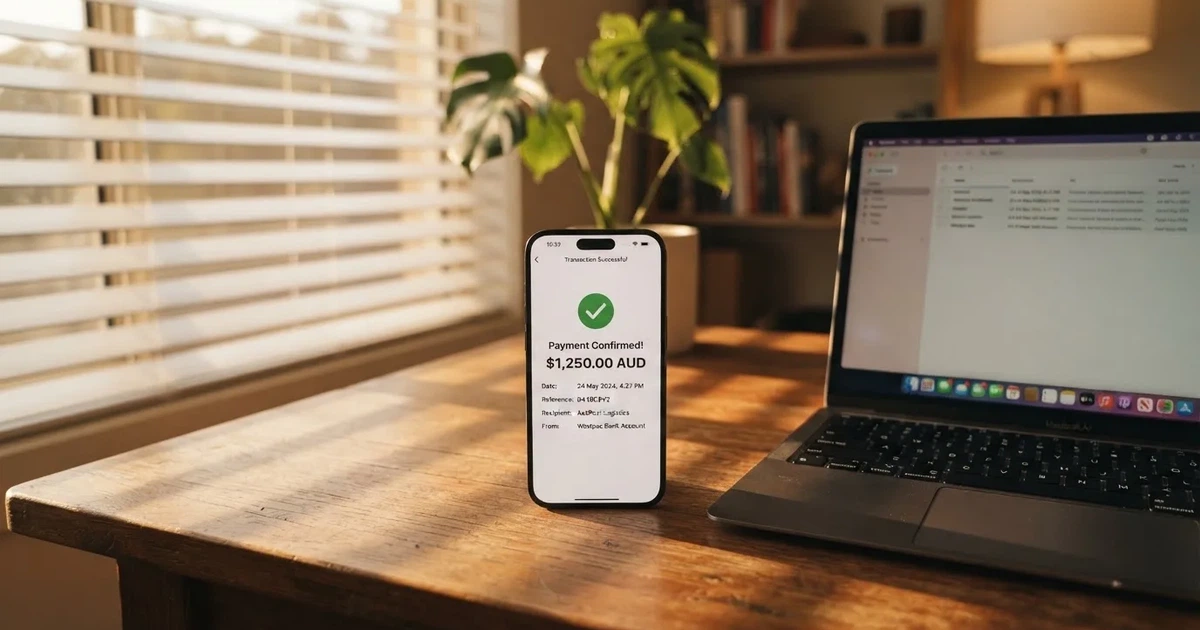
The second is Osko. When two PayID-capable Australian banks sit on either side of a transfer, Osko lands the payment at the receiving account in under a minute, including on weekends and at three in the morning. Whether the transfer is addressed to a BSB-and-account-number or to a PayID, the settlement window is the same.
These two mechanics are why a casino that supports PayID can plausibly advertise an “instant” withdrawal: the rail is capable of it, and the named-recipient check is the casino’s defence against being paid to the wrong account. The rail is not the bottleneck. The bottleneck, in every case the marketing omits, is the casino’s own settlement review.
Where the “instant” really waits
The casino’s cashier does not press a button that drops the money onto the New Payments Platform the moment a player hits withdraw. Three steps sit between request and arrival.
First, internal review. Anti-fraud and anti-money-laundering screening runs on every payout. The casino’s payments team checks the deposit history against the withdrawal amount, looks at how recent the deposits are, looks at whether any bonus terms have been touched, and decides whether the request passes a manual rule set. In the best case this is automatic and runs in seconds; in the worst, it queues behind a human reviewer who works business hours.
Second, source-of-funds and identity verification. The first withdrawal at any Australian-facing offshore casino triggers KYC: passport or driver’s licence, proof of address, sometimes a selfie, occasionally a video call. A bank statement showing the account that holds the PayID is usually part of the same package.
Third, the actual transfer. Once the casino releases the funds, Osko carries them through to the linked bank account in under a minute, twenty-four-seven. That is the part the marketing can honestly call instant.
What the marketing calls instant is therefore a compound: a rail that can deliver in a minute, gated by an internal review that may take hours, an identity check that may take days, and a withdrawal queue that may take longer still. The honest version of the promise is “instant once we have decided to send it”.
The legal frame around the speed
Speed does not change the legal category of the operator sending it. Australia’s prohibition on online casino gambling applies to a PayID-processing site the same as it does to any other offshore operator: it is still the offer of a prohibited interactive gambling service to a person physically in Australia, and the Interactive Gambling Act 2001, as tightened by the Interactive Gambling Amendment Act 2017, treats it as an offence by the provider, not the player.
The legal ceiling on what an Australian can be offered is narrow. Online wagering on a race or sporting event placed before the event is licensable; online lotteries and keno are licensable; online casino games and online pokies are not. The Northern Territory Racing and Wagering Commission regulates fifty-two of Australia’s online bookmakers — Sportsbet, Bet365 and Ladbrokes among them — for tax reasons, and is itself a body without full-time staff that meets once a month in Darwin. That is the regulator the law has for the products the law allows.
The legal floor for what an Australian can pay with is just as narrow. Since 11 June 2024, Australian-licensed online wagering services cannot accept credit cards, other credit-related products, or digital currency. The legal deposit routes are debit card, bank transfer, PayID and Osko, and BPAY. A site asking an Australian for a credit card or a crypto deposit is not running on Australian rules.
A casino that offers an instant PayID withdrawal to an Australian is, with very rare exceptions, not licensed to offer casino games to Australians at all. The exception that needs to be checked is the one: does the site hold an Australian licence that actually covers the product on offer. Almost none of the brands that market instant PayID withdrawals to Australians do.
What the ACMA has been doing about it
The Australian Communications and Media Authority has the power to investigate, to issue formal warnings, and to ask Australian internet service providers to block illegal sites. By the end of June 2026, a total of 1,751 illegal gambling and affiliate websites had been blocked since the first blocking request in November 2019, and more than 230 unlicensed gambling services had left the Australian market since enforcement was stepped up in 2017.
The shape of the campaign is consistent. Formal warnings go out to operators by name, naming the brands and the corporate vehicle behind them, and giving the operator a window to stop offering the prohibited service before further action. Where the operator does not stop, the ACMA escalates to ISP-level blocking. The June 2026 round asked ISPs to block 7Signs, ChromaBet, Donbet, Duospin, Freshbet, Slots Gem, Jacks Club, Lucky Start, Pointsbetz.com, Spinrise, Vinyl Casino and Wildsino. Each block removes a route by which an Australian punter could otherwise reach the site — but the brands resurface under new corporate vehicles with discouraging regularity.
The blocking rate, as a band, is one of the few numbers on this subject that lets a reader see the scale rather than guess it. Dividing the 1,751 blocked sites by the time between the first blocking request in November 2019 and the end of the June 2026 reporting window — roughly seventy-nine months — gives an average of around twenty-two sites blocked per month across the life of the programme. The rate is not flat: early rounds moved more slowly while the legal infrastructure was being built, recent rounds have moved faster, and the long-run average is a floor, not a ceiling. The honest reading of the figure is that blocking runs in the order of dozens of new sites per month, with the long-run average sitting at the low end of that band.
The campaign has a market-level effect too. H2 Gambling Capital’s 2025 report estimates that Australians lose around A$3.9 billion a year to illegal gambling sites, and that the share of gambling going through legal channels has fallen from 74% in 2021 to 64%. The legal channel is losing share to the illegal one, even as the regulator chases the illegal one.
Responsible gambling under the speed
A withdrawal that clears in minutes is not, on its own, a sign of anything other than how the operator moves money. It says nothing about whether the operator meets any Australian responsible-gambling standard, and offshore casinos that market to Australians are not connected to BetStop, the National Self-Exclusion Register that went live in August 2023. BetStop binds Australian-licensed online and phone wagering services. An offshore casino is not one of them, and self-excluding through BetStop does not stop that casino from accepting a deposit or processing a withdrawal.
The protections that the Australian framework puts around a withdrawal are therefore not present at an offshore site. There is no Australian complaints body with jurisdiction over the operator; there is no recourse through Australian consumer law if a withdrawal is refused; there is no Australian regulator to escalate to when an offshore casino stalls, voids winnings or closes an account. If the operator is blocked at ISP level — which the ACMA’s blocking rounds are designed to achieve — the balance can sit behind the block with no obvious route to it. Speed on the way in does not imply speed, or even arrival, on the way out.
Help exists, separately from the operator. The National Gambling Helpline is 1800 858 858, free, twenty-four hours a day, with chat at Gambling Help Online. For someone whose gambling has stopped being a choice they are making, that is the number to ring; for someone comparing operators, the point is the absence rather than the presence.
What a bonus actually costs at this kind of site
The promised shape of an offshore casino welcome package is familiar: a percentage match on the first deposit, plus a batch of free spins, sometimes a reload on the second deposit, sometimes a third. The realised shape is always longer, because the wagering requirement, the game-weighting table and the maximum-cashout cap each take a pass at the offer in turn.
The wagering requirement is the multiplier the casino applies to the bonus before any of it converts to withdrawable cash. A 100% match on a A$500 deposit with a 40x wagering requirement on the bonus means A$20,000 of qualifying bets before the bonus is cleared. At a typical slot spin cost of A$1 and a five-second spin interval, that is 20,000 spins, or just under 28 hours of continuous play, before the bonus is even theoretically withdrawable. The arithmetic is clean and the conclusion is not: a welcome offer that reads as “free money” is, in time-cost terms, more than a working day of uninterrupted slot play at standard stakes.
The game-weighting table is where the wagering requirement quietly multiplies. Most slots contribute 100% of each bet toward clearing; most table games contribute 10% or less; some — usually the live-dealer titles — contribute nothing. A punter who plans to clear a bonus at blackjack rather than at the slots will need to bet ten times the headline multiple to clear the same amount. The table is rarely on the welcome page; it is in the bonus terms, linked once and in small print.
The maximum-cashout cap is the third pass. Some offers, particularly the no-deposit free-spins batches, cap the amount that can be withdrawn from bonus-derived winnings at a fixed figure — A$100, A$200, sometimes less. Anything above the cap is voided at withdrawal. A punter who runs a bonus balance into a four-figure win and finds a two-figure ceiling on it has not been mis-sold the offer; they have been sold the offer as written.
The calculation the page is built around is the simplest of these: how long the bonus takes to clear on the assumption that only the bonus amount is wagered, at a standard stake, on a standard-spin-interval slot. The point of saying it in one line is to make the time-cost visible without dressing it up. Twenty-eight hours to clear a A$500 bonus at standard slot conditions is not a marketing figure; it is the cost a reader is being asked to pay before any of the bonus is theirs.
Operators the ACMA has named
What follows is not a ranking. None of these brands can lawfully offer online casino games to an Australian resident, regardless of how fast their PayID withdrawal clears. They appear here because the ACMA has issued a formal warning over each one, naming the corporate vehicle behind the brand and the date the warning was published. The point of listing them in one place is to let a reader see the scale of the campaign and the names that have come through it, not to suggest any of them as a place to play.
RocketPlay
The ACMA issued a formal warning to Pulsup Ltd over Rocketplay.com.au in March 2026. Dama N.V. was the subject of an earlier formal warning over the same brand in May 2022, one of six casino brands named in that round. The brand has changed hands twice inside four years; the product on offer to an Australian has not.
RocketPlay carries the licence it carries wherever its corporate vehicle is registered; that licence does not cover online casino games offered to a person in Australia. A reader who values the speed of a PayID withdrawal at RocketPlay is reading the rail, not the operator, and the rail is the same rail every other site on this list uses.
The verdict on RocketPlay is the verdict on its category: it is a brand the ACMA has named twice in four years, which is the clearest available evidence that whatever the brand’s Australian-facing site says about licensing, the regulator treats it as a prohibited service.
Level Up Casino
Level Up Casino was named in the May 2022 formal warning to Dama N.V., one of six brands in that round. The warning predates PayID being a common deposit method at the brand; it does not predate the legal position the brand is in. Online casino games cannot be licensed for Australian residents, and a brand that the ACMA named four years ago is a brand the regulator has not stopped watching.
For a reader comparing withdrawal speeds across this set, Level Up is a data point rather than a destination: a brand the ACMA moved against in 2022, still operating in 2026 under the same corporate umbrella. That is the kind of persistence a reader needs to see in a list rather than be told about in passing.
The verdict on Level Up Casino is the same shape as the verdict on RocketPlay: a brand on the ACMA’s list, by name, and therefore not a lawful destination for an Australian punter, however the marketing frames the speed.
Woo Casino
The ACMA issued a further formal warning to Dama N.V. over Woo Casino in March 2025. Dama N.V. is also the operator behind the May 2022 warnings; Woo Casino is the first warning Dama N.V. has received since that round for offering prohibited services to Australians.
The pattern matters. Woo Casino was named by the regulator three years after the Dama N.V. round, which is the regulator telling the operator that the May 2022 warning did not stick for this brand. For a reader, the inference is the obvious one: a brand that has been warned once and then warned again is a brand the regulator considers to have had its chance.
The verdict on Woo Casino is that the ACMA has now told Dama N.V. twice, three years apart, that Woo Casino is offering a prohibited service to Australians. A reader looking for the brand that pays out fastest has read the wrong column.
Spirit Casino
The ACMA issued a formal warning to Dama N.V. over Spirit Casino in May 2025, two months after the Woo Casino warning. Two warnings to the same operator in the space of a quarter, for two different brands, is the regulator’s way of saying that the underlying conduct — offering prohibited casino games to Australians — has not stopped.
For a reader comparing Spirit Casino to any other name on this list, the relevant comparison is not PayID speed. The relevant comparison is that the corporate vehicle behind Spirit Casino has now received two formal warnings in 2025, which makes the operator one of the more heavily-warned vehicles on the ACMA’s list.
The verdict on Spirit Casino is straightforward: an Australian-facing casino whose operator has been warned twice in three months is not an Australian-facing casino that intends to leave the Australian market on its own. The regulator will eventually move it off the market, but in the meantime the operator’s Australian players have the protections of an operator the ACMA has told to stop.
National Casino
The ACMA issued a formal warning to Consolutetish S.R.L. over National Casino in July 2025. National Casino is one of two brands named in that round — Bizzo Casino is the other — and Consolutetish S.R.L. is the corporate vehicle named for the first time.
The National Casino name has been around long enough that some readers will have seen it on affiliate sites that promise instant PayID withdrawals to Australian accounts. The speed of the rail does not change the legal status of the operator; the regulator’s view is that National Casino is offering a prohibited service to Australians, and the formal warning is the published record of that view.
The verdict on National Casino is the same shape as the verdict on every brand in this list: the ACMA has named it by name, in a published warning, and the speed of a PayID withdrawal does not put the operator back inside Australian law.
Bizzo Casino
The ACMA issued a formal warning to Consolutetish S.R.L. over Bizzo Casino in July 2025 — the second time the brand has been named. TechSolutions (CY) Group Limited and TechSolutions Group N.V. were the subjects of an earlier formal warning over Bizzo Casino in 2022. Two warnings, three years apart, two different corporate vehicles, the same brand name.
For a reader who has been on an Australian-facing affiliate list that ranks casinos by PayID withdrawal speed, Bizzo Casino is almost certainly on it. The ACMA has now named the brand twice, and the second naming is the regulator’s view that the first naming did not work. A brand that resurfaces under a new corporate vehicle after a warning is a brand the regulator will, on the evidence of the blocking rounds, eventually block at ISP level. The balance on a blocked site does not move faster for being PayID-funded.
The verdict on Bizzo Casino is that it is the clearest case on this list of a brand the ACMA has warned twice and watched continue. A reader who wants a brand the regulator has not come back to is not looking at Bizzo Casino.
Ignition Casino
The ACMA issued a formal warning to Bamboo Media over Ignition Casino in July 2025. Ignition Casino is one of the better-known offshore brands among Australian-facing affiliate sites, and the formal warning is the regulator’s first published action on the brand under that name.
For a reader, the relevant fact is the same one it is for every brand on this list: the ACMA has named the brand and the operator, the operator has not stopped offering prohibited services to Australians, and the next step on the regulator’s escalation ladder is an ISP-level block. A blocked site cannot return a withdrawal, no matter how fast the PayID rail is.
The verdict on Ignition Casino is that an Australian-facing site named in a formal warning is an Australian-facing site that is offering a prohibited service, and the speed of the withdrawal does not move the brand back inside the law.
Instant Casino
The ACMA issued a formal warning to EOD Code SRL over Instant Casino in February 2025. The brand name borrows the term — “instant” — and the warning is the regulator’s view that the brand is offering a prohibited service to Australians.
The mismatch between the marketing name and the legal status is the point. A site called Instant Casino is not faster than any other brand on this list; what it has is a name that suggests speed, and a formal warning from the regulator over the offer of prohibited services. A reader who chose Instant Casino for the brand name has been sold the word, not the product.
The verdict on Instant Casino is that the marketing is the warning. A brand whose name promises the speed the reader is looking for, and which the regulator has named for offering prohibited services, is the brand the reader should be most careful about, because the marketing is doing the work the regulator says the operator is not entitled to do.
Jackbit
The ACMA issued a formal warning to Ryker B.V. over Jackbit in April 2026. CasinOK was named in the same warning. Ryker B.V. is the first appearance of that corporate vehicle on the ACMA’s published warning list.
For a reader looking at Jackbit specifically, the relevant comparison is not to the rest of this list — it is to the blocking rounds. A brand named in a formal warning in 2026 is, on the regulator’s own timeline, a step ahead of a brand that has not yet been warned. A reader who arrives at Jackbit via an Australian-facing affiliate page is arriving at a brand the ACMA has had on file for the better part of the year.
The verdict on Jackbit is the same shape as every other verdict on this list: a brand the regulator has named, by name, for offering a prohibited service to Australians. The PayID rail underneath the brand is no different from the PayID rail underneath any other brand on the list, and the legal ceiling on what an Australian can be offered by any of them is the same.
Casino Intense
The ACMA issued a formal warning to Sterplay Holding Ltd over Casino Intense in April 2025. Sterplay Holding Ltd is the first appearance of that corporate vehicle on the ACMA’s published warning list.
For a reader, Casino Intense is a single data point on the regulator’s timeline: a brand named in a 2025 warning, operating in 2026 under the same name, with no Australian licence covering the product on offer. The persistence of the brand across the regulator’s action is the persistence of the operator, not a sign that the regulator’s view has changed.
The verdict on Casino Intense is that a brand the regulator named in 2025 is a brand the regulator still considers to be offering a prohibited service to Australians, and the absence of a second warning is not the same as a clearance.
Sky Crown
The ACMA issued a formal warning to Hollycorn N.V. over its Sky Crown and Blue Leo casino services in September 2022. Hollycorn N.V. is one of the more frequently-named operators on the ACMA’s published warning list, and Sky Crown is one of the better-known brands in the offshore casino market.
For a reader, the relevant fact is that the warning is now four years old and the brand is still operating. The ACMA’s blocking rounds are how the regulator escalates when a warning does not change the operator’s behaviour, and Sky Crown has had long enough on the warning list that it is one of the brands the regulator has had the most time to act on if it had chosen to.
The verdict on Sky Crown is that a brand the ACMA has had on file for four years is a brand the regulator has, by its actions, decided to escalate. A reader who arrives at Sky Crown via an Australian-facing affiliate page is arriving at a brand the regulator has had under active consideration for as long as some of the brands on the blocking list.
What this means for someone comparing sites
The honest comparison across this set is not about the rail. Every brand on the ACMA’s published warning list that supports PayID runs its payouts on the same New Payments Platform, in the same Osko envelope, to the same kind of Australian bank account. The rail is the rail.
The honest comparison is about the operator.
A reader who is choosing between brands on this list is choosing between brands the regulator has named, by name, for offering prohibited services to Australians. The fastest PayID withdrawal on a brand the ACMA has warned twice is still a withdrawal from a brand the ACMA has warned twice; the slowest PayID withdrawal on a brand the ACMA has warned once is still a withdrawal from a brand the ACMA has warned once. The rail is the same; the regulator’s view of the operator is the different thing.
The lawful comparison is between the licensed Australian wagering market and the unlicensed offshore one. The licensed market has BetStop, has a regulator that meets monthly in Darwin, has deposit routes that exclude credit and crypto, and has an Australian complaints body. The unlicensed market has PayID, has the speed the marketing promises, and has no Australian recourse when something goes wrong. The cost of the speed is the absence of everything else.
For a reader who has decided that they want to play, the comparison the regulator would point them to is between Sportsbet, Bet365 and Ladbrokes — the licensed wagering providers the NTRWC regulates — and the offshore brands on this list. The licensed providers cannot offer casino games or pokies. The offshore brands cannot lawfully offer casino games or pokies to Australians. The space in which the speed is being sold is a space the law does not recognise on either side, and that is the cost the speed is hiding.
The 2026 reform that has not yet started
The Interactive Gambling Amendment (Gambling Reform) Bill 2026 passed Parliament on 19 August 2026. Its advertising and inducement measures commence on 1 January 2027. The bill is law with a start date, not law in force; on a 2026 page it is a forward-looking measure, not a current one.
For a reader comparing operators in 2026, the practical reading is that the present legal frame is the one the ACMA is enforcing today: formal warnings, blocking requests, and the prohibition on offering prohibited interactive gambling services to Australians. The 2026 reform does not change that picture in the current year; it changes the marketing that will surround it from 1 January 2027.
Money, tax and the part the speed does not reach
Gambling winnings of a recreational player in Australia are not assessable income, under section 6-5 of the Income Tax Assessment Act 1997. Losses are not deductible. The model is the model only; the Australian Taxation Office is the body to check with, particularly if the gambling has crossed into a business.
The point that the speed does not reach is the tax question. A PayID withdrawal that lands in a linked bank account in under a minute is a deposit the ATO can see, and a pattern of deposits the ATO can match against a person’s declared income. The legal category of the winnings does not depend on the speed of the rail, and a reader who treats the rail as making the winnings invisible is making a mistake the ATO is not the body to fix.
What an Australian-facing punter can actually do
Three options sit inside the law.
The first is to use a licensed Australian wagering provider for the products the law allows — pre-event sports and racing wagering, lotteries, keno. The list is narrow on purpose. The licensed market has the protections the offshore market does not, including BetStop and the National Gambling Helpline on 1800 858 858.
The second is not to play at all. The lawful market does not cover most of what an offshore casino offers; for someone whose interest is in casino games and pokies specifically, the lawful answer is that the product is not on the lawful market.
The third is to seek help. The National Gambling Helpline is free, twenty-four hours a day, with chat at Gambling Help Online. For someone whose gambling has stopped being a choice they are making, that is the number to ring. For someone comparing operators, the same number answers a different question.
What the page does not do
This page does not recommend a place to play. It describes the brands the ACMA has named, the rail underneath them, and the legal frame around both. The marketing of “instant PayID withdrawal” describes the rail; the regulator’s view of the operator behind the rail is the more useful comparison, and it is the comparison the marketing does not include.
It also does not tell a reader that an instant PayID withdrawal is impossible. The rail works the way the marketing says it works, in under a minute, twenty-four hours a day, every day of the year. The rail is the rail. The operator on the other end of it is the part the marketing does not describe, and the operator is the part the reader is paying for.
Frequently asked questions
Is it legal for an online casino to process a PayID withdrawal for a player in Australia?
Online casino games cannot be licensed in Australia. The Interactive Gambling Act 2001, as amended in 2017, makes it an offence to offer them to a person physically in Australia; the ACMA enforces that prohibition through formal warnings and ISP-level blocking. A PayID withdrawal moves the money faster, but it does not move the operator back inside Australian law. The individual player is not prosecuted, but the operator is, and the balance can be stranded if the site is blocked.
What steps does a casino usually complete before releasing an instant PayID withdrawal?
Three steps sit between request and arrival. First, internal anti-fraud and anti-money-laundering screening, which can be automatic or queued behind a human reviewer. Second, identity and source-of-funds verification on the first withdrawal, usually passport or driver’s licence, proof of address, and a bank statement. Third, the actual transfer, which Osko carries to the linked account in under a minute. The instant in the marketing is the third step; the wait is the first two.
Does a PayID withdrawal clear any faster outside normal banking hours?
No. Osko runs twenty-four hours a day, seven days a week, including weekends and public holidays. The rail does not have an out-of-hours slowdown. What does have an out-of-hours slowdown is the casino’s own settlement review, which can queue behind a human reviewer who works business hours. The rail is always open; the operator is not always open.
Is there a maximum amount that can be withdrawn instantly through PayID at once?
The New Payments Platform does not impose a single published cap on a PayID-to-PayID transfer, but individual banks set per-transaction and daily limits on outgoing Osko payments. The relevant limit on a casino withdrawal is more often the casino’s own maximum withdrawal per transaction, which is set by the operator and varies by brand and account status. The rail’s limit and the operator’s limit are different limits, and either one can be the binding constraint.
What identity checks apply before a first PayID withdrawal is approved?
First withdrawals at Australian-facing offshore casinos trigger KYC: a government-issued identity document (passport or driver’s licence), proof of address (utility bill or bank statement, usually within the last three months), and sometimes a selfie or short video. A bank statement showing the account that holds the PayID is usually part of the same package. The checks run on the casino’s timeline, which can be hours or days, and the rail does not start until the checks clear.
Can an instant PayID withdrawal be recalled once a casino has sent it?
Once Osko settles the transfer to the linked bank account, the funds are at the receiving bank and cannot be recalled by the sender. If the casino has released the funds and the receiving bank has accepted the payment, the transfer is final in the way a normal Osko transfer is final. The recall window the casino has is before release — during the settlement review — not after. A casino that releases the funds has, in the practical sense, sent the money.