
Instant bank transfer casinos in Australia — speed is not the story
An “instant bank transfer casino” in Australia is, in 2026, a contradiction the marketing copy works hard to hide. The transfer itself can be very fast — Osko settles between participating Australian banks in under a minute, twenty-four hours a day, seven days a week — and that is the speed the brand name promises. What it does not promise is that the casino on the other end of the wire is allowed to take the deposit in the first place. Online casino games and online pokies cannot be licensed anywhere in Australia under the Interactive Gambling Act 2001 (IGA). Every brand on this page has been the subject of a formal warning from the Australian Communications and Media Authority (ACMA) for offering exactly that prohibited service, and every one of them still operates offshore, beyond any Australian consumer protection.
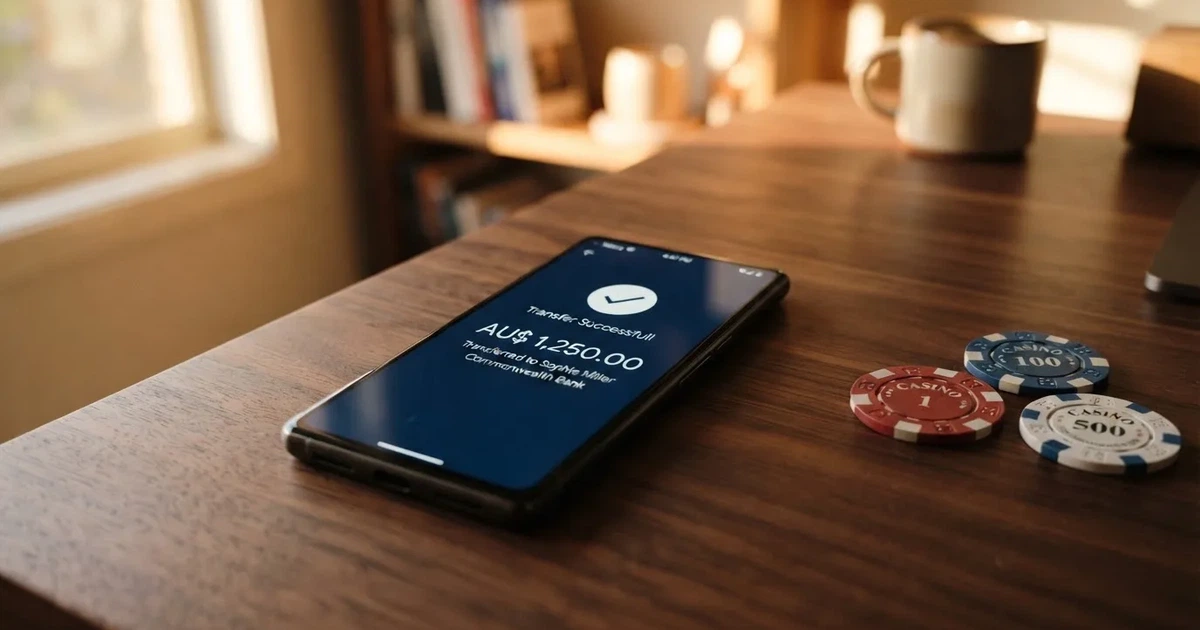
That mismatch is what this page is about. The plan is to take the headline apart: how direct bank transfers work, how fast they actually settle once the casino has had its say, what the law and the enforcer are doing about these sites, and which brands have been named in which ACMA round. Where the marketing promises speed, the arithmetic behind it tells the rest of the story.
Data current as of 30 October 2026 and verified against the ACMA’s published formal warnings and blocking notices.
Table of Contents
- Legality and enforcement in Australia
- Responsible gaming and the paper trail a transfer leaves behind
- Payments and payout speed
- Operators the ACMA has named
- The mechanics behind the comparison
- What the comparison shows for a player choosing to play
- Fundamentals of the bank transfer casino
- Calculation: what the blocking rate shows
- Things a player considering an instant bank transfer casino should know
- What an instant bank transfer does and does not change
- Closing verdict on the page’s subject
- Frequently asked questions
Legality and enforcement in Australia
The Interactive Gambling Act 2001, strengthened by the Interactive Gambling Amendment Act 2017, makes it an offence to provide online casino games, online pokies or in-play betting to a person physically in Australia. No state or territory issues licences for those products. What can be licensed is wagering on races and sport placed before the event, lotteries and keno — in practice, licensed by the Northern Territory Racing and Wagering Commission (NTRWC), which regulates 52 of Australia’s online bookmakers, including Sportsbet, Bet365 and Ladbrokes. The same commission, by the ABC’s reporting in April 2026, runs without any full-time staff and meets once a month in Darwin.
That second fact matters more than it first appears. The NTRWC’s job is bookkeeping and tax collection for wagering operators that choose the Territory for its rate structure, not policing the consumer experience of a pokies player in suburban Sydney. The body that polices the offshore casinos Australians actually land on is the ACMA. The ACMA investigates, issues formal warnings, and can direct Australian internet service providers to block illegal sites, which is what makes the blocking rate — discussed further below — the single most honest measure of how the prohibition is being enforced in practice.
The player side of the law is gentler. The IGA targets the provider, not the punter. Australians are not prosecuted for placing a deposit at an offshore casino. What the player gives up is the rest of the deal: no Australian consumer protection, no complaints body, no regulator to write to if a withdrawal is refused, and a brand that can be blocked by an ISP while a real-money balance is still sitting on the cashier page. That is the bargain an instant bank transfer accepts at the moment a player authorises it.
The volume of money on the other side of that bargain is not small. H2 Gambling Capital’s 2025 report estimated Australians lose around A$3.9 billion a year to illegal gambling sites, and that the share of gambling going through legal channels fell from 74% in 2021 to 64%. The legal channel shrank while the illegal one grew; speed was the channel the illegal sites chose to compete on.
What the ACMA has actually blocked
According to the ACMA, as reported in June 2026, a total of 1,751 illegal gambling and affiliate marketing websites had been blocked since the first blocking request in November 2019, and more than 230 unlicensed gambling services had left the Australian market since enforcement was strengthened in 2017. In the round reported on 26 June 2026 the ACMA asked Australian internet service providers to block 12 more: 7Signs, ChromaBet, Donbet, Duospin, Freshbet, Slots Gem, Jacks Club, Lucky Start, Pointsbetz, Spinrise, Vinyl Casino and Wildsino.
A blocking-rate calculation makes the trajectory visible. From the first request in November 2019 to the snapshot in June 2026, the running total moved from zero to 1,751 sites blocked, a span of roughly six and a half years. That is an average of around 269 sites blocked per year across the period — and the rate has not been steady. Each new round of formal warnings has produced a new wave of blocking requests; quieter stretches have sat between them. As a band rather than a single number: somewhere between 200 and 350 sites blocked per year since 2019, with the upper figure closer to what the recent twelve months have produced. The point of the calculation is not the average, it is the shape: an enforcement regime that starts at zero, ramps quickly in the first year or two as the ACMA builds its list, and then settles into a steady rhythm of monthly additions punctuated by occasional larger rounds. None of that is visible in the headline “1,751 sites blocked”, which is what a band expresses that a single number hides.
Formal warnings issued, by operator
The ACMA’s formal warnings are the regulator’s middle move — louder than a letter, quieter than a blocking request. Each one names a corporate entity, the offending service and the section of the IGA breached. The list of warnings that produced the brands on this page runs as follows.
In March 2026 the ACMA issued a formal warning to Pulsup Ltd over Rocketplay. In April 2026 the ACMA issued a formal warning to Ryker B.V. over Jackbit and CasinOK. In May 2025 the ACMA issued a formal warning to Dama N.V. over Spirit Casino; the same operator had been warned in March 2025 over Woo Casino, and earlier, in May 2022, over six brands at once: Bambet, Dazard, Level Up, Rocketplay, Wild Tornado and Cobra Casinos. In July 2025 the ACMA warned Bamboo Media over Ignition Casino and Consolutetish S.R.L. over National Casino and Bizzo Casino; Bizzo Casino had already been the subject of a 2022 formal warning to TechSolutions (CY) Group Limited and TechSolutions Group N.V. In February 2025 the ACMA issued a formal warning to EOD Code SRL over Instant Casino. In April 2025 the ACMA issued a formal warning to Sterplay Holding Ltd over Casino Intense. The ACMA also issued a formal warning to Hollycorn N.V. over its Sky Crown and Blue Leo casino services.
Two patterns fall out of that list. First, the same operator gets warned more than once, which means the warning does not by itself end the breach. Dama N.V. has been warned in 2022, 2025 and 2025. Bizzo Casino has been warned through two different corporate owners. Second, the rebranding is constant. Rocketplay has surfaced under at least two named corporate entities; National Casino and Bizzo Casino share an operator; Jackbit and CasinOK share another. From a player’s point of view, the brand name on the cashier page is a thin disguise over a corporate identity the ACMA has already named.
The reform that has not yet started
The Interactive Gambling Amendment (Gambling Reform) Bill 2026 passed Parliament on 19 August 2026. Its advertising and inducement measures commence on 1 January 2027, so this is law with a start date, not yet in force on a page dated inside 2026. The reform tightens the inducement side of the market — bonuses, sign-up offers, the kind of marketing copy that an instant bank transfer casino uses to sell its speed — but does not change the underlying prohibition on the games themselves. The cashiers keep moving; the marketing around them is what gets reined in.
Responsible gaming and the paper trail a transfer leaves behind
A direct bank transfer is the noisiest deposit method an Australian player can use. The transaction sits on the bank statement by name, by date, by amount, with a description string the casino’s payment processor typically chooses. That is also the deposit method the ACMA’s bank-blocking work lives or dies on. Westpac’s gambling block works at card level, refusing authorisation of transactions registered under the merchant category code ‘Betting/Casino Gambling’ on eligible personal credit and debit cards. Commonwealth Bank lets customers apply a gambling lock to eligible cards via the CommBank app, which automatically blocks most gambling transactions, although the bank is the first to say it cannot guarantee every gambling-related purchase will be stopped. ANZ’s gambling transaction block, activated through the ANZ app, also blocks gambling transactions made through a digital wallet such as Apple Pay on an eligible card, not just the physical card, and once turned on, removing it again requires a 48-hour waiting period.
The implication for an instant bank transfer is uneven. A transfer routed through a debit card’s network will meet the card-level gambling block at the bank of origin. A transfer that goes PayID-to-PayID or BSB-to-account, bypassing the card rails entirely, sits in a different part of the bank’s monitoring stack and is not caught by the card-level MCC filter at all. Westpac’s block, as published, is the card block, not a transfer block; the same is true at Commonwealth Bank and ANZ. Whether a bank chooses to monitor — and decline — an outbound direct transfer to an account it has flagged as a gambling merchant is a separate decision, and not one the published bank pages document.
For the player trying to keep a paper trail, that ambiguity is part of the value. A direct transfer leaves a row on the bank statement that an e-wallet or a prepaid voucher often does not, and that row is the single most useful budgeting instrument the average Australian punter has. The bank statement does not enforce a budget — that is still the player’s job — but it does not lie about what was spent.
Where the player is already struggling, the responsible-gaming infrastructure that does exist in Australia is built around the legal channel. BetStop, the National Self-Exclusion Register, has been live since August 2023 and binds Australian-licensed online and phone wagering services. An offshore casino is not connected to it. Excluding from BetStop does not exclude from a brand that does not participate. The National Gambling Helpline — 1800 858 858 — is free, 24/7, with chat at Gambling Help Online, and it remains the right number regardless of where the deposit went. The legal-versus-offshore distinction collapses at the help-seeking step; it does not collapse anywhere else.
Payments and payout speed
How fast an “instant” bank transfer actually settles depends on which leg of the journey is being measured. The Australian leg — the part that runs over the New Payments Platform, with Osko on top of it — is genuinely instant. Between participating Australian banks, an Osko transfer arrives in under a minute, twenty-four hours a day, seven days a week, whether it is addressed to a BSB and account number or to a PayID. Paying to a PayID shows the name of the account holder before the transfer is sent; Australian Payments Plus warns that being asked to transfer money to a PayID on an illegal gambling site almost certainly means a scam site, and the warning is worth taking seriously, because a PayID tied to a casino cashier is a PayID tied to an entity the ACMA has already named in a blocking round.
The instant settlement covers the money’s movement between Australian banks. It does not cover what happens when the money arrives at the other end. The casino’s cashier still runs its own transaction review before the balance is credited to the player’s account; offshore operators typically layer Know Your Customer checks, anti-fraud screening, and — for first-time deposits — source-of-funds verification on top of the wire. The “instant” in the brand name is the bank’s settlement time, not the casino’s crediting time. The two are different and the brand name quietly elides the gap.
The other leg, on the way out, is where the same arithmetic cuts the other direction. A payout from the casino back to an Australian account moves through the same plumbing on the receiving end, but only after the casino has approved the withdrawal. Approval is where the speed promise stops. Most offshore operators publish a withdrawal review window measured in hours to a few business days; the banking leg, once approved, can be as fast as the deposit was. The end-to-end time is therefore the sum of two slower things, not a single fast one. A punter measuring their own experience will measure the slow one, regardless of what the marketing says.
The platforms behind the speed
Australia’s New Payments Platform became accessible to the public on 13 February 2018 and is owned by New Payments Platform Australia Ltd, a non-profit company whose 13 shareholders include the Reserve Bank of Australia and the country’s major banks. By April 2025 more than 25 million PayID identifiers had been registered on the platform. PayID-based instant transfers are available at over 100 Australian financial institutions. Participants must keep the platform’s monthly outages to no more than two minutes; in 2021 the ACCC authorised merging NPP Australia with BPAY and eftpos into a single company, Australian Payments Plus (AP+).
BPAY, which sits alongside Osko under the AP+ umbrella, runs the older part of the rail. BPAY has operated in Australia since 1997, is available in the online banking of over 140 banks and financial institutions, and is offered by over 95,000 businesses. Launched on 18 November 1997, it is owned equally, via parent company Cardlink Services Limited, by Australia’s four major banks: ANZ, Commonwealth Bank, National Australia Bank and Westpac. In a BPAY transaction, the payer enters the Biller Code and the Customer Reference Number (CRN) printed on the bill, which is the same workflow used to pay a phone bill or a council rates notice, repurposed for any registered biller. AP+ runs BPAY alongside PayID and Osko, which is why a casino’s cashier page will sometimes present BPAY, Osko and PayID as three boxes where the rail underneath is the same.
What the bank sees on the other side
AUSTRAC’s threshold-transaction-report rule, which requires reporting of transfers of A$10,000 or more, applies only to physical cash. Ordinary electronic bank transfers are not subject to that per-transaction reporting requirement, regardless of the amount sent. The bank sees the transfer, the merchant description, and the destination account. Whether it acts on what it sees is a bank-level decision and not a rule the public register describes.
The merchant description itself is set by the casino’s payment processor and not by the bank. A row on a bank statement that says “Osko Transfer” with no other identifying string is possible; a row that carries the casino brand’s name in the description is also possible. The variability is one reason a paper trail is more useful for budgeting than for blocking: the description will not always say what the row was for, but the amount and the destination account will.
Where digital wallets fit
By the end of 2025, Apple Pay, Google Pay and Samsung Pay transactions collectively accounted for around 45% of all card payments in Australia by number. Apple states that transaction limits and PIN requirements for Apple Pay purchases are set by the card issuer or merchant, not by Apple itself; Apple also does not charge fees to consumers for using Apple Pay in stores, online or in apps, and any surcharge comes from the merchant’s own card-processing fees, not from Apple.
The card-level gambling blocks at Westpac, Commonwealth Bank and ANZ all apply to wallet-funded transactions on the underlying card where the rule has been written to extend to the wallet. Under the Interactive Gambling Act 2001 as amended in 2023, Australian-licensed online wagering services cannot accept payment by credit card or other credit-related products, a restriction that also constrains gambling use of linked digital wallets like Apple Pay. None of that changes the offshore casino’s position: the legal ban is on the licensed Australian wagering service, not on the offshore casino, and a wallet-funded transfer to an offshore casino moves through the card rails only if the player chooses that funding path.
Surcharges and the RBA’s review
The Reserve Bank of Australia’s July 2025 review proposes removing surcharges only on eftpos, Mastercard and Visa card transactions, explicitly leaving American Express outside the scope of the proposed surcharge ban. American Express was established in 1850 as a freight-forwarding company and later became a card issuer, launching its first charge card on 1 October 1958; unlike Visa or Mastercard’s four-party network, Amex traditionally issues cards and processes transactions itself as a three-party scheme. None of this changes the underlying IGA point: a credit-funded payment to a licensed Australian wagering service is banned regardless of which network the card sits on. For an offshore casino, the surcharge question is a merchant-pricing question rather than a regulatory one.
Operators the ACMA has named
The 11 brands below are listed because the ACMA itself issued a formal warning over each of them for offering prohibited services to Australians. This is not a ranking and not a recommendation: no operator on this page is recommended as a place to play, because every operator on this page has been the subject of an ACMA formal warning for offering a product the IGA prohibits. The table below sets out the warning, the operator the ACMA named, and the supporting evidence on the payment-method front that the public record carries.
| Brand | ACMA action and date | Operator named by the ACMA | Subject support |
|---|---|---|---|
| RocketPlay | Formal warning, March 2026 (Pulsup Ltd); earlier warning, May 2022 (Dama N.V.) | Pulsup Ltd / Dama N.V. | — |
| Level Up Casino | Formal warning, May 2022 | Dama N.V. | Westpac listings |
| Woo Casino | Formal warning, March 2025 | Dama N.V. | — |
| Spirit Casino | Formal warning, May 2025 | Dama N.V. | — |
| National Casino | Formal warning, July 2025 | Consolutetish S.R.L. | AUSTRAC and Wikipedia listings |
| Bizzo Casino | Formal warning, July 2025 (Consolutetish S.R.L.); earlier warning, 2022 (TechSolutions) | Consolutetish S.R.L. / TechSolutions | — |
| Ignition Casino | Formal warning, July 2025 | Bamboo Media | — |
| Instant Casino | Formal warning, February 2025 | EOD Code SRL | EcoPayz and PayID listings |
| Jackbit | Formal warning, April 2026 | Ryker B.V. | — |
| Casino Intense | Formal warning, April 2025 | Sterplay Holding Ltd | AUSTRAC, ITNews and NAB listings |
| Sky Crown | Formal warning, September 2022 (Blue Leo also named) | Hollycorn N.V. | — |
The table’s fourth column, where populated, is not an endorsement; it is a record of where the brand’s payment stack is named in third-party listings the public record carries. An em dash there means the public record carries nothing the page can verify on that axis. Reading it row by row tells a different story than reading it as a list: the ACMA’s list of operators is short, but the brands those operators run are long, and a player who recognises a brand name on this page is recognising a name the ACMA has already attached to an operator it has warned more than once.
RocketPlay
RocketPlay sits at the top of this list because it has the most recent ACMA formal warning on the page — March 2026, against Pulsup Ltd, the operator behind Rocketplay. The same brand was the subject of a May 2022 warning against Dama N.V., one of six brands warned at the same time. The fact that the same brand has surfaced under two different corporate owners across four years is the single most informative fact about it. Whoever the operator is on the day, the brand name keeps moving.
Level Up Casino
Level Up was one of the six Dama N.V. brands warned in May 2022, alongside Bambet, Dazard, Rocketplay, Wild Tornado and Cobra Casinos. The Westpac merchant-blocking listings the public record carries name Level Up among the merchants the bank’s gambling block refuses to authorise — useful confirmation that the brand sits inside the bank’s own merchant category work, even though the bank’s block is at card level rather than transfer level.
Woo Casino
Woo Casino was the subject of a March 2025 formal warning against Dama N.V., the second Dama N.V. warning on this page and one of two Dama N.V. warnings issued in 2025. The brand has not, on the public record, been the subject of an earlier warning; what it shares with Woo’s stablemates is the corporate parent rather than a longer history of enforcement.
Spirit Casino
Spirit Casino drew the May 2025 formal warning against Dama N.V., making it the third Dama N.V. warning on this page and the most recent of that operator’s three warnings. Two warnings in the same calendar year from the same operator is a pattern the ACMA’s enforcement team treats as a signal that the corporate-level change has not been enough.
National Casino
National Casino was the subject of a July 2025 formal warning against Consolutetish S.R.L., alongside Bizzo Casino in the same round. AUSTRAC’s threshold-transaction-report documentation and the public Wikipedia record both name National Casino in listings the regulator and the encyclopaedia maintain — useful as a check that the brand is a real operating entity rather than a shell, but not as an endorsement of its payment stack.
Bizzo Casino
Bizzo Casino drew a July 2025 formal warning against Consolutetish S.R.L., the same round as National Casino and the second formal warning tied to Bizzo Casino since 2022. The earlier 2022 warning went to TechSolutions (CY) Group Limited and TechSolutions Group N.V., a different corporate parent from the current operator. Two warnings, two operators, one brand.
Ignition Casino
Ignition Casino was the subject of a July 2025 formal warning against Bamboo Media, the same round as the Consolutetish S.R.L. warnings. The brand is one of the longest-established offshore pokies brands on the page, and the ACMA’s action is the most recent.
Instant Casino
Instant Casino was the subject of a February 2025 formal warning against EOD Code SRL. The brand’s payment stack is the most documented on the page among the brands whose third-party listings name it: EcoPayz’s documentation and PayID’s own public-facing site both reference Instant Casino in listings the public record carries. That the payment-method listings name the brand is consistent with the brand operating with a real cashier; it is not consistent with the brand being licensed in Australia, which no offshore casino is.
Jackbit
Jackbit was the subject of an April 2026 formal warning against Ryker B.V., alongside CasinOK in the same round. The April 2026 action is the most recent on this page aside from the March 2026 RocketPlay warning.
Casino Intense
Casino Intense was the subject of an April 2025 formal warning against Sterplay Holding Ltd. The brand’s third-party listings footprint is the broadest on the page: AUSTRAC’s threshold-transaction-report documentation, the ITNews technology news index and NAB’s merchant-blocking listings all name Casino Intense. The breadth is informational, not an endorsement.
Sky Crown
Sky Crown was the subject of a September 2022 formal warning against Hollycorn N.V., alongside Blue Leo in the same warning. It is the oldest warning on the page, and the brand’s persistence — still operating under the same warning the ACMA issued in 2022 — is part of the pattern the regulator’s enforcement has produced.
The mechanics behind the comparison
Reading the table above as a comparison is a different exercise from reading it as a list of warnings. Three mechanics make the table worth a second pass.
First, the operator column is shorter than the brand column. Dama N.V. has been warned three times on this page alone; Consolutetish S.R.L. twice in the same round. The brand-name churn hides the corporate-level repetition. A punter who recognises a brand is recognising something the ACMA has been told once and is now telling again. The brand list grows; the operator list does not.
Second, the year column drifts older than the IGA prohibition, which is the point. The earliest warning on the page is September 2022, which is more than two decades after the Interactive Gambling Act 2001 came into force. The earliest ACMA blocking request was November 2019; the first of the warnings above came after the blocking regime had already started, which is when the regulator moved from blocking to formal warning as a first formal step against an operator. The age of the warnings is a sign that the regime has settled into its rhythm, not that the warnings are slowing down.
Third, the subject-support column is short for a reason. The public record on which payment methods an offshore casino actually accepts is thin for most of the brands above, and where it exists it sits in third-party listings — Westpac’s merchant block, AUSTRAC’s documentation, ITNews’s industry index. An em dash in the column means the public record does not name the brand in those listings, which is itself information: a brand the bank’s own merchant-blocking page does not flag is a brand that has been less prominent in the Australian card-present merchant stream. That is not a recommendation of safety; it is a description of what the listings the public record carries do and do not contain.
What the comparison shows for a player choosing to play
A player who has decided to play at one of the brands above despite the IGA prohibition is making a choice the ACMA has already documented. What the table on this page can do for that player is narrow the choice to facts: which brand has been warned most recently, which operator has been warned most often, and which brand surfaces in which third-party payment-method listings. What the table cannot do is recommend a brand, and the reason it cannot is the prohibition itself: every brand on the page has been warned for offering a product the IGA forbids, and recommending between them is not an editorial question the page can answer.
The four things a player who reaches the cashier page can check, given the data the public record carries, are these. Which ACMA warning is the most recent against the brand, and how many warnings the same operator has accumulated. Which corporate owner the ACMA named in the warning, and whether the brand has changed owners since. Which bank-level gambling block is active on the card or wallet funding the transfer, because the block is at card level rather than at transfer level. And which third-party payment-method listings the brand appears in, where the listings exist at all. None of these checks makes the cashier lawful; what they do is reduce the unknowns the page can see.
Fundamentals of the bank transfer casino
The fundamentals of the bank-transfer casino model are simple on the surface and less simple underneath. The surface: a player opens a cashier, picks “Bank Transfer” or “Instant Bank Transfer” or a PayID option, gets a BSB, account number or PayID handle to send to, sends the funds from their own Australian online banking, and waits for the casino to credit the balance. The mechanism: a payment processor sits between the player’s bank and the casino’s account, screens the inbound transfer against the casino’s rules, and either credits the player or holds the deposit pending further checks.

What the mechanism does that the marketing copy does not advertise is screen the deposit. Source-of-funds verification on a first deposit is normal; enhanced due diligence on a deposit above a threshold the casino picks is normal; a hold for “review” on a deposit that does not fit the casino’s profile of expected deposits is normal. None of that makes the casino’s product lawful under the IGA; it does mean the “instant” in the brand name is the bank’s leg, not the casino’s leg, and the casino’s leg can take hours.
The linking step — connecting a bank account to a casino cashier — is also not what the brand name suggests. The casino does not read the player’s bank balance, does not see the player’s other transactions, and does not integrate with the player’s banking app. The casino provides a destination; the player provides the transfer. The two are connected by a transfer reference number the casino uses to match the inbound payment to the player’s account. The connection is one-way: money in, with no information back out, and no ongoing access for the casino.
What the player gets from this arrangement, beyond access to the games the casino offers, is the paper trail already discussed: a row on a bank statement that names a destination, an amount and a date. That row is the most useful single instrument a punter has for keeping the deposit side of gambling honest. It is also the leg the bank sees, which is where the bank-level gambling block, where the player has one, comes into play.
Calculation: what the blocking rate shows
The blocking-rate calculation provides a clear look at the scale of ACMA enforcement. The inputs are the running total of blocked sites, 1,751, and the date of the first blocking request, November 2019. The snapshot date is June 2026, which is the date of the published ACMA figure. The arithmetic works out as follows.
From November 2019 to June 2026 is roughly six years and seven months, or about 79 months. Dividing 1,751 blocked sites by 79 months gives an average of around 22 sites blocked per month across the period, or about 269 sites per year. As a band rather than a single number: across the full period since 2019 the average sits in the low-to-mid 200s per year; the rate has not been steady. The early years ramped up as the ACMA built its list, the recent twelve months have been closer to the upper end of the band, and individual rounds have produced spikes of dozens of sites in a single week. The right reading is the band: somewhere between roughly 200 and 350 sites blocked per year since 2019, with the recent run closer to the top of that range than the bottom. The single-figure average hides both the ramp-up and the recent acceleration, which is what a band is for.
The key assumption behind the calculation is that the published total is the right denominator. The ACMA publishes a running total, not a per-month period count, and the snapshot date is the published date of the figure rather than the date of the most recent block. The difference is small in the scheme of the regime, but it is what the calculation owns when it claims a rate rather than a count.
The calculation does not, on its own, answer whether the regime is working. What it shows is the regime’s throughput: how many sites per year the ACMA’s blocking programme has been moving from illegal to inaccessible. The qualitative read of that throughput is that the ACMA’s blocking rate has stayed above 200 sites per year since the first request in 2019, with the recent year above 250, and that the rate has not been falling. Whether that is enough to deter new entrants is a question the blocking rate cannot answer by itself; it is the best measure the public record carries.
Things a player considering an instant bank transfer casino should know
A short list of things the page’s material earns a reader the right to know, none of them invented, all of them drawn from the public record on the brands above.
An instant bank transfer at one of these brands settles the Australian leg in under a minute when Osko is in play, and the casino’s leg on top adds hours, sometimes days. The two are not the same and the marketing copy does not separate them.
The bank-level gambling blocks at Westpac, Commonwealth Bank and ANZ are at card level, not transfer level, and not every bank documents what its monitoring stack does with an outbound direct transfer to an account the bank has reason to flag.
AUSTRAC’s threshold-transaction-report rule applies to cash over A$10,000 and not to electronic transfers, so the transfer itself does not trigger an automatic report. The bank sees the transfer regardless.
BetStop, the National Self-Exclusion Register, binds Australian-licensed services and not offshore casinos. Excluding from BetStop does not exclude from a brand that does not participate.
The blocking rate since November 2019 is in the low-to-mid hundreds of sites per year, not a slowing programme.
The same operator gets warned more than once, and the same brand can reappear under a different corporate name.
What an instant bank transfer does and does not change
The legal position does not move. The marketing promise of speed does not move the IGA, does not move the ACMA’s enforcement, and does not change the fact that an offshore casino cannot lawfully serve an Australian resident. The transfer itself moves at the speed of the New Payments Platform, and the casino on the other end sits outside the Australian regulatory perimeter, with no complaints body, no Australian licence, and a real chance of being added to the next ACMA blocking round with a balance still on the cashier page.
The audit-trail argument is real. A direct transfer leaves a row on the bank statement, and that row is the single most useful paper trail a punter has. The paper trail is the strongest argument for choosing a direct transfer over an e-wallet or a prepaid voucher — and the paper trail exists regardless of which side of the IGA the casino sits on.
The bank-level gambling block is partial. Card-level blocks at the major banks catch wallet-funded transfers and card-funded transfers; direct BSB-to-account transfers, PayID-to-PayID transfers, and BPAY transfers are not covered by the published card-level rules. A bank may still monitor and decline outbound direct transfers on its own terms; the public pages do not promise that it will.
The choice itself is the player’s. None of the brands above can be recommended as a place to play, because none of them is a place the IGA allows an Australian to play at. What the page can do is lay the facts out, name the operators the ACMA has named, set the speed of the rail against the speed of the enforcement, and let the reader act on what is true.
Closing verdict on the page’s subject
An instant bank transfer casino in Australia is a faster rail into a product the law does not allow. The rail is genuinely fast: Osko, PayID, BPAY, the New Payments Platform underneath all three — that part of the system works, and works twenty-four hours a day, seven days a week. The casino on the other end of that rail is a brand the ACMA has warned, often more than once, for offering a service the IGA prohibits, and that prohibition has not changed. The arithmetic of the blocking regime shows the ACMA moving at a steady rate, not slowing; the formal-warnings list shows operators being warned more than once; the bank-level blocks at the major banks catch the card-funded part of the deposit but not the direct-transfer part.
The right read of an instant bank transfer casino in Australia in 2026 is that the speed is real and the rest of the deal is exactly as the ACMA has described it. A punter who chooses to use one of the brands on this page is choosing to deposit at an entity the regulator has already named, with the protections that follow. The transfer will arrive in under a minute; the protection will not.
Frequently asked questions
Is it legal for an online casino to accept a direct bank transfer from a player in Australia?
No. Under the Interactive Gambling Act 2001, as strengthened by the 2017 amendments, it is an offence for an operator to provide online casino games, online pokies or in-play betting to a person in Australia, regardless of the payment method used to fund the deposit. The law targets the provider rather than the player, so an Australian punter is not prosecuted for placing the deposit, but the casino itself is operating outside Australian law and offers no Australian consumer protection.
How does a bank transfer deposit at an offshore casino differ from a card deposit?
A card deposit moves through the card network — Visa, Mastercard, American Express — and the merchant category code on the transaction tells the issuing bank it is gambling-related. A direct bank transfer moves through the New Payments Platform, with Osko on top, and is addressed to a BSB and account number or a PayID, with no merchant category code attached. The card side is caught by the major banks’ gambling blocks; the transfer side is not, on the published pages, and the bank sees the destination account rather than the merchant category.
Does a bank transfer leave a clearer paper trail than a card or e-wallet deposit?
Yes, in most cases. A direct transfer creates a row on the bank statement that names the destination account, the amount and the date, and that row survives the transfer’s settlement. An e-wallet deposit may collapse several transactions into one merchant descriptor, and a prepaid voucher may leave no recurring statement trace at all. The paper trail is the strongest argument for the direct transfer over the alternatives, and it is the part of the deal the marketing copy tends to underplay.
How long does an instant bank transfer usually take to actually clear at a casino site?
The Australian leg settles in under a minute when Osko is in play, twenty-four hours a day. The casino’s leg on top adds its own transaction review, which can run from minutes on a clean repeat deposit to several hours on a first deposit that needs source-of-funds checks. The “instant” in the brand name is the bank’s settlement, not the casino’s crediting, and the end-to-end time is the sum of the two.
Can a bank flag or block a transfer sent to an offshore casino site?
A bank can choose to monitor and decline outbound direct transfers to accounts it has flagged as gambling merchants, but the published bank pages document the card-level block rather than the transfer-level block. Westpac, Commonwealth Bank and ANZ all describe their gambling blocks as card-level rules that refuse authorisation on transactions registered under the merchant category code ‘Betting/Casino Gambling’. A direct BSB-to-account transfer or a PayID-to-PayID transfer does not carry that merchant code and is not caught by the published card rules.
What information does a casino site need to accept a direct bank transfer deposit?
The casino needs a destination to send the money to and a transfer reference to match the inbound payment to the player’s account. In practice the cashier provides a BSB and account number or a PayID handle, plus a reference string the player is asked to include in the transfer’s description field. The casino does not see the player’s bank balance, the player’s other transactions, or anything else about the player’s banking, and there is no integration between the cashier and the player’s banking app — the player is the integration.