
Live blackjack online casino Australia 2026: what the stream is and what the law says about it
A live-dealer blackjack table running on a phone screen in Australia looks, to the player holding it, like a real casino. A real shoe of cards, a real dealer wearing a headset, real chips sliding across real felt. The marketing around these tables leans into that likeness hard: authentic, immersive, as if you were there. The first job of any reader thinking about clicking through that stream is to notice what the likeness leaves out. Online casino games — live-dealer blackjack not excepting — are prohibited interactive gambling services under Australian federal law. The same prohibition that bars a computer-generated pokie also bars the human dealer riffling a six-deck shoe behind a camera in Malta or Curaçao. The shape of this page is built around that fact. The fundamentals of the game come first, because a reader comparing options still needs to know what a blackjack hand actually is, what the dealer rule does to their bankroll, and why a side bet labelled “perfect pairs” costs more than the main bet to play. The legal frame comes next, because every other shelf in this comparison — the payment rails, the bonus terms, the app versus the browser table, the bitcoin-funded variant — runs into the same wall. The operators reviewed in the second half of the page are all brands the ACMA itself has acted against for offering exactly this product to Australians. The comparison the reader came for is honest only if the prohibition sits at its front, not at its end.
Data current as of 31 October 2026 and cross-checked against the Australian Communications and Media Authority’s register of formal warnings and blocking requests.
Table of Contents
- How live blackjack actually works at an online casino
- The Interactive Gambling Act and what it makes of a live blackjack stream
- Responsible play at a continuous-shoe table
- Crypto, anonymity and what changes when the deposit is bitcoin
- PayID, payout speed and the review window every withdrawal sits behind
- The live-dealer providers and what their product actually is
- The eleven operators the ACMA has warned, in the order the regulator put them on notice
- What the comparison does and does not tell a reader
- Frequently asked questions
How live blackjack actually works at an online casino
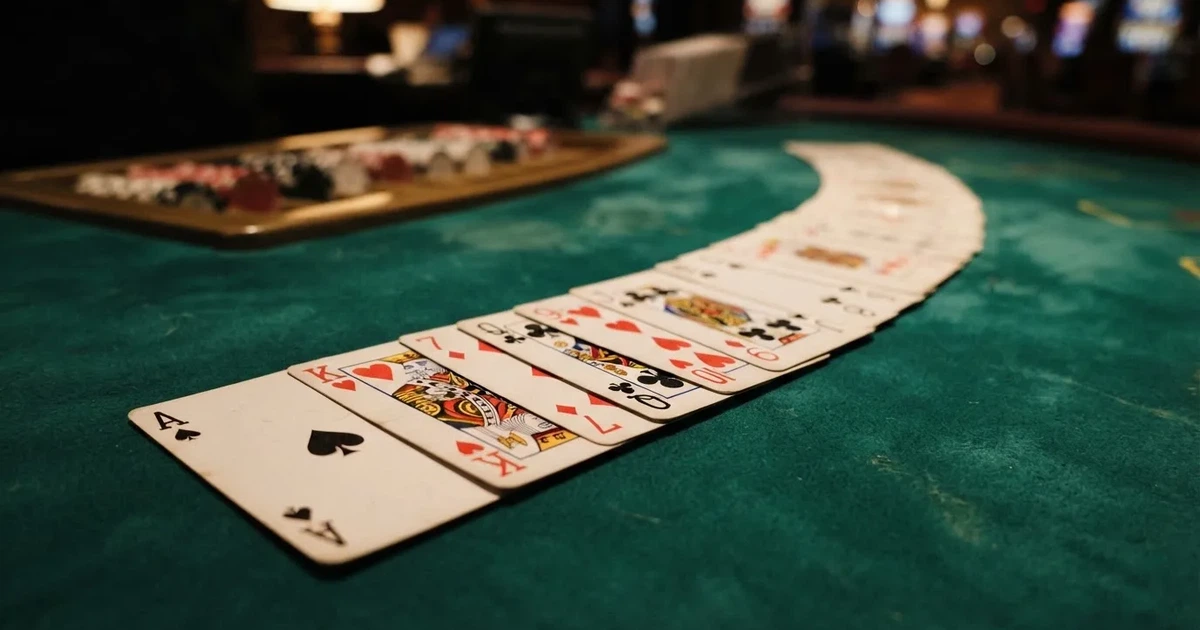
A live blackjack table streamed to a phone or laptop is a video feed from a studio or a land-based casino floor, with the player’s bet placed through a digital interface layered on top of the picture. The dealer cannot see the player. The player sees the dealer, the shoe, the felt, the dealer’s hands and — usually — a chat window for typing at the dealer, which a moderator screens before it reaches them. Cards are real, drawn from a real shoe, and the result of each hand is read by optical character recognition rather than by software, which is why a cut-card jam or a mis-deal produces a real-world pause rather than a digital one. Hands run roughly every 30 to 45 seconds once the dealer is settled at the table, which is faster than a computer-generated version but slower than a hand-dealt game in a smoke-free room of a Melbourne casino at four in the morning. The pace is the one thing the marketing tends to underplay, because a continuous shoe-based game with multiple players deciding in parallel is where most players quietly lose track of how many hands they have played.

The game itself has not changed much since its modern name caught on. The English game vingt-un was its immediate predecessor; a related game called veintiuno turns up in Miguel de Cervantes’ Rinconete y Cortadillo, written around 1601–1602, and the first formal English-language rules were published in Britain in 1800. The name blackjack itself dates from around 1899, with the Klondike Gold Rush of 1896–99 credited by card historian Thierry Depaulis with giving the game its modern label, after a special ten-of-spades-and-ace-of-clubs payout that gave the original rule its name. What changed in the twentieth century was not the game but the apparatus around it: a multiple-deck shoe to slow down card counters, side bets to monetise the gaps between hands, and a video pipeline to put the shoe on a screen.
What a hand looks like and why the dealer rule matters
In a standard blackjack hand, number cards count at face value, the jack, queen and king each count as ten, and the ace counts as either one or eleven at the player’s option. A starting two-card total of 21 is a blackjack or natural and is the strongest hand; it pays 3:2 on the main bet in almost every rule set, although 6:5 paytables still survive on some tables and cost the player roughly 1.4% of every natural compared with the standard payout. The dealer must keep drawing cards until reaching a total of 17 or higher. Some rule sets require the dealer to also hit on a soft 17 — a hand like ace-six, which counts as seven or seventeen — and that single rule is the largest single mover of the house edge between one table and another. Other rules that move the edge: whether the player can double down on any two cards, whether doubling is allowed after a split, whether aces can be resplit, and whether late surrender is on the menu. None of these is exotic. Every one of them appears on a rule card at the side of the felt, often small enough that a player joining a hand has to lean in to read it.
With optimal strategy — the right hit, stand, double and split decision for every possible player hand against every possible dealer up-card — the house edge on a standard blackjack hand is about 0.28% under liberal Las Vegas Strip rules, and about 0.43% under more common Atlantic City rules. Compared with baccarat, where the Banker bet runs at 1.06% and the Player bet at 1.24%, blackjack is the cheapest standard table game in the casino when it is played correctly. Compared with craps, where Pass/Come runs at 1.41% and any one of the proposition bets on the centre of the layout runs as high as 16.67%, blackjack is in a different league. The catch is that “optimal strategy” is doing the work in that sentence. A player who plays by feel — hitting whenever the hand feels small, standing whenever it feels big — gives back most of the edge they would otherwise have kept. A live dealer does not correct a player. The shoe does not correct a player. The result is whatever the player asked for.
Variants a live studio will put in front of you
The standard game is the spine, but the variants are where most live studios earn their margins. Spanish 21 removes the tens from the deck, replacing them with a card that counts as zero, and offsets the missing card by stacking player-favourable rules on top: doubling on any number of cards, late surrender, a player twenty-one always beating a dealer twenty-one. Double Exposure Blackjack deals both dealer cards face-up at the cost of a tweaked paytable, so the player knows what they are up against but the casino keeps more on a natural. Blackjack Switch lets the player swap the top cards of two hands, again with the paytable rebalanced in the house’s favour. Super Fun 21 allows up to four splits, which sounds generous until the reader notices that a hand split four ways at A$5 each becomes A$20 of exposure on a single starting pair. Side bets — Perfect Pairs, 21+3, Lucky Ladies, the studio’s own branded variant — sit alongside the main bet with their own house edges, usually in the 5% to 10% range, and most of them lose money faster than the main bet does.
At Crown Melbourne, which is the licensed Australian venue where a reader can sit at a real blackjack table, the Victorian Gambling and Casino Control Commission has to approve any change to a table-game rule before it goes live. The VGCCC’s public log of approved changes to Crown’s blackjack variants includes renaming the Perfect Pairs side bet to Crown Pairs on 23 December 2024, and introducing a Free Bet option with a new Pot of Gold side bet on 25 March 2024. A reader comparing side-bet menus between an Australian licensed venue and an offshore live stream is comparing apples with a marketing PDF: the regulator knows what is in front of the player, the offshore studio knows what it can sell.
The browser tab, the phone app and the shoe
A live blackjack app is usually a wrapper around the same browser-based live-dealer product the operator runs in a desktop tab. The Evolution Gaming and Pragmatic Play Live studios that supply most of these tables do not ship a separate hand-dealt product for iOS or Android; they ship a stream and a betting panel, and the operator wraps that stream inside a native app so it can sit on the home screen, send push notifications about new tables, and run a touch-tuned betting panel. Some operators — and one of the brands in this comparison is in this group — push the live table inside a phone app, mark it as a “mobile-only” product, and price the side bets to read smaller on a thumb-sized screen. None of this changes the game. The cards are dealt the same way, the dealer draws to the same 17, the shoe holds the same number of decks. What changes is friction. A betting panel that fits on a phone is faster to use than a browser tab on a desktop. A push notification that announces a new table is more likely to bring a player back to a hand than a marketing email. The marketing material around live-dealer blackjack tends to lean on this friction as if it were a feature. It is a feature, but it is a feature that costs the punter in the same direction every other shortcut costs them — by making it easier to play another hand, not by making any single hand fairer.
The Interactive Gambling Act and what it makes of a live blackjack stream
Australia’s federal prohibition on online casino games sits in the Interactive Gambling Act 2001, strengthened by the Interactive Gambling Amendment Act 2017. The Act makes it an offence to provide online casino-style games, online pokies or in-play betting to a person physically in Australia. The prohibition is on the provider, not on the player: an individual Australian clicking through to a live blackjack table commits no offence under the IGA. The offshore operator serving that stream is the one the Act targets, and the penalties are sized to make the target bite — individuals face fines of up to A$220,000 per day and corporations up to A$1.1 million per day. No state or territory licenses online casino games or online pokies. What is licensed, under the Northern Territory Racing and Wagering Commission’s regime, is wagering on races and sport placed before the event, lotteries and keno; the NTRWC regulates 52 of Australia’s online bookmakers, including Sportsbet, Bet365 and Ladbrokes, for tax reasons, and operates without full-time staff, meeting once a month in Darwin.
A live-dealer blackjack stream is not a wagering service. The player places a bet on a casino-style game against the house, in real time, against a human dealer. That is exactly the service the IGA prohibits, and the Act does not distinguish between a dealer generated by software and a dealer dealing real cards through a camera. The distinction the marketing draws between RNG blackjack and live blackjack is real at the studio — a hand dealt from a shoe is a hand dealt from a shoe — and irrelevant at the regulatory border.
The Interactive Gambling Amendment (Gambling Reform) Bill 2026 passed Parliament on 19 August 2026. Its advertising and inducement measures commence on 1 January 2027. The Bill is law with a start date, not yet in force on a 2026 page, which means the comparison a reader is making today runs against the regime as it stood before the 2026 amendment. The shape of the regime does not change between today and the 1 January 2027 commencement; what changes is the tools the ACMA has to enforce it. The comparison this page makes is unchanged either way.
How the ACMA enforces the prohibition
The Australian Communications and Media Authority investigates complaints, issues formal warnings to operators, and directs Australian internet service providers to block illegal sites. As reported in June 2026, the ACMA had asked ISPs to block 1,751 illegal gambling and affiliate marketing websites since the first blocking request in November 2019. More than 230 unlicensed gambling services had left the Australian market since enforcement was strengthened in 2017. In the round reported on 26 June 2026 alone, the ACMA asked ISPs to block a further 12 sites: 7Signs, ChromaBet, Donbet, Duospin, Freshbet, Slots Gem, Jacks Club, Lucky Start, Pointsbetz.com, Spinrise, Vinyl Casino and Wildsino.

The blocking rate — the share of illegal sites the ACMA has actually moved against since November 2019 — sits in a band. The block-and-leave rate that matters to a reader is between roughly 12 and 15 sites per month, on the inputs the ACMA has published: 1,751 blocking requests over a period of just over six and a half years from November 2019 to the June 2026 report. That is the cadence the regulator runs at. The cadence a single operator avoids is harder to read, because the ACMA does not publish the denominator — the total number of illegal offshore sites targeting Australian customers at any one time — but the published blocking list has been long enough and consistent enough that an offshore operator offering prohibited games to Australians should expect the regulator to find them. The bands matter because a reader weighing whether to sign up with a brand whose warning sits in this comparison is weighing against a regulator that moves at this cadence, not against one that does not move at all.
A formal warning is not a blocking request. It is a published notice, on the ACMA’s own register, naming the operator and the brand and the date. The warning puts the operator on notice that further enforcement action may follow. Most operators issued a formal warning do not get blocked in the same calendar quarter, and a few — Dama N.V., the operator behind several brands in this comparison — have been warned more than once. The formal warnings the ACMA has published against the brands in this comparison are listed in the table further down.
The blocking rate as a band
The arithmetic on this page, given the inputs available, runs as follows. The ACMA’s first blocking request was issued in November 2019. By the report dated 26 June 2026, the cumulative total had reached 1,751 blocked sites. That is 1,751 blocking requests over roughly 79 months. The mean works out at about 22 blocked sites per month, but the published rounds have not run at that pace — the cadence is lumpy, with bursts in some months and quiet stretches in others, and the ACMA publishes blocks in rounds rather than continuously. A reader who wants a defensible figure should treat the rate as a band: somewhere between roughly 15 and 25 sites blocked per month on the long-run average, with significant month-to-month variation. The rate a reader can act on is not the mean; it is the probability that an offshore operator currently targeting Australians will end up on a blocking round at some point in the next year. The published enforcement record makes that probability material, not negligible.
This is a statistical estimate of enforcement cadence, not a guarantee that any one operator will be blocked or that any one player will be denied a withdrawal. The cadence describes the regulator, not the reader’s experience.
What the prohibition leaves the reader holding
An Australian resident playing at an offshore live-dealer blackjack site is not committing an offence. They are also not protected by Australian consumer law. There is no Australian complaints body with jurisdiction over a Curaçao-licensed operator. There is no Australian recourse if the operator refuses a withdrawal, voids a bonus win on a technical reading of the bonus terms, or closes the account and keeps the balance. The site can be blocked by an Australian ISP — and the ACMA has asked for 1,751 of them to be blocked since November 2019 — while a balance is still on it. There is no statutory guarantee a player can withdraw before a block takes effect. The block lands when the ISP’s filter updates, and the player’s funds sit in the account the filter has just cut off.
The offshore protection the site advertises — its Curaçao or Kahnawake or Anjouan licence — protects the site, not the player. The licence gives the site a regulator to answer to, in that regulator’s own jurisdiction, on that regulator’s terms. It does not give an Australian player an Australian forum. A player who loses a dispute with an offshore operator has, in practice, no faster remedy than a civil action in the operator’s home jurisdiction, which is a remedy the cost of pursuing exceeds the value of almost every disputed withdrawal.
Responsible play at a continuous-shoe table
A live blackjack table at an offshore site runs hands quickly. Once a dealer is settled at a shoe, a hand turns over in roughly 30 to 45 seconds, and the decision points — hit, stand, double, split, take the side bet, lay the insurance — sit inside that window. A player who joins a table and stays through two shoes will play, on average, somewhere between 60 and 90 hands, depending on the number of players at the table and how often the dealer has to wait for a decision. At A$10 a hand, that is A$600 to A$900 of action in a single sitting. At A$25 a hand, A$1,500 to A$2,250. The arithmetic is the kind of thing that is easy to forget mid-session, because the per-hand figure is small and the hands come fast.
This is the one place the offshore market’s design makes a sharp edge visible. A licensed Australian venue has a Responsible Gambling Officer on the floor, a visible exclusion scheme, and a ban on credit-card gambling that pushes players toward a budget they have to set before they arrive. An offshore live-dealer table has none of that. The only bankroll limit a player sets is the one they set themselves, and the only self-exclusion a player takes is the one they take themselves. The marketing material on offshore live-dealer products tends to mention “responsible gambling tools” as a bullet point — deposit limits, time-outs, self-exclusion — and the tools, where they exist, are operated by the offshore site on its own terms, with no Australian regulator reviewing whether they actually do what they say.
BetStop and what it does not cover
BetStop, the National Self-Exclusion Register, has been live since August 2023. It binds every Australian-licensed online and phone wagering service — a Sportsbet account, a Ladbrokes account, a Bet365 account — and it does not bind an offshore casino. A punter who registers with BetStop and then opens an account with an offshore live-dealer blackjack site has not excluded themselves from that site, because the site has no obligation to check BetStop, no obligation to honour the exclusion, and no obligation to close the account if it finds out. The exclusion is real for licensed Australian wagering. It is silent for everything else.
The help line that does work
The National Gambling Helpline — 1800 858 858 — is free, runs 24 hours a day, and is the line that does work whether the gambling in question happened at Crown Melbourne or at an offshore live-dealer studio. Gambling Help Online runs a live chat at the same number’s web address. The counselling and financial advice these services offer do not depend on where the gambling took place, and they do not depend on whether the offshore site cooperates with the self-exclusion. The line a reader keeps is the line that works regardless of which side of the prohibition the gambling sat on.
A bankroll limit set before the first hand is the only responsible-gambling tool that has any chance of working at an offshore live-dealer table. A player who decides what they are willing to lose before they open the table, and stops when they have lost it, has done what no offshore site will do for them. A player who decides mid-session is already behind the session’s pace.
Crypto, anonymity and what changes when the deposit is bitcoin
A bitcoin-funded live blackjack table deals the same cards as a card-funded one. The dealer cannot tell the difference. The shoe does not know what rail the funds arrived on. The result of any hand is identical regardless of the deposit method. What changes is everything around the hand. A bitcoin deposit bypasses the bank account the player would otherwise use. It bypasses the credit card ban the IGA put on licensed Australian wagering from 11 June 2024, although that ban applies to licensed wagering services and an offshore casino is not bound by it anyway. It bypasses PayID, which is the instant bank-to-bank rail that licensed Australian operators use. It lands in the offshore operator’s wallet, where the operator chooses what to do with it.
This is what the marketing around bitcoin blackjack tends to emphasise: fast, private, borderless. It is what the marketing tends to leave out: the same offshore operator is still serving Australian residents in breach of the Interactive Gambling Act 2001, the same ACMA has jurisdiction to ask an Australian ISP to block the site, and the same bitcoin balance sits inside an account that an Australian player has no Australian remedy to recover if the operator decides to keep it. Bitcoin is faster than a bank transfer. Bitcoin is not faster than the regulator.
The mechanics of funding a live blackjack table with bitcoin run as follows. The player sends bitcoin — or, on a few sites, ethereum or litecoin — from their own wallet to a deposit address the casino provides. The deposit usually confirms within an hour, often within ten minutes, and the casino credits the player’s account at a rate set by the site, which may differ from the rate the player saw when they sent the funds. Withdrawals reverse the route: the player requests a withdrawal, the casino processes it, and the bitcoin lands back in the player’s wallet, sometimes within minutes, sometimes after a review period that runs longer than the deposit. The route is fast on the bitcoin side of the ledger and slow on the casino side of the ledger, which is the same problem a PayID withdrawal has at an offshore site — the speed of the rail is not the speed of the operator.
The licence the offshore casino displays — Curaçao, Kahnawake, Anjouan, the Comoros — is the licence the casino chose. None of them is an Australian licence, because there is no Australian licence to display for online casino games. The marketing that wraps a bitcoin live-dealer blackjack site in the language of Web3, decentralised, permissionless is selling a payment rail, not a legal status. A player funding a live blackjack table with bitcoin is still playing a prohibited interactive gambling service, still at an offshore site, still with no Australian recourse if the balance goes missing.
PayID, payout speed and the review window every withdrawal sits behind
A PayID deposit at a licensed Australian wagering operator is, in practice, instant. PayID is the instant bank-to-bank rail that runs through Osko, and a deposit from a bank account into a Sportsbet or Ladbrokes account using PayID lands in seconds. A PayID withdrawal reverses the route, and a withdrawal from a licensed wagering account back to a PayID-enabled bank account usually clears inside an hour, sometimes faster. This is what the licensed Australian market looks like. This is also not the market a live-dealer blackjack table lives in.
A live-dealer blackjack site is an offshore casino. Its deposit rails include PayID on some sites — and one of the brands in this comparison is in that group — and its withdrawal rails include PayID on fewer. The deposit works the way PayID works everywhere. The withdrawal is where the picture changes. An offshore casino processes a withdrawal in two stages: an internal review, which checks the bonus terms, the wagering requirements, the anti-money-laundering rules and the player’s identification documents, and a payout, which moves the funds to the rail the player chose. The internal review can take anywhere from a few hours to several days, and the time it takes is the time the player spends waiting. A PayID withdrawal that is approved in 24 hours and arrives in 24 hours is a two-day withdrawal. A PayID withdrawal that takes the operator four days to approve is a five-day withdrawal, regardless of how fast PayID itself runs.
This is the comparison a reader is making when they weigh a live-dealer blackjack site on payout speed: not PayID versus bitcoin, which is the rail, but this operator’s review window versus another operator’s review window. A site whose published payout time is “instant” through PayID is making a claim about the rail, not about its own review. A site whose published payout time is “within 24 hours” is making a claim about its own review, and that is the claim the reader can use.
The no-deposit bonus and what it usually turns into
A live blackjack no-deposit bonus is the marketing offer that costs the operator the least to advertise and the player the most to clear. The shape of the offer is well established: a small bonus credit, often between A$10 and A$50, credited to the player’s account without a deposit, with a wagering requirement attached that is usually higher than the wagering requirement on a deposit bonus. The wagering requirement on table games is almost always calculated differently from the way it is calculated on slots. Slots usually contribute 100% of the wager to the requirement. Table games — blackjack especially — usually contribute between 5% and 20%, which means the player has to wager five to twenty times more on blackjack than the headline requirement suggests.
A player who claims a A$20 no-deposit bonus with a 40x wagering requirement and tries to clear it on slots will wager A$800 and finish the requirement, if the bonus survives the playthrough, with a balance that has shrunk to whatever the slots left. A player who tries to clear the same bonus on blackjack, with blackjack contributing 10% to the requirement, will need to wager A$8,000 to clear the same playthrough, at a house edge that runs as low as 0.28% under optimal play and as high as several percent under any play that is not optimal. The no-deposit bonus is a marketing offer. It is not a free way to play live blackjack.
What a blackjack bonus actually costs
A blackjack bonus offer from an offshore casino usually carries three terms the player has to read before they sign up: a maximum bonus, a wagering requirement, and a maximum cashout — the cap on how much of the bonus-derived balance the player is allowed to withdraw. A A$500 blackjack bonus with a 40x wagering requirement and a 5x maximum cashout is, in practice, a A$500 bonus that, even if the player clears the wagering requirement, will let them withdraw no more than A$2,500 of the balance the bonus produced. The cap sits on the exit, not on the entry. A player who clears the wagering at A$500 of bonus × 40 = A$20,000 of required turnover, at a house edge of 0.43% on a standard table, has an expected loss of about A$86 — a number small enough to look harmless and large enough to be the cost of clearing the bonus, before any cap on the exit kicks in. This is the arithmetic the marketing never prints. The arithmetic is what the offer actually costs.
The expected loss on a cleared bonus is a statistical estimate — an average over many players under the stated assumptions — not a guaranteed outcome for any one player. A single player may win more or lose less. The estimate describes the average cost of clearing the bonus, not the player’s experience.
The live-dealer providers and what their product actually is
The studios that supply most live-dealer blackjack to offshore casinos targeting Australian customers are concentrated in a handful of names. Evolution Gaming — listed on the Stockholm stock exchange under the ticker Evolution — is the largest, with studios in Latvia, Malta, Georgia, Romania, Canada and the United States, supplying tables to hundreds of operator brands. Pragmatic Play Live runs a smaller studio footprint, with tables in Bucharest and a wider range of game-show products alongside the standard blackjack. Playtech Live, OnAir Entertainment, Vivo Gaming and a handful of smaller studios fill out the rest of the long tail.
The studios are not the operators. A live-dealer blackjack site is usually a brand wrapper around a studio’s tables — the studio deals the hands, the brand takes the bets, the brand issues the bonus and processes the withdrawal. The studio’s footprint is the same regardless of which brand a player signs up with, because most brands rent tables from the same studios. The difference between the brands is in everything around the table — the bonus, the deposit rail, the payout time, the regulatory exposure — not in the cards. The cards come from the same shoe.
A player comparing two offshore live-dealer blackjack sites on the look of the table is comparing the studio’s product, not the operator’s. A player comparing them on the bonus terms, the payout speed, the deposit limits or the ACMA history is comparing the operator’s product, which is the comparison the page is built around.
The shoe, the player count and the social layer
A live-dealer blackjack table is, mechanically, a multi-player game. Most live tables seat seven players in the standard blackjack layout, with a bet behind option for additional players who bet on the outcome of a seated player’s hand without taking their own decision. The seated players hit, stand, double and split their own hands; the bet-behind players bet on the same outcome without making a decision. The pace of the table is set by the slowest seated decision. A player who has not decided within the dealer’s window — usually 15 to 20 seconds — is played by the system on a default rule, which is usually stand on any total of 17 or higher, hit on 16 or lower. The default rule is not optimal strategy; it is whatever the operator has set the default to. A player who lets the default play their hand is leaving edge on the felt.
The chat layer at a live table is what makes the table feel like a real casino and what makes the table a different product from a computer-generated game. Players type at the dealer. The dealer reads the chat, sometimes aloud. Other players read the chat, sometimes aloud. The chat is moderated, which is what the marketing means by safe environment, and the moderation is what makes the chat unreadable at busy tables — the messages that survive the moderator’s screen are the ones that look like the moderator’s idea of polite. The social layer is real. It is also the layer where the table’s pace is set, where the bet-behind queue stacks up, and where a punter who came for authentic ends up typing at a stranger whose hand they are betting on.
The eleven operators the ACMA has warned, in the order the regulator put them on notice
The brands in the ranking below are not a top ten. The product they offer — online casino games, including live-dealer blackjack — is prohibited in Australia under the Interactive Gambling Act 2001, and every one of them has been the subject of a formal warning from the Australian Communications and Media Authority for offering prohibited services to Australian residents. The order follows the ACMA’s own record: most recent warning first, then by operator and brand, with the brands the regulator has had to warn more than once placed where the most recent warning sits in the calendar. The comparison the reader came for is honest only if the prohibition is at the front of the comparison, and the prohibition is in the front matter of this page.
A side-by-side look at how the ACMA has handled these brands:
| Brand | ACMA action and date | Operator named by the ACMA | Subject support |
|---|---|---|---|
| RocketPlay | Formal warning, March 2026 | Pulsup Ltd | — |
| Jackbit | Formal warning, April 2026 | Ryker B.V. | — |
| Woo Casino | Formal warning, March 2025 | Dama N.V. | — |
| Spirit Casino | Formal warning, May 2025 | Dama N.V. | — |
| Instant Casino | Formal warning, February 2025 | EOD Code SRL | — |
| Casino Intense | Formal warning, April 2025 | Sterplay Holding Ltd | Listed by the ACMA, ABC News and Crown Melbourne |
| National Casino | Formal warning, July 2025 | Consolutetish S.R.L. | Listed on Wikipedia |
| Bizzo Casino | Formal warning, July 2025 (prior warning 2022) | Consolutetish S.R.L. (prior: TechSolutions) | — |
| Ignition Casino | Formal warning, July 2025 | Bamboo Media | — |
| Sky Crown | Formal warning, September 2022 | Hollycorn N.V. | — |
| Level Up Casino | Formal warning, May 2022 | Dama N.V. | Listed by BGaming |
The pattern in the table is the pattern in the regulator’s record: one operator, Dama N.V., has been warned three times across the brands it controls — Level Up in May 2022, Woo Casino in March 2025, Spirit Casino in May 2025. A second operator, Consolutetish S.R.L., has been warned once over two brands, National Casino and Bizzo Casino, in July 2025, with Bizzo Casino already on the regulator’s record from a 2022 warning to TechSolutions. The other operators have one warning each. None of the brands carries an Australian licence, because no brand can. The licences these sites display are Curaçao, Kahnawake and Anjouan, in roughly that order, and none of them is an Australian licence.
The brands the ACMA has acted against are not, on this page, the only offshore sites offering live blackjack to Australian residents. They are the ones the regulator has named in a public warning. The set is a sample of the market, not the market itself. A reader who reads the table as a top eleven has read the wrong page; a reader who reads it as a regulator’s record has read this one.
RocketPlay
Pulsup Ltd was identified by the ACMA in a formal warning regarding Rocketplay.com.au in March 2026. The site previously drew a 2022 warning to Dama N.V. — the brand has persisted through operator changes. Its product is a comprehensive live-dealer suite from Evolution and Pragmatic Play, offering standard blackjack variants like VIP and Speed alongside game-show titles. The site displays a Curaçao licence through its operator’s parent, but as with all offshore brands, this holds no legal weight in Australia. For players outside this jurisdiction, it is a well-stocked casino; for those within, the regulator’s record is the primary takeaway.
Jackbit
Ryker B.V. was cited by the ACMA in a formal warning concerning Jackbit and CasinOK in April 2026. Jackbit prioritizes crypto deposits, with a live-dealer suite featuring standard blackjack options. While the brand has expanded its marketing to attract Australian interest, its reliance on operator-centric defences like licensed and regulated status remains unpersuasive regarding the IGA. The ACMA warning is its first public brush with Australian enforcement.
Woo Casino
Dama N.V. received a formal ACMA warning regarding Woo Casino in March 2025, just months before Spirit Casino was also flagged. As a long-standing Curaçao-licensed operator controlling brands like Level Up and Wild Tornado, Dama N.V. has accumulated several regulatory notices. The Woo Casino experience is typical of its Evolution-powered sites, featuring aggressive bonus structures. This triple-warning history across Woo, Spirit, and Level Up brands constitutes the most extensive record held by any single operator in this comparison.
Spirit Casino
Dama N.V. was flagged again by the ACMA for Spirit Casino in May 2025, following the warning issued to its sister brand just a month prior. Since its 2024 launch, Spirit has mirrored the broader Dama N.V. live-dealer offering. Receiving an ACMA warning within its first year of operation demonstrates the regulator’s focused scrutiny on this operator’s Australian-facing activities.
Instant Casino
EOD Code SRL drew an ACMA warning for Instant Casino in February 2025. Marketed on the premise of rapid payouts, its live-dealer suite is standard across the board. The instant claim frequently fails to account for internal review periods, which remain the primary bottleneck rather than the payment rail itself. One formal ACMA action is currently associated with this brand.
Casino Intense
Sterplay Holding Ltd was cited by the ACMA in an April 2025 warning regarding Casino Intense. While its live-dealer footprint is modest compared to market leaders, its presence in public reports from the ACMA, ABC News, and Crown Melbourne’s own responsible-gambling pages highlights its notoriety. These listings reflect institutional concern rather than the site’s relative market scale.
National Casino
Consolutetish S.R.L. was the subject of an ACMA warning for National Casino in July 2025, concurrent with a warning for Bizzo Casino. National Casino features a standard live-dealer suite with typical bonus structures. As an operator warned twice on the same day for different brands, its regulatory standing remains strained.
Bizzo Casino
Consolutetish S.R.L. was flagged in July 2025 for Bizzo Casino, a brand that also appeared in a 2022 warning issued to TechSolutions (CY) Group Limited and TechSolutions Group N.V. This implies a brand that has survived multiple operator transitions without escaping regulatory notice. It remains a fixture on the ACMA’s records, having faced enforcement actions under two different corporate entities.
Ignition Casino
Bamboo Media was warned by the ACMA regarding Ignition Casino in July 2025. As a long-standing offshore entity that pivoted from poker to a broader casino focus, Ignition possesses significant tenure. Unlike several other brands in this list, this warning represents the regulator’s first public enforcement step specifically targeting this brand.
Sky Crown
Hollycorn N.V. was issued a formal ACMA warning regarding Sky Crown and Blue Leo in September 2022. Sky Crown utilizes standard Evolution live-dealer tables, heavily promoting its ‘crown’ branding. This warning stands as one of the oldest entries in the regulator’s current dataset, marking it as a foundational site in terms of ACMA enforcement history.
Level Up Casino
Dama N.V. faced an ACMA warning for Level Up Casino in May 2022, which also included four other Dama brands. This action initiated the sequence of three formal warnings the operator has received. Frequently cited by providers like BGaming, Level Up serves as a central component of this operator’s Australian-facing portfolio.
What the comparison does and does not tell a reader
The table above is a regulator’s record, not a top eleven. A reader who came to the page looking for a best live blackjack site is reading the wrong column. The brand that offers the most generous bonus, the fastest payout or the most side-bet-heavy live-dealer product is not the brand the regulator has acted against most recently — the regulator’s record is shaped by the regulator’s enforcement calendar, not by the brand’s product quality. The reader who came for the product is reading a different table; the reader who came for the regulator’s record is reading this one.
What the comparison does tell a reader is the shape of the offshore market targeting Australian customers, the operators that recur across it, and the brands that have cycled through operators in a way that has not reduced the regulator’s attention. Dama N.V. has been warned three times across three of its brands, and the brand names are not the warning’s subject — the operator is. A reader weighing the brand against the operator will find that the operator’s record is the more durable fact. A reader who signs up with a brand from a different operator will find a different operator’s record, and the ACMA’s record will tell the reader what that operator has done in the past.
Where the ACMA’s enforcement is heading
The Interactive Gambling Amendment (Gambling Reform) Bill 2026 became law on 19 August 2026, with advertising and inducement restrictions effective from 1 January 2027. This legislation empowers the ACMA to target those who promote these prohibited services, including the affiliate networks facilitating traffic. The regulator is currently accelerating its enforcement cadence, moving faster than in previous years. Readers evaluating these sites today are essentially gauging their risk against an increasingly active authority.
The reader’s exit from the comparison
A reader who has read the page this far and has decided the offshore market is not for them has a clear set of alternatives. The licensed Australian wagering market is one — Sportsbet, Ladbrokes, Bet365, all licensed by the NTRWC for wagering on races and sport before the event. The licensed Australian land-based casino market is another — Crown Melbourne for blackjack, with the VGCCC’s approved rule set, the Responsible Gambling Officer on the floor, and the BetStop register the player can join. The third is the line at 1800 858 858, which works regardless of where the gambling happened. None of these alternatives offers a live-dealer blackjack table streamed to an Australian resident, because the law does not allow that stream to exist. The product the reader came for is not on offer in the licensed Australian market. The licensed Australian market is what is on offer, and the comparison the page is built around is the comparison between the licensed market and the offshore market the ACMA is moving against.
Frequently asked questions
Is it legal to play live blackjack for real money at an online casino in Australia?
No. The Interactive Gambling Act 2001, as amended in 2017, prohibits the provision of online casino games — live-dealer blackjack included — to a person physically in Australia. The penalty sits on the operator, not the player, with fines of up to A$1.1 million per day for a corporation. The player is not committing an offence by clicking through. The offshore operator is committing the offence the IGA prohibits, and the ACMA has asked Australian ISPs to block 1,751 such sites since November 2019.
How does a live-dealer blackjack table differ from a computer-generated version?
The cards are real and the dealer is real. The shoe holds the same number of decks a land-based casino uses, the dealer draws to the same 17, and the result of each hand is read by optical character recognition rather than by software. The pace is faster than a hand-dealt game in a Melbourne casino but slower than a software RNG game, and a side bet costs the same fraction of the main bet regardless of the version. The marketing draws a sharp line between live and RNG; the regulator draws no line at all.
What dealer rule most affects the house edge in blackjack?
Whether the dealer hits or stands on a soft 17 — a hand like ace-six, which counts as seven or seventeen. With optimal strategy, the house edge is about 0.28% under liberal Las Vegas Strip rules (dealer stands on soft 17, double on any two, double after split, resplit aces, late surrender) and about 0.43% under Atlantic City rules. A soft-17 hit rule moves the edge by roughly 0.2%, which is the largest single rule change in the standard rule set. The rule card sits at the side of the felt, small enough to lean in for.
Does a blackjack bonus offer usually count table game bets the same as slot bets?
Almost never. Slots usually contribute 100% of the wager to the wagering requirement; blackjack usually contributes between 5% and 20%, depending on the operator and the bonus. A 40x wagering requirement that is cleared on slots is A$800 of wagering per A$20 of bonus; the same bonus cleared on blackjack at 10% contribution is A$8,000 of wagering. The headline number on the bonus page is the slot number; the number the player pays in time and turnover on blackjack is several times higher.
Is a live blackjack app a separate product from a site’s browser-based table?
Usually not. The Evolution and Pragmatic Play Live studios that supply most offshore live-dealer blackjack tables ship a stream and a betting panel; the operator wraps the same stream inside a native iOS or Android app so it can sit on the home screen and send push notifications. The cards, the shoe and the dealer are the same; the betting panel is touch-tuned; the friction is lower. Lower friction is a feature for the operator and a cost for the punter, in the same direction every other shortcut costs them — by making the next hand easier to play.
Can a live blackjack hand be joined partway through a dealer’s shoe?
Yes, with two practical caveats. A live table seats seven players, and a hand can be joined whenever a seat is open and a new round is about to start. A player who wants to bet on the outcome without taking a decision can use the bet behind option, betting on a seated player’s hand. The bet-behind queue stacks up at busy tables, and a player who joins mid-shoe has not seen enough cards to count, which is irrelevant for any other player but relevant to the player who came for the edge the shoe gives a counter. The shoe does not pause for late joiners; the dealer deals.