
Casino dice games in Australia in 2026: what the odds really look like, and where the offer is
Casino dice games carry some of the sharpest divisions in the house. A Pass Line bet in craps sits at a 1.41% house edge; the same game’s Any Craps one-roll bet sits at 11.11%. That single number is the entire story of this page. It explains why a punter who chooses the wrong wager inside a legitimate dice game loses roughly eight times faster than one who chooses the right one, and it is the reason a guide to dice games in Australia is, at heart, a guide to which bets to make and which to walk past. That choice matters more than any bonus code, any sign-up offer and any “VIP” framing an offshore site hangs on its landing page.
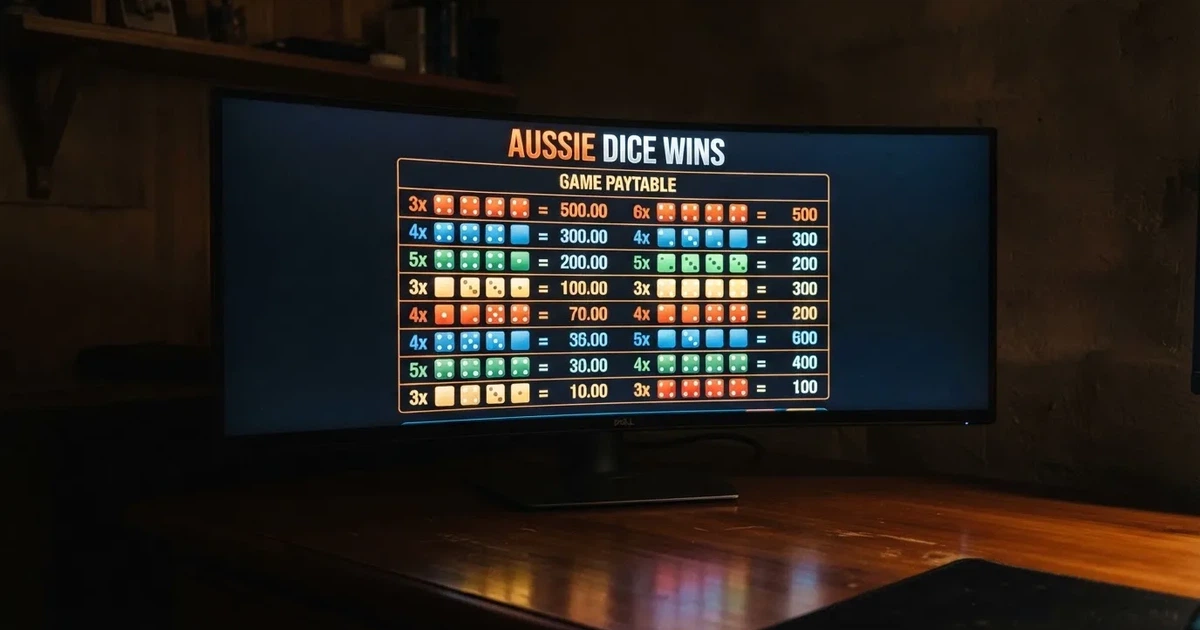
The picture for someone searching from Australia in 2026 is a particular one. Dice games themselves are not the problem. The problem is the online dice game. Craps and sic bo are played on the licensed floors of Australian casinos — Crown Melbourne, Crown Perth, the Star Sydney — under state rules that the regulators approve. What the Interactive Gambling Act 2001 makes an offence is offering those same games to a person in Australia over the internet. Every offshore casino that streams a “live craps” table or accepts a real-money dice bet from an Australian IP is operating outside Australian law, and the Australian Communications and Media Authority has spent years saying so — through formal warnings to operators and through blocking requests to internet service providers.
This page sets out what the math of casino dice games actually looks like, where the offer to play them is and is not lawful in Australia, and what the ACMA’s recent enforcement record says about the offshore sites that market them. The angle is cost to the reader: what each wager takes out of a bankroll, what the choice of bet does to that figure, and what offshore play gives up in return.
Current as of 2 November 2026. Verified against the ACMA’s formal warning register and the Interactive Gambling Act 2001 as published on the Federal Register of Legislation.
Table of Contents
- Legality and regulation: what the Interactive Gambling Act 2001 actually says about dice
- Responsible gaming: where a dice player in Australia gets help
- Specific games: how craps, sic bo and two-up actually work — and what they cost
- Top 11 brands the ACMA has warned: what the enforcement record actually says
- The arithmetic of ACMA enforcement: how fast the blocklist grows
- Overview: putting it together for a reader in Australia
- Frequently asked questions
Legality and regulation: what the Interactive Gambling Act 2001 actually says about dice
The Interactive Gambling Act 2001 — strengthened by the Interactive Gambling Amendment Act 2017 — makes it an offence to provide online casino games, online pokies or in-play betting to a person physically in Australia. No state or territory licenses those products. What is licensable is wagering on races and sport placed before the event, lotteries and keno — in practice, licensed by the Northern Territory Racing and Wagering Commission, which the ABC in April 2026 described as regulating 52 of Australia’s online bookmakers including Sportsbet, Bet365 and Ladbrokes, meeting once a month in Darwin with no full-time staff.
Casino dice games fall on the prohibited side of that line. Craps, sic bo, the dice-based variants of baccarat and any live-dealer table streamed into an Australian account from an offshore operator are interactive gambling services the Act does not permit. The IGA targets the provider, not the individual player. A punter who opens an account with an offshore site does not face prosecution under the statute; the offshore operator does. That distinction is small comfort, because the operator is the only party a player has a relationship with, and when an offshore site refuses a withdrawal the player has no Australian complaints body, no Australian regulator and no recourse that runs through Australian consumer law.
Enforcement runs through the ACMA. The authority investigates complaints, issues formal warnings to operators it judges to be in breach, and can direct Australian internet service providers to block illegal sites at the network level. According to the ACMA as reported in June 2026, a total of 1,751 illegal gambling and affiliate marketing websites had been blocked since the first blocking request in November 2019, and more than 230 unlicensed gambling services had left the Australian market since enforcement was strengthened in 2017. In a round reported on 26 June 2026 the ACMA asked Australian ISPs to block 12 more: 7Signs, ChromaBet, Donbet, Duospin, Freshbet, Slots Gem, Jacks Club, Lucky Start, Pointsbetz, Spinrise, Vinyl Casino and Wildsino. The list changes week to week; the pattern does not. The sites cycle through new domain names and new corporate vehicles, and the ACMA’s blocklist keeps pace.
H2 Gambling Capital’s 2025 report estimates that Australians lose about A$3.9 billion a year to illegal gambling sites, and that the share of gambling going through legal channels fell from 74% in 2021 to 64%. That is the cost of the offshore market in money, before any calculation of the harm it does to the consumer-protection framework a licensed system relies on.
What changes in 2026
The Interactive Gambling Amendment (Gambling Reform) Bill 2026 passed Parliament on 19 August 2026. Its advertising and inducement measures commence 1 January 2027. The bill is law with a start date, not law in force on a 2026 page. The change matters for any operator that markets to Australians — it tightens the rules on bonus offers and affiliate content — and the start date matters more: nothing in it changes what a player can or cannot do between now and the end of the year.
Payments: what an offshore site asks for
Since 11 June 2024 credit cards, credit-related products and digital currency have been banned as payment for licensed online wagering, with penalties up to A$247,500 for operators. The legal deposit routes for licensed wagering are debit card, bank transfer, PayID/Osko and BPAY. An offshore site asking an Australian for a credit card or a crypto deposit is operating outside the Australian rules. That tells a player two things at once: the site is not under Australian supervision, and the payment rail it prefers is the one Australian law has closed off to its own licensed market.
Responsible gaming: where a dice player in Australia gets help
Help is free, confidential and reachable around the clock. The National Gambling Helpline is 1800 858 858, available 24/7. Gambling Help Online runs live chat and email counselling. Both services are funded independently of any operator and exist whether a player is on a licensed site, an offshore site, or a casino floor.
BetStop, the National Self-Exclusion Register, has been live since August 2023. It binds every Australian-licensed online and phone wagering service: a person who registers with BetStop is blocked from opening new accounts and from logging into existing ones for the period they nominate. The register does not bind offshore operators. A punter who self-excludes and then opens an offshore account has not defeated the system — the system does not reach the offshore operator — but the offshore site will not enforce the exclusion either, and that is part of what an offshore account gives up.
State self-exclusion registers — the one run by the Victorian Gambling and Casino Control Commission, the one tied to the NSW Casino Control Act, the schemes in Queensland, Western Australia and the ACT — apply to the casino floors and the gaming rooms those regulators license. A player who self-excludes at Crown Melbourne or at the Star Sydney cannot enter those venues for the nominated period. The registers do not extend to offshore online play. Two exclusions, run by two different layers of government, cover the lawful offer; nothing on the register side covers the offshore market.
The money side. Gambling winnings of a recreational player are not assessable income under section 6-5 of the Income Tax Assessment Act 1997, and losses are not deductible, unless the person carries on a business of gambling. The model answer from the Australian Taxation Office is “check with the ATO” for any case where the line between punter and trader blurs. A punter playing craps at Crown Melbourne is at the recreational end; a punter running a staking plan across hundreds of offshore bets a week may not be. The distinction matters at tax time, not at the table.
Specific games: how craps, sic bo and two-up actually work — and what they cost
The math decides the page. Three games dominate the dice side of a casino floor in Australia, and the house edge varies more across the bets within each game than it does across the games themselves.
Craps and the cost of picking the wrong bet
Craps is played with two dice and a table layout that lays out dozens of wagers. The Pass Line bet, made before the come-out roll, wins on 7 or 11 and loses on 2, 3 or 12. The carry-through of the point is what gives the bet its long-run edge: 1.41% against the player. Don’t Pass — betting against the shooter — carries 1.36%, a marginally better number but a socially odd position at a real craps table. Come and Don’t Come, the same bets made after the point is established, sit at the same edges.
The bets to avoid are the proposition bets in the middle of the layout. Any Craps — a one-roll wager that the next roll will be 2, 3 or 12 — pays 7:1 and carries an 11.11% house edge. Specific triples and hardways run higher still. The gap between 1.41% and 11.11% is the gap between a game that costs a disciplined bettor a slow, predictable bleed and a game that empties a bankroll in a sitting. Same dice, same shooter, same table — the choice of bet does all the work.
The “right” bettor and the “wrong” bettor distinction is part of craps vocabulary and not part of the math. A right bettor backs the Pass Line and the Come; a wrong bettor backs Don’t Pass and Don’t Come. Both are legal bets; both pay close to each other in expectation. The names refer to which side of the table the bettor stands on and, more loosely, to the etiquette of rooting for or against the shooter.
Craps has no counterpart on a licensed Australian online casino because there is no licensed Australian online casino for casino games. The game appears on the floors of Crown Melbourne and Crown Perth and the Star Sydney, on physical tables approved by the state regulator, and that is where the math above actually pays out — over many sessions, against a real felt layout, with chips the player holds in their hand.
Sic bo: a wider field, the same lesson
Sic bo is a dice game of ancient Chinese origin played with three dice; the name literally means “precious dice”. Chinese immigrants brought it to the United States in the early 20th century, and from there it spread to casino floors worldwide. Three dice produce 216 equally likely combinations, of which 56 are distinguishable once duplicates are collapsed. The bet that pays closest to even money is Big/Small — a wager that the total will be high (11–17) or low (4–10), with 11.11% of combinations excluded as triples. The house edge on Big/Small is 2.78%. Specific Triple bets, where the player names the exact three-of-a-kind, can run from 11.6% up to 30.09% depending on the ruleset the casino offers.
The lesson carries over from craps. The size of the payout on the layout is not the size of the edge against the player. A specific triple that pays 180:1 still costs the player roughly a quarter of every dollar wagered, on average, before any variance is counted. The Big/Small bet is the bet a serious sic bo player stays on; the rest of the layout is decoration.
Two-up and the Australian exception
Two-up is a coin game rather than a dice game, and earns its place in any guide to Australian casino dice tradition because it is the one game the law has carved out a special exception for. Two coins are placed on a flat board; a player — the “spinner” — tosses them so they land flat, not stacked. Both heads wins double the stake, both tails loses the stake, one of each is a re-toss.
The game evolved from the 18th-century English and Irish game “cross and pile” and was brought to Australia by convicts. It was legalised in Australian casinos starting in 1973 at Hobart’s casino, and is now offered only at Crown Perth and Crown Melbourne among licensed casinos. Outside casinos, New South Wales permits it on Anzac Day under the Gambling (Two-Up) Act 1998, played in RSL clubs and hotels. Kalgoorlie in Western Australia hosts Australia’s only year-round legal two-up school. Two-up is illegal in every other setting in Australia, and the prohibition is one of the few points of gambling law that survives the modern regulatory framework intact.
The math is not the point of two-up. The bet pays 1:1 on heads-heads, loses on tails-tails, repeats on mixed results, and the house takes a small percentage of every wager in some venues. The game is a cultural artefact as much as a casino product, and the ACMA’s enforcement priorities lie elsewhere.
How the dice-game edges compare to the rest of the floor
A punter choosing among the games on a casino floor should know the order of magnitude, because it tells them which bets to treat as entertainment and which to treat as a slow drain.
| Game / bet | House edge | Notes |
|---|---|---|
| Blackjack, liberal Vegas Strip rules | ~0.28% | Optimal basic strategy, dealer stands on soft 17 |
| Blackjack, Atlantic City rules | ~0.43% | Optimal basic strategy |
| Baccarat, Banker | 1.06% | Punto banco standard |
| Baccarat, Player | 1.24% | Punto banco standard |
| Craps, Pass / Come | 1.41% | Long-run, against a real layout |
| Craps, Don’t Pass / Don’t Come | 1.36% | Same structure, opposite side |
| Sic bo, Big / Small | 2.78% | Excludes triples |
| Craps, Any Craps (one roll) | 11.11% | Same dice, different bet |
| Sic bo, Specific Triple | 11.6%–30.09% | Depends on ruleset |
| Baccarat, Tie | 14.36% | Punto banco standard |
Blackjack at optimal strategy is the cheapest game on the floor by a wide margin, then baccarat on Banker, then craps on Pass. The proposition bets in craps and the specific-triple bets in sic bo are four to ten times costlier than the pass-line equivalent of the same game. A punter who treats dice tables the way they treat blackjack — make the cheapest bet, do not deviate — is paying roughly the same long-run cost as a baccarat or a single-zero roulette player. A punter who chases the proposition bets is paying for the privilege of watching the dice land in a smaller set of combinations.
Top 11 brands the ACMA has warned: what the enforcement record actually says
The brands below are not a ranking and not a recommendation. They are listed because the ACMA itself issued a formal warning to the operator behind each one, for offering prohibited interactive gambling services to Australians. Every one of them streams or markets online casino games including dice products. Every one of them is, under the Interactive Gambling Act 2001, providing a service that cannot be licensed in Australia, regardless of any offshore licence the site displays in its footer. That framing is the same for all eleven and is not repeated under every entry.
RocketPlay
The ACMA’s formal warning register lists Pulsup Ltd over Rocketplay in March 2026. The same brand was earlier the subject of a May 2022 warning to Dama N.V., one of the most-warned operators on the register. Rocketplay carries no published Australian licence; the offshore Curaçao registration it advertises does not authorise supply into Australia. A punter opening an account there is, by the regulator’s own characterisation of the matter, transacting with a service the ACMA has decided is breaking the law. The site streams dice-style games among a larger casino catalogue; the dice side is not the reason the warning was issued, but it is the subject of this page, and it sits inside the same prohibition.
Level Up Casino
Level Up was named in the ACMA’s May 2022 warning to Dama N.V., which covered six brands: Bambet, Dazard, Level Up, Rocketplay, Wild Tornado and Cobra Casinos. The 2022 warning is the published record. The site lists a number of software providers in its footer, including BGaming, whose own corporate pages appear on listings directories. The warning itself is the regulator’s statement; the AGMA has not updated that record on the operator page, which is what an enforcement log looks like once a brand sits on it.
Woo Casino
The ACMA issued a formal warning to Dama N.V. over Woo Casino in March 2025. Woo runs a typical offshore casino catalogue — slots, live tables, dice-style games including craps variants. The operator is the same corporate vehicle the ACMA warned in May 2022 over a different set of brands, which tells a reader something about the structural shape of the offshore market: one operator runs many brands, and warnings over one brand are warnings over a portfolio.
Spirit Casino
The ACMA issued a formal warning to Dama N.V. over Spirit Casino in May 2025. Spirit is one of the newer Dama brands. The pattern — same operator, fresh brand, fresh warning — is the ACMA’s working definition of the offshore market: the corporate shell moves, the warnings follow.
National Casino
The ACMA issued a formal warning to Consolutetish S.R.L. over National Casino in July 2025. National Casino sits on the same register as a number of its peers and is listed by Wikipedia in its catalogue of online gambling operators. The warning itself is the regulator’s word; the brand’s product list is a separate matter, the dice games inside it are the same as the dice games everywhere else, and the prohibition the ACMA enforces is structural rather than per-game.
Bizzo Casino
The ACMA issued a formal warning to Consolutetish S.R.L. over Bizzo Casino in July 2025. Bizzo had already been the subject of a 2022 formal warning to TechSolutions (CY) Group Limited and TechSolutions Group N.V. Two operators, two warnings, one brand — the corporate vehicle churn behind offshore casino branding, and the regulator keeping up.
Ignition Casino
The ACMA issued a formal warning to Bamboo Media over Ignition Casino in July 2025. Ignition has been a long-running brand in the offshore market, originally pitched at the US-facing segment and operating internationally since. The warning covers the Australian end of that offer, which is the end the IGA prohibits.
Instant Casino
The ACMA issued a formal warning to EOD Code SRL over Instant Casino in February 2025. Instant Casino is one of the more heavily marketed offshore brands, with affiliate spend that puts it on a number of comparison sites a reader searching for “casino dice game australia 2026” is likely to see. The ACMA’s position, on the record, is that the brand’s offer to Australians is unlawful. The marketing tells a reader nothing about that.
Jackbit
The ACMA issued a formal warning to Ryker B.V. over Jackbit in April 2026, in the same action that covered CasinOK. Jackbit markets itself around a sportsbook and casino combination with crypto deposit rails; both the crypto rail and the casino offer are outside what an Australian-licensed operator is permitted to provide.
Casino Intense
The ACMA issued a formal warning to Sterplay Holding Ltd over Casino Intense in April 2025. The brand is named in published listings alongside Australian venues such as Crown Melbourne as a comparator — the kind of comparison a reader should treat with care, because Casino Intense’s “intense” name is a marketing word and the licence it advertises is an offshore licence that does not extend to Australian customers.
Sky Crown
The ACMA issued a formal warning to Hollycorn N.V. over Sky Crown and Blue Leo, as published in September 2022. Sky Crown is one of the older entries on the warning register; the warning has stood for several years without the operator adjusting its Australian-facing offer to bring it inside the law.
| Brand | ACMA action and date | Operator named by the ACMA | Subject support |
|---|---|---|---|
| RocketPlay | March 2026 (Pulsup); May 2022 (Dama N.V.) | Pulsup Ltd; Dama N.V. | — |
| Level Up Casino | May 2022 | Dama N.V. | — |
| Woo Casino | March 2025 | Dama N.V. | — |
| Spirit Casino | May 2025 | Dama N.V. | — |
| National Casino | July 2025 | Consolutetish S.R.L. | — |
| Bizzo Casino | July 2025; 2022 | Consolutetish S.R.L.; TechSolutions | — |
| Ignition Casino | July 2025 | Bamboo Media | — |
| Instant Casino | February 2025 | EOD Code SRL | — |
| Jackbit | April 2026 | Ryker B.V. | — |
| Casino Intense | April 2025 | Sterplay Holding Ltd | — |
| Sky Crown | September 2022 | Hollycorn N.V. | — |
The column reads “—” across the board for one reason: the ACMA’s formal warning register is the source for what is on it, and “subject support” — whether a brand actually carries the dice-game products the page is built around — is a different matter that the warnings themselves do not confirm. The same column on an affiliate marketing page would carry a string of “✓” marks; that string is not what the regulator records, and that is the point.
The arithmetic of ACMA enforcement: how fast the blocklist grows
The ACMA’s enforcement record is the only public, running measure of the offshore market’s size, and it produces a calculation the page can stand behind without inventing a figure. The first blocking request went out in November 2019. The cumulative total as reported in June 2026 was 1,751 blocked sites. That covers both gambling sites and affiliate marketing sites, which the ACMA publishes together. Taking the published numbers as given, the blocklist grew by 1,751 sites over roughly six and a half years, an average of roughly 270 sites per year, or about 22–23 sites a month. The average is a band rather than a single figure because the monthly rate is not constant — the ACMA’s blocking rounds are published in bursts, with months of no new blocks followed by rounds of a dozen or more — and because affiliate marketing sites are included in the count alongside gambling sites, which the register does not separate.
Two numbers do not need an average. The first is the headline total: 1,751. The second is the duration: just over six and a half years from November 2019 to the June 2026 report. Those are the inputs and the headline result the page can quote without overreaching. The per-month rate is a derived figure that depends on how the count is read.
The blocking record is the ACMA’s word for what the offshore market looks like, not the offshore market itself. A site that the ACMA has not yet blocked is not, by that fact, lawful — it is simply not yet on the published list. The list is what the regulator has caught up to, not what is operating. The same caveat applies to the formal warnings: a brand on the warning register is a brand the regulator has decided to act against; a brand not on it is a brand the regulator has not yet reached.
Overview: putting it together for a reader in Australia
A punter in Australia searching for a casino dice game in 2026 is, by the regulator’s own enforcement record, the target market for the ACMA’s warnings. The brands above are not the whole offshore market; they are the brands the ACMA has chosen to publish warnings about. The market around them is larger and quieter.
Three facts make the picture. First, the IGA prohibits the supply of online casino games to Australians and does not license that supply. Second, the ACMA has been blocking illegal sites and warning operators for the better part of a decade, with 1,751 blocking actions since November 2019. Third, the house edge on the bets a punter is most likely to be steered toward — the proposition bets in craps, the specific-triple bets in sic bo, the tie bet in baccarat — is several times the house edge on the bets a serious player should be making. The cost of picking the wrong bet inside a game that is already being supplied unlawfully is the cost this page exists to spell out.
Where the offer is lawful, it is on the floor. Craps, sic bo, baccarat and blackjack all run on the tables at Crown Melbourne, Crown Perth and the Star Sydney, under rules approved by the state regulator — the Victorian Gambling and Casino Control Commission for Crown Melbourne, the Western Australian Department of Local Government, Sport and Cultural Industries for Crown Perth, Liquor & Gaming NSW for the Star. Under section 66 of the NSW Casino Control Act 1992, a casino operator must not permit a game to be played unless the game and its rules are approved by the regulator, and the operator must make a copy of the approved rules available to patrons on request. The Victorian Casino Control Act 1991 places the same requirement on Crown Melbourne through the VGCCC, which replaced the VCGLR on 1 July 2022 and publishes an open log of approved rule changes — including the renaming of the “Perfect Pairs” blackjack side bet to “Crown Pairs” in December 2024 and the introduction of a “Free Bet” option with a “Pot of Gold” side bet in March 2024.
Two-up is the cultural exception: legal at Crown Perth and Crown Melbourne year-round, legal in NSW on Anzac Day under the Gambling (Two-Up) Act 1998, illegal everywhere else. That is the dice-side of the Australian floor as the law stands.
For the punter who decides to play online anyway, the cost runs in three registers at once. The first is the house edge, which on the wrong craps bet sits at 11.11% and on the wrong sic bo bet above 25%. The second is the payment risk: an offshore site has no obligation under Australian consumer law, no Australian complaints body and no BetStop enforcement, and a refused withdrawal has no Australian recourse. The third is the blocklist risk: an ACMA blocking action can cut a punter off from a site that still holds their balance. The arithmetic of an offshore dice game in Australia is not a calculation the regulator can do for a punter; the regulator has decided, in plain words on a public register, that the offer should not be made.
Frequently asked questions
What is the house edge on a Pass Line bet in craps?
The Pass Line bet in craps carries a 1.41% house edge over the long run, against a player making no other wagers. The mathematically adjacent Don’t Pass bet sits at 1.36%. Both are line bets; both are settled across multiple rolls once a point is established. A single number on the layout, repeated over many sessions, is what those edges cost a bankroll.
Why does the Any Craps one-roll bet carry a much higher house edge than Pass Line?
Any Craps pays 7:1 for a one-roll hit on 2, 3 or 12, and the payout is sized to make the bet feel generous while keeping a hold for the house. The probability of winning is small — about 1 in 9 — and the payout does not match it. That gap between the true odds of the roll and the payout offered is the 11.11% the house keeps, every time the bet is made. The Pass Line’s smaller edge comes from the same dice, the same shooter and a payout that more closely matches the underlying probability over the run of a point cycle.
Are dice games like craps offered on licensed Australian casino floors?
Yes. Craps, sic bo, baccarat and blackjack run on the tables at Crown Melbourne, Crown Perth and the Star Sydney under state-approved rules. The IGA prohibits the online supply of those games; the law does not prohibit them on a licensed floor. A punter in Australia who wants to play craps on real dice, lawfully, has a route through the casino floors of those venues.
What’s the difference between a ‘right’ bettor and a ‘wrong’ bettor in craps?
A right bettor wagers on the Pass Line and the Come, betting with the shooter. A wrong bettor wagers on Don’t Pass and Don’t Come, betting against the shooter. The terms are positional — they describe which side of the table the bettor stands on — and the math is close, with Don’t Pass carrying 1.36% and Pass Line 1.41%. The convention is etiquette rather than strategy.
Do all casino dice games use the same house-edge structure as craps?
No. Sic bo, played with three dice, runs a different structure: Big/Small carries a 2.78% house edge and Specific Triple bets run from 11.6% up to 30.09% depending on the ruleset. The pattern is the same — the cheapest bets on the layout are the bets to stay on — but the edges are not interchangeable. A serious dice player treats each game’s paytable as its own document.
Can an online dice game legally be offered to someone based in Australia?
No. The Interactive Gambling Act 2001, as strengthened in 2017, prohibits the supply of online casino games — which include dice games such as craps and sic bo — to a person in Australia. No state or territory licenses that supply. The individual player is not prosecuted, but the offshore operator is in breach and an Australian-licensed route to the games does not exist.